


Curry
Keywords: spicy · warm · earthy
Curry powder is any of several spice mixes for curry. Its main ingredients include spices such as coriander, turmeric, cumin and chili peppers.
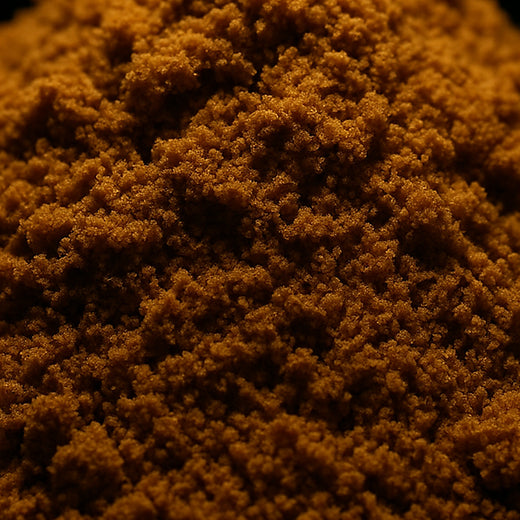
- Olfactive family
- Spicy · 153 entries of the glossary in this family Subfamily: Warm spices · 143 entries in this subfamily Cluster: Classic spices · 84 entries in this cluster
- Material
- Fantasy/Concept Mix of spices such as coriander, turmeric, cumin and chili peppers
- Pyramid
- Heart · Volatility: Heart Note
- Strength
- N/A — no measured strength for a fantasy accord Not on the graded scale
- Also called
- Curry powder, kari
Family, subfamily and cluster: PREMIEREPEAU house classification, version 2026‑11.
Curry · Facets
Entries of the glossary that carry each facet, of 3,979:
- earthy 660
- sweet 1,988
- warm 1,108
Editorial note We own no rights to this material, its name or its trademark. This entry is independent editorial journalism, published under freedom of expression.
Curry · Scent
Turmeric powder has an earthy, mustard-like aroma. Cumin has a warm aroma, due primarily to cuminaldehyde. Cuminaldehyde has an intense aroma described as spicy, cumin, green, herbal. Sotolon has the typical smell of fenugreek or curry at high concentrations, and that of maple syrup, caramel or burnt sugar at lower concentrations. Major odor compounds in curry tree leaves include the sulfury-smelling 1-phenylethanethiol, the citrusy-smelling linalool, the resinous-smelling α-pinene and the grassy-smelling cis-3-hexenal.
Evolution over time
Curry: scent over time.
- Immediately
N/A — no documented evolution for a fantasy accord
- After a few hours
N/A
- Tenacity
- N/A — no measured tenacity for a fantasy accord
Curry · In Perfumery
Cumin oil is used for a variety of flavors, perfumes and essential oil. Cuminaldehyde is a precursor to another commercially important fragrance, cyclamen aldehyde. Fenugreek is used as a flavoring agent in imitation maple syrup or tea.
Pyramid
Curry: Heart. Entries of the glossary stored at each place of the pyramid, of 4,006 (42 store no place):
- Top 718
- Top · Heart 497
- Heart 1,641
- Heart · Base 514
- Base 594
Role in the formula
Curry: roles in the formula. Entries of the glossary that share each role, of 4,006:
- N/A — no documented formula role 361
Curry · Terroir & Origins
- Producing countries
- India
Curry · Extraction & Chemistry
Turmeric rhizomes are often boiled in water and dried, then ground into a spice powder. The oil of curry leaves can be extracted and used to make scented soaps. Cuminaldehyde can be prepared synthetically by the reduction of 4-isopropylbenzoyl chloride or by the formylation of cumene.
Available as
Curry: available as.
- synthetic accord
- fantasy note
- Appearance
- N/A — olfactory concept
Curry · Did You Know?
Eating foods high in sotolon, such as fenugreek, can impart a maple syrup aroma to one’s sweat and urine. Sotolon is thought to be responsible for the maple syrup smell that has occasionally wafted over Manhattan since 2005, with the source a factory in New Jersey that processes fenugreek.
Curry · In Depth
What curry powder is
Curry powder is adapted from garam masala in Indian cuisine. In the United States, curry powder is expected to contain at least turmeric, coriander, fenugreek, cinnamon, cumin, black pepper, ginger and cardamom. The Bombay curry powder of an 1895 cookbook used coriander, cumin, turmeric, mustard seed, pepper, chillies and a little fenugreek.
The curry leaf
The curry tree is a tree in the citrus family Rutaceae. It is native to the Indian subcontinent, southern China and mainland Southeast Asia. Its leaves are used in many culinary dishes in India, Sri Lanka and Bangladesh. Curry leaves have a mild, aromatic, slightly bitter flavor. The word curry is not derived from the name of the curry tree, although some curries do include curry leaves among many other spices.
Spice constituents
Turmerones are sesquiterpenes found in turmeric, and ar-turmerone is one of their structural types. More than 40 volatile compounds have been identified in turmeric essential oils, with turmerone, germacrone, atlantone and zingiberene among their major constituents. Cuminaldehyde is responsible for the characteristic aroma of cumin seed. Cuminaldehyde, cymene and terpenoids are the major volatile components of cumin oil. Sotolon is the chemical responsible for the distinctive maple syrup smell of fenugreek. Fenugreek seeds are often roasted whole before grinding, to reduce their inherent bitterness and enhance flavour.
Helichrysum, the curry plant
Helichrysum italicum is sometimes called the curry plant because of the strong fragrance of its leaves. Although it bears the aroma of curry powder, it is not related to that mixture of spices nor to the curry tree. It has a resinous, somewhat bitter aroma reminiscent of sage or wormwood.
Explore all seven extraits in the Discovery Set.
Related: Baking Spices · Spicy Notes · Cilantro
Curry · History
The first commercial curry powder product was sold in London in 1784. Curry powder was first sold by Indian merchants to British traders during the period of Company rule in India. British traders introduced the powder to Meiji Japan in the mid-19th century.
The word curry was first recorded in print in Hannah Glasse’s 1747 English cookery book. The English word curry is derived from the Tamil word kaṟi, meaning sauce or relish for rice. The 11th-century Lokopakara used asafoetida, cumin, curry tree leaves and mustard to flavour a dal. Sotolon was first isolated in 1975 from fenugreek.
Curry · Technical Sheet
Identity
- Botanical
- N/A — olfactory concept (associated with Murraya koenigii leaves + spice blends)
- Type
- Accord
- Category
- Spices
- Note
- Curry in perfumery is an evocative spicy accord. Components may include immortelle (helichrysum) absolute, cumin, fenugreek, and turmeric-like aromatics.
Classification
- Chemical class
- Spice mix
Chemical data
- Formula
- N/A — olfactory concept
Performance and rules
- IFRA status
- No IFRA Standard for the material itself (51st Amendment)
Curry · See Also
Entries related to Curry, by their place in the pyramid. “shared” marks a scent word Curry has too.
Top notes

Ginger
spicy (shared) · fresh · citrus Spicy / Same subfamily / Natural
Peruvian Pepper
spicy (shared) · peppery · sweet (shared) Spicy / Top · Heart / Same subfamily / Natural
Cardamom
spicy (shared) · aromatic · fresh Spicy / Top · Heart / Same subfamily / Natural
Serrano Pepper
spicy (shared) · fresh · warm (shared) Spicy / Natural


Heart notes

Biryani
spicy (shared) · warm (shared) · aromatic Spicy / Same cluster / Fantasy/Concept
Chutney
spicy (shared) · fruity · sweet (shared) Spicy / Same cluster / Fantasy/Concept
Indian Spices
spicy (shared) · warm (shared) · rich Spicy / Same cluster / Natural
Longoza
spicy (shared) · peppery Spicy / Same subfamily / Natural


Curry · Sources
- Foods (2019) Variations in the Volatile Compositions of Curcuma Species
- Current Research in Food Science (2021) Spatial variation of volatile organic compounds and antioxidant activity of turmeric (Curcuma longa L.) essential oils harvested from four provinces of China
- IFRA Standards, 51st Amendment
- Wikipedia Curry powder
- Wikipedia Murraya koenigii
- Wikipedia Turmeric
- Wikipedia Cuminaldehyde
- Wikipedia Sotolon
- Wikipedia Curry
- Wikipedia Cumin
- Wikipedia Fenugreek
- Wikipedia Helichrysum italicum
- Wikipedia Turmerone
Cite as PREMIEREPEAU Glossary, “Curry”, https://premierepeau.com/
