


Cyclohexanol
Keywords: camphoraceous · fermented · mint
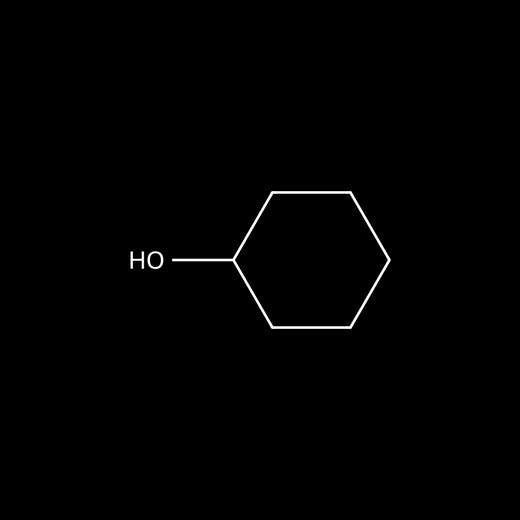
Cyclohexanol is a secondary alcohol, cyclohexane bearing a single hydroxy substituent. It smells camphoraceous and mentholic.
- Olfactive family
- Aromatic · 495 entries of the glossary in this family Subfamily: Classic aromatics · 157 entries in this subfamily Cluster: Camphoraceous aromatics · 116 entries in this cluster
- Material
- Natural & Synthetic
- Pyramid
- Top Note
- Also called
- Cyclohexyl alcohol, Cyclohexanol-d11, Cyclohexanol [mi]
Cyclohexanol · Facets
Entries of the glossary that carry each facet, of 3,979:
- camphoraceous 142
- fermented 58
- mint 45
- phenolic 94
- mentholic 13
Cyclohexanol · Scent
A camphoraceous, mentholic and phenolic odour with a warm, fermented edge.
Cyclohexanol · In Perfumery
It is used as a fragrance ingredient with a warm, camphoraceous and mentholic character.
Pyramid
Cyclohexanol: Top. Entries of the glossary stored at each place of the pyramid, of 4,000 (35 store no place):
- Top 718
- Top · Heart 501
- Heart 1,646
- Heart · Base 512
- Base 588
Cyclohexanol · Extraction & Chemistry
It is made industrially by the liquid-phase oxidation of cyclohexane.
- Appearance
- Colourless liquid or forms white crystals
Cyclohexanol · In Depth
Identity
Its CAS number is 108-93-0, its formula is C₆H₁₂O and its molecular weight is 100.16 g/mol.
Odour
It smells camphoraceous, mentholic and phenolic, with a fermented edge. At 10 % in dipropylene glycol the odour reads as camphor, menthol and phenol. Its odour is warm and camphoraceous.
Occurrence in nature
It occurs in Fragaria, Gossypium hirsutum, Mangifera indica and Punica granatum.
Production
It is made industrially by the liquid-phase oxidation of cyclohexane.
Use in perfumery
It is a fragrance ingredient.
Use in flavours
It is used as a flavouring agent.
Properties
It melts at 25.5 °C and boils at 158 °C at 760 mmHg. Its flash point is 62.78 °C and its logP is 1.23. Its vapour pressure is 0.975 mmHg at 20 °C. It dissolves in water at 42000 mg/L at 10 °C and it is hygroscopic. As a solvent it is used for lacquers, varnishes and oils, and it goes into the production of nylon, paints and plastics.
Safety and IFRA
No IFRA Standard covers this material itself, under the 51st Amendment now in force. Its INCI name is Cyclohexanol and its cosmetic function is perfuming. Its EC number is 203-630-6 and it is registered under REACH. Its hazard statements are H302, H315, H332 and H335: harmful if swallowed, causes skin irritation, harmful if inhaled and may cause respiratory irritation.
Cyclohexanol · Technical Sheet
Molecular weight
100.16 g/mol Heavier than 178 of the 546 other entries at the same place of the pyramid that store a weight; 19 weigh the same
2,572 entries store a molecular weight. By place in the pyramid: Top 547, Top · Heart 411, Heart 888, Heart · Base 454, Base 272.
Identity
- Type
- Ingredient
- Category
- Aroma chemicals
Classification
- Chemical class
- Alcohol
Chemical data
- Formula
- C6H12O
- CAS
- 108-93-0
- PubChem CID
- 7966, compound record on PubChem
- InChIKey
- HPXRVTGHNJAIIH-UHFFFAOYSA-N
Physical properties
- Boiling point
- 158 °C at 760 mmHg
- Melting point
- 25.5 °C at 760 mmHg
- Flash point
- 62.78 °C (145 °F)
- Vapour pressure
- 0.975 mmHg at 20 °C
- Log P
- 1.23
Performance and rules
- Available as
- synthetic
- IFRA status
- No IFRA Standard for the material itself (51st Amendment)
Cyclohexanol · See Also
Entries related to Cyclohexanol, by their place in the pyramid.
Base notes
-
Sandela
woody · creamy · milky Woods / Synthetic / 236.39 g/mol 
Sandalwood
woody · floral Woods / Natural
Indian Sandalwood
woody · creamy · rich Woods / Natural


Cyclohexanol · Sources
- PubChem Cyclohexanol
- ChEBI Cyclohexanol: chemical classification record
- Pyrfume Arctander, Perfume and Flavor Chemicals: odour descriptions (Pyrfume archive)
- Pyrfume Good Scents odour data (Pyrfume archive)
- Pyrfume Leffingwell odour data (Pyrfume archive)
- The Good Scents Company Information System Cyclohexanol: data sheet
- Wikidata (LOTUS natural products data) Cyclohexanol: organisms it is reported in, with the papers
- IFRA Standards, 51st Amendment
- European Commission, CosIng Cyclohexanol: cosmetic ingredient record
- European Chemicals Agency Cyclohexanol: substance record
Cite as PREMIEREPEAU Glossary, “Cyclohexanol”, https://premierepeau.com/pages/glossary-terms/cyclohexanol Updated 2026-11-18
