


Gully Gum Eucalyptus
Keywords: fresh · soft · lemony
Gully gum eucalyptus is Eucalyptus smithii, a tree of the family Myrtaceae whose leaves are distilled into a cineole-rich eucalyptus oil. Its aroma is fresh, soft and lemony.
- Olfactive family
- Aromatic · 495 entries of the glossary in this family Subfamily: Herbal aromatics · 227 entries in this subfamily Cluster: Camphoraceous aromatics · 114 entries in this cluster
- Material
- Natural Leaves of Eucalyptus smithii
- Pyramid
- Top Note
- Also called
- Eucalyptus smithii leaf oil, gully gum, gully peppermint, blackbutt peppermint, ironbark peppermint
Gully Gum Eucalyptus · Facets
Entries of the glossary that carry each facet, of 3,979:
- fresh 1,390
- camphoraceous 140
- citrus 488
- clean 64
- herbal 757
- soft 17
Gully Gum Eucalyptus · Scent
The aroma is fresh, soft and lemony. The oil is high in cineole but gentler than other eucalyptus oils. Cineole, which is high in the oil, has a fresh camphor-like odor.
Gully Gum Eucalyptus · In Perfumery
Eucalyptus smithii leaf oil has the cosmetic function of fragrance, which enhances the smell of a product. Eucalyptus oil in general is used as a fragrance component to impart a fresh and clean aroma in soaps, detergents, lotions and perfumes.
Pyramid
Gully Gum Eucalyptus: Top. Entries of the glossary stored at each place of the pyramid, of 4,000 (35 store no place):
- Top 718
- Top · Heart 496
- Heart 1,644
- Heart · Base 513
- Base 594
Role in the formula
Gully Gum Eucalyptus: roles in the formula. Entries of the glossary that share each role, of 4,000:
- Perfuming agent 43
- Freshness 720
- Top note fewer than 40 entries
- Fragrance ingredient 51
Gully Gum Eucalyptus · Extraction & Chemistry
The leaves are steam distilled. In an early test, leaves and terminal branchlets from Monga, near Braidwood, gave a yield of oil of 1.4 per cent. The abnormal leaves gave a yield of 1.8 per cent. The oil from them was identical in appearance, odour and constituents with that of the mature leaves, except that pinene was a little higher and cineol a little less.
- Appearance
- Light reddish yellow (crude oil)
Gully Gum Eucalyptus · Did You Know?
The oil of this species may be regarded as one of the best of the eucalypts for producing a rich cineol eucalyptus oil. The yield of oil from the leaves is large for an oil so rich in cineol.
Gully Gum Eucalyptus · In Depth
The Tree
Eucalyptus smithii is commonly known as the gully gum, gully peppermint, blackbutt peppermint or ironbark peppermint. It is a species of medium-sized to tall tree, sometimes a mallee, that is endemic to southeastern Australia. Gully gum grows in shallow soils on sloping sites on the coast and tablelands, from Yerranderie in New South Wales south to eastern Victoria.
The Oil
The species is widely grown in southern Africa, and its leaves are used for the production of distilled eucalyptus oil. The oil is high in cineole (75–84%). In an early test, the cineol content of the crude oil, determined by the phosphoric acid method, was 70 per cent.
Chemistry
Cineole, also called eucalyptol, is a monoterpenoid colorless liquid and a bicyclic ether. In an early analysis of the oil, pinene was the principal terpene and phellandrene was absent. Volatile aldehydes were present only in small amount, and the esters were in a minimum quantity. Only a small amount of high-boiling constituents such as aromadendrene was present.
Gully Gum Eucalyptus · History
Eucalyptus smithii was first formally described in 1899 by Richard Thomas Baker in Proceedings of the Linnean Society of New South Wales, from specimens collected by William Bäuerlen near Braidwood. The specific epithet smithii honours the academic chemist Henry George Smith, for his pioneering work on essential oils of eucalypts and other Australian flora.
Gully Gum Eucalyptus · Technical Sheet
Identity
- Botanical
- Eucalyptus smithii
- Botanical records
- Eucalyptus smithii: POWO, Eucalyptus smithii · IPNI, Eucalyptus smithii · GBIF, Eucalyptus smithii · Wikidata, Eucalyptus smithii · Wikipedia, Eucalyptus smithii · IUCN Least concern (LC), Eucalyptus smithii
- IPNI
- Eucalyptus smithii R.T.Baker, Proc. Linn. Soc. New South Wales xxiv. 292. — Richard Thomas Baker (1854–1941)
- Type
- Ingredient
- Category
- Greens, herbs and fougeres
In Nature
- Recorded altitude
- 300–1,100 m · median 750 m · 169 records with an altitude · GBIF
- Wild or cultivated
- 115 native · 6 introduced · 5 cultivated among 2,984 records (the rest carry no such mark) · GBIF
- Recorded in
- 9 of 512 squares of the world grid; a brighter dot holds more records · GBIF
- Also from this genus
- Eucalyptus: Blue Mallee · Eucalyptus · Kangaroo Island Mallee · Kochii Mallee · Lemon Ironbark · Narrow-Leaved Peppermint Eucalyptus · River Red Gum
- Also from this botanical family
- Myrtaceae: Allspice · Anise Myrtle · Cajeput · Clove · Clove Leaf · Cloves · 20 more entries
In Print
- In English books
- most mentioned in the 2000s · Google Books Ngram
Classification
- Chemical class
- Essential oil, high in cineole
Chemical data
- Formula
- Complex natural mixture (key constituents: 1,8-cineole C₁₀H₁₈O; pinene)
- Structure
- Eucalyptol (1,8-Cineole):
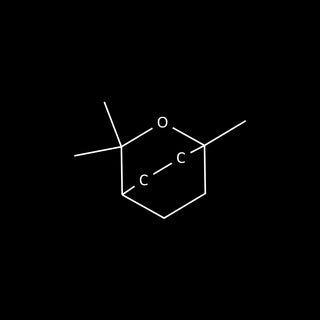
Eucalyptol (1,8-Cineole)
PubChem, Eucalyptol (1,8-Cineole)
Physical properties
- Specific gravity
- 0.915 (crude oil, 15 °C)
- Refractive index
- 1.4649 (crude oil, 20 °C)
Performance and rules
- Available as
- essential oil
- IFRA status
- No IFRA Standard for the material itself (51st Amendment)
Gully Gum Eucalyptus · See Also
Entries related to Gully Gum Eucalyptus, by their place in the pyramid. “shared” marks a scent word Gully Gum Eucalyptus has too.
Top notes

Eucalyptus
fresh (shared) · aromatic · woody Aromatic / Same cluster / Natural-
Kangaroo Island Mallee
eucalyptus · camphoraceous (shared) · honey Aromatic / Top · Heart / Same cluster / Natural -
Kochii Mallee
camphoraceous (shared) · woody · sweet Aromatic / Same cluster / Natural -
Narrow-Leaved Peppermint Eucalyptus
sweet · fresh (shared) · camphoraceous (shared) Aromatic / Top · Heart / Same cluster / Natural 
Citronellal
citrus (shared) · floral · fresh (shared) Citrus / Natural & Synthetic
Lemon Myrtle
citrus (shared) · fresh (shared) · green Citrus / Natural


Heart notes

Methyl Cinnamate
balsamic · fruity · sweet Resinous / Heart · Base / Natural & Synthetic

Gully Gum Eucalyptus · Sources
- GBIF Eucalyptus smithii (GBIF species record)
- EFSA J Safety and efficacy of a feed additive consisting of an essential oil derived from <i>Eucalyptus globulus</i> Labill. (eucalyptus oil) for all animal species (FEFANA asbl)
- PubChem Eucalyptol
- IFRA Standards, 51st Amendment
- Chest of Books 73 Eucalyptus Smithii
- COSMILE Europe Eucalyptus smithii leaf oil
- Wikipedia Eucalyptus smithii
- Wikipedia Eucalyptol
- Wikipedia Eucalyptus oil
- PubChem 1,8-cineole
Cite as PREMIEREPEAU Glossary, “Gully Gum Eucalyptus”, https://premierepeau.com/
