


Hazel Blossom
Keywords: floral · nutty · rich
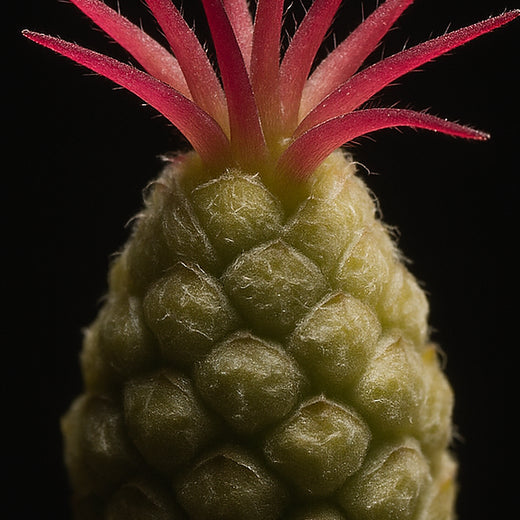
Hazel Blossom: The male catkins of the common hazel, Corylus avellana, are pale yellow and wind-pollinated. The male catkins appear before the leaves.
- Olfactive family
- Florals · 779 entries of the glossary in this family Subfamily: Green florals · 143 entries in this subfamily Cluster: Green-fresh florals · 135 entries in this cluster
- Material
- Fantasy/Concept Flower
- Pyramid
- Heart · Volatility: Heart Note
- Strength
- N/A — no measured strength for a fantasy accord Not on the graded scale
- Also called
- Hazelnut flower extract, Corylus avellana L. flower extract
Family, subfamily and cluster: PREMIEREPEAU house classification, version 2026‑11.
Hazel Blossom · Facets
Entries of the glossary that carry each facet, of 3,979:
- woody 792
- floral 1,546
- green 1,442
- sweet 1,988
- warm 1,108
- fresh 1,387
- nutty 258
Editorial note We own no rights to this material, its name or its trademark. This entry is independent editorial journalism, published under freedom of expression.
Hazel Blossom · In Perfumery
No standardised essential oil of the blossom exists. The hazel extract that is listed, Corylus avellana bud extract, is a cosmetic ingredient for skin conditioning and is marked not for fragrance use.
Pyramid
Hazel Blossom: Heart. Entries of the glossary stored at each place of the pyramid, of 4,006 (42 store no place):
- Top 718
- Top · Heart 497
- Heart 1,641
- Heart · Base 514
- Base 594
Role in the formula
Hazel Blossom: roles in the formula. Entries of the glossary that share each role, of 4,006:
- N/A — no documented formula role 361
Hazel Blossom · Terroir & Origins
- Producing countries
- Europe, Turkey
Hazel Blossom · Extraction & Chemistry
Hazel Blossom · Did You Know?
The pollen of wind-pollinated hazel is not sticky, and each grain repels the others, so bees can gather it only in small loads.
Hazel Blossom · In Depth
The plant
Corylus avellana, the common hazel, is a species of flowering plant in the birch family Betulaceae. It is native to Europe and Western Asia. Its flowers appear very early in spring, before the leaves, in single-sex catkins that are wind-pollinated. The male catkins are pale yellow and 5–12 cm long. The female flowers are very small and largely concealed in the buds, with only the bright red styles visible.
Flowering and pollen
Hazel catkins bloom from January to March. The yellow male catkins hang in clusters from mid-February. In Britain, catkins can be seen in January or February, when many trees are bare for winter. Each catkin of the common hazel holds 150–200 flowers. Hazel pollen is often the cause of allergies in late winter or early spring. Hazel flowers provide early pollen as a food for bees.
Distribution and name
Corylus avellana occurs from Ireland and the British Isles south to Iberia, Italy, Greece, Turkey and Cyprus, north to central Scandinavia, and east to the central Ural Mountains, the Caucasus and northwestern Iran. The scientific name avellana derives from the town of Avella in Italy. The genus Corylus has around 14–18 species, and the common hazel is the one grown most extensively for its nuts.
Hazelnut flower extract
Hazelnut flower extract carries CAS 84012-21-5 and the synonym Corylus avellana L. flower extract. It belongs to the class of botanicals, powders and extracts.
Explore all seven extraits in the Discovery Set.
Related: Filbertone
Hazel Blossom · Technical Sheet
Identity
- Botanical
- Corylus avellana
- Taxonomy
- Fagales order › Betulaceae family › Corylus genus · GBIF
- Botanical records
- Corylus avellana: POWO, Corylus avellana · IPNI, Corylus avellana · GBIF, Corylus avellana · Wikidata, Corylus avellana · Wikipedia, Corylus avellana · IUCN Least concern (LC), Corylus avellana
- IPNI
- Corylus avellana L., Sp. Pl. 2: 998 (1753) — Carl Linnaeus (1707–1778)
- Type
- Accord
- Category
- Flowers
- Note
- Corylus avellana (hazel) flower catkins; no standardized essential oil of blossom specifically
In Nature
- Native range
- Northern Europe · Middle Europe · Southwestern Europe · Southeastern Europe · Eastern Europe · Caucasus · Western Asia · POWO
- Introduced to
- 11 regions · Northern America 8 · Europe 1 · Africa 1 · Temperate Asia 1
- Flowering
- peak in February–March · north of the equator · iNaturalist
- Sample origins in GC-MS studies
- Türkiye (1 paper; one: J Agric Food Chem 2003, Türkiye)
- Recorded altitude
- 50–1,000 m · median 450 m · 191,439 records with an altitude · GBIF
- Wild or cultivated
- 166,475 native · 500 introduced · 991 cultivated among 1,447,234 records (the rest carry no such mark) · GBIF
- Recorded in
- 51 of 512 squares of the world grid; a brighter dot holds more records · GBIF
- Also from this genus
- Corylus: Hazelnut
- Also from this botanical family
- Betulaceae: Birch · Birch Tar · Birch Tar Oil
In Print
- Timeline
- first described 1753 · earliest aroma paper in Europe PMC, 2003
- In English books
- most mentioned in the 2000s · Google Books Ngram
Classification
- Chemical class
- Fantasy note (accord)
Chemical data
- Formula
- Complex mixture; contains filbertone (C₈H₁₄O, the key hazelnut odorant)
- Most reported compounds
- Afzelin (1 paper; one: Chem Nat Compd 1986, Afzelin) · Myricetin (1 paper; one: Chem Nat Compd 1986, Myricetin) · Quercetin (1 paper; one: Chem Nat Compd 1986, Quercetin) · alpha-Tocopherol (1 paper; one: Journal of Chromatography A 1998, alpha-Tocopherol) · LOTUS
- CAS
- 84012-21-5
- INCI names (CosIng)
- CORYLUS AVELLANA SEED OIL (FRAGRANCE)CORYLUS AVELLANA BARK EXTRACT (SKIN CONDITIONING – MISCELLANEOUS)CORYLUS AVELLANA BUD EXTRACT (SKIN CONDITIONING)CORYLUS AVELLANA FLOWER EXTRACT (SKIN CONDITIONING)CORYLUS AVELLANA LEAF EXTRACT (SKIN CONDITIONING)CORYLUS AVELLANA SEED EXTRACT (SKIN CONDITIONING)CORYLUS AVELLANA LEAF WATER (FRAGRANCE, TONIC)CORYLUS AVELLANA SEED POWDER (ABRASIVE)
- Compound classes reported
- Diterpenoids 29 % · Diarylheptanoids 26 % · of 35 compounds reported, 29 % of them esters · LOTUS
Performance and rules
- Tenacity
- N/A — no measured tenacity for a fantasy accord
- IFRA status
- No IFRA Standard for the material itself (51st Amendment)
Hazel Blossom · See Also
Entries related to Hazel Blossom, by their place in the pyramid. “shared” marks a scent word Hazel Blossom has too.
Heart notes

Almond Blossom
floral (shared) · nutty (shared) · sweet (shared) Florals / Same cluster / Fantasy/Concept
Orange Blossom
floral (shared) · honeyed · citrus Florals / Natural
Violet
floral (shared) · violet Florals / Natural & Synthetic
Jasmine
floral (shared) Florals / Natural
Dogwood Blossom
floral (shared) · woody (shared) · fresh (shared) Florals / Fantasy/Concept


Other entries · Place in the pyramid not stored

Carnation
floral (shared) · spicy · clove Florals / Natural

Hazel Blossom · Sources
Read the science
- J Agric Food Chem (2003) Comparison of natural and roasted Turkish tombul hazelnut (Corylus avellana L.) volatiles and flavor by DHA/GC/MS and descriptive sensory analysis
- J Chromatogr A (2010) Profiling food volatiles by comprehensive two-dimensional ga schromatography coupled with mass spectrometry: advanced fingerprinting approaches for comparative analysis of the volatile fraction of roasted hazelnuts (Corylus avellana L.) from different origins
- J Agric Food Chem (2013) Sensomics analysis of key hazelnut odorants (Corylus avellana L. ‘Tonda Gentile’) using comprehensive two-dimensional gas chromatography in combination with time-of-flight mass spectrometry (GC×GC-TOF-MS)
- International Plant Names Index (IPNI) Corylus avellana L.
- IFRA Standards, 51st Amendment
- The Good Scents Company Corylus avellana bud extract
- Wikipedia Corylus avellana
- Wikipedia Catkin
- Wikipedia Hazel
- Wikipedia Absolute (perfumery)
Cite as PREMIEREPEAU Glossary, “Hazel Blossom”, https://premierepeau.com/
