


Isobutyric Acid
Keywords: sour · buttery · fruity
Isobutyric Acid is a branched fatty acid, a colourless liquid that smells sour, buttery and cheesy, like rancid butter.
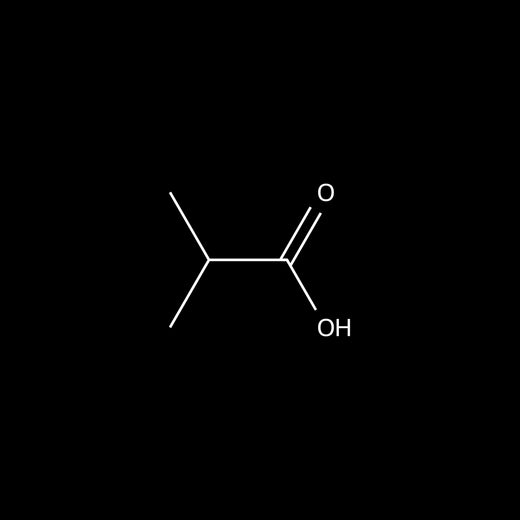
- Olfactive family
- Gourmand · 476 entries of the glossary in this family Subfamily: Creamy gourmands · 84 entries in this subfamily Cluster: Classic gourmands · 168 entries in this cluster
- Material
- Synthetic
- Pyramid
- Top · Volatility: Top Note
- Strength
- Medium Step 3 of 5 · shared by 1,473 of 2,156 graded entries Graded entries at each step, from 1 to 5: 4, 119, 1,473, 498, 39. 23 more sit between two steps.
- Also called
- 2-methyl-propionic acid, i-Butyric acid, 2-methyl-propanoic acid, alpha-Isobutyric acid
Family, subfamily and cluster: PREMIEREPEAU house classification, version 2026‑11.
Isobutyric Acid · Facets
Entries of the glossary that carry each facet, of 3,979:
- sour 45
- buttery 81
- fruity 1,301
- cheesy 73
- acid 6
Isobutyric Acid · Scent
Arctander describes it as powerful, diffusive and sour, less repulsive and less buttery than n-butyric acid, becoming almost pleasant and fruity in extreme dilution.
Isobutyric Acid · In Perfumery
It is a fragrance ingredient and is used to make esters for fragrance bases, with a sour, buttery and cheesy odour.
Pyramid
Isobutyric Acid: Top. Entries of the glossary stored at each place of the pyramid, of 4,006 (42 store no place):
- Top 718
- Top · Heart 497
- Heart 1,641
- Heart · Base 514
- Base 594
Isobutyric Acid · Extraction & Chemistry
It can be prepared by oxidation of isobutyraldehyde produced by the Oxo process. It can also be made by oxidation of isobutyl alcohol. High-pressure hydrocarboxylation of propylene in the presence of a palladium catalyst gives isobutyric acid as the main product.
- Appearance
- A colourless liquid
Isobutyric Acid · In Depth
Identity
Isobutyric Acid is a branched fatty acid, propanoic acid carrying a methyl branch at C-2, with the systematic name 2-methylpropanoic acid. Its CAS number is 79-31-2, its formula is C₄H₈O₂ and its molecular weight is 88.11 g/mol. It is a colourless liquid.
Odour
Isobutyric acid smells sour, buttery and cheesy, with fruity and rancid facets. Arctander describes the odour as powerful, diffusive and sour, less repulsive and less buttery than that of n-butyric acid. In extreme dilution the odour becomes almost pleasant and fruity. It is pungent like butyric acid but not as unpleasant, and it recalls rancid butter. At 1 % in propylene glycol it is also acidic and dairy. Its odour strength is medium, and it is best smelled in a solution of 1 % or less.
At full strength it lasts 8 hours.
Occurrence in nature
It is found in Actinidia chinensis, Arctium lappa, Arnica montana, Artemisia afra, Capsicum annuum, Carica papaya, Centipeda minima and Coffea arabica. It is also a plant metabolite.
Production
It can be prepared by oxidation of isobutyraldehyde produced by the Oxo process. It can also be made by oxidation of isobutyl alcohol. High-pressure hydrocarboxylation of propylene in the presence of a palladium catalyst gives isobutyric acid as the main product.
Use in perfumery
It is a fragrance ingredient, and it is used to make esters for fragrance bases. Under cosmetic rules it has a buffering function.
Use in flavours
It is a flavouring agent. Its taste is acidic, sour, cheesy and creamy. It has no safety concern at current levels of intake when used as a flavouring agent.
Properties
It boils at 153 to 154 °C and melts at −47 to −46 °C. Its flash point is 55.56 °C, its logP is 0.94 and its vapour pressure is 1.81 mmHg at 25 °C. It is soluble in alcohol, fixed oils and glycerin.
Safety and IFRA
Its INCI name is ISOBUTYRIC ACID, its function is buffering, and its EC number is 201-195-7. It is registered under REACH. No IFRA Standard covers this material itself, as of the 51st Amendment. It is harmful if swallowed and harmful in contact with skin, and it is corrosive to metals and tissue.
Isobutyric Acid · Technical Sheet
Molecular weight
88.11 g/mol Heavier than 103 of the 536 other entries at the same place of the pyramid that store a weight; 8 weigh the same.
2,515 entries store a molecular weight. By place in the pyramid: Top 537, Top · Heart 403, Heart 861, Heart · Base 452, Base 262.
Identity
- Type
- Ingredient
- Category
- Aroma chemicals
Classification
- Chemical class
- Carboxylic acid
Chemical data
- Formula
- C4H8O2
- CAS
- 79-31-2
- Reported in plants
- Capsicum annuum (2 papers; one: J Food Compost Anal 1997, Capsicum annuum) · Arctium lappa (1 paper; one: Journal of the agricultural chemical society of Japan 1985, Arctium lappa) · Arnica montana (1 paper; one: Justus Liebigs Ann Chem 1873, Arnica montana) · Coffea arabica (1 paper; one: J Agric Food Chem 1968, Coffea arabica) · Glycyrrhiza glabra (1 paper; one: Journal of the agricultural chemical society of Japan 1987, Glycyrrhiza glabra) · Lavandula angustifolia (1 paper; one: Journal of essential oil research 1997, Lavandula angustifolia) · LOTUS
- PubChem CID
- 6590, compound record on PubChem
- InChIKey
- KQNPFQTWMSNSAP-UHFFFAOYSA-N
- Wikidata · Wikipedia
- Isobutyric Acid: Q415062, item on Wikidata · Wikipedia, English article
Physical properties
- Boiling point
- 153 to 154 °C at 760 mmHg
- Melting point
- −47 to −46 °C
- Flash point
- 55.56 °C (132 °F)
- Vapour pressure
- 1.81 mmHg at 25 °C
- Log P
- 0.94
Performance and rules
- Tenacity
- 8 hours at 100 %
- Odour threshold
- 1.5 ppb in air · Abraham et al. 2012
- Available as
- synthetic
- IFRA status
- No IFRA Standard for the material itself (51st Amendment)
Isobutyric Acid · See Also
Entries related to Isobutyric Acid, by their place in the pyramid. “shared” marks a scent word Isobutyric Acid has too.
Top notes

Acetyl isobutyryl
buttery (shared) · creamy · fruity (shared) Gourmand / Same cluster / 114.14 g/mol
Carob Tree
chocolaty · caramel · sweet Gourmand / Natural
Crotonic Acid
milky · burnt · caramellic Gourmand / Synthetic / 86.09 g/mol
Isobutyraldehyde
banana · fruity (shared) · green Fruity / Synthetic / 72.11 g/mol
Methyl isobutyrate
fruity (shared) · apple · pineapple Fruity / 102.13 g/mol
Isobutyl isobutyrate
fruity (shared) · pineapple · ethereal Fruity / Top · Heart / Synthetic / 144.21 g/mol


Heart notes

2-(Methyldithio)
isobutyraldehyde
aromatic · chocolate · cocoa Gourmand / 150.3 g/mol
Phenylethyl Isobutyrate
floral · rosy · fruity (shared) Florals / Synthetic / 192.25 g/mol
Isoamyl isobutyrate
fruity (shared) · apricot · green Fruity / 158.24 g/mol
Octyl isobutyrate
green · fruity (shared) · earthy Green / Heart · Base / 200.32 g/mol


Base notes

Asparagus
agrestic · hay · tobacco Aromatic / Natural

Isobutyric Acid · Sources
- PubChem Isobutyric Acid
- ChEBI Isobutyric Acid: chemical classification record
- Pyrfume Arctander, Perfume and Flavor Chemicals: odour descriptions (Pyrfume archive)
- Pyrfume Good Scents odour data (Pyrfume archive)
- Pyrfume Leffingwell odour data (Pyrfume archive)
- The Good Scents Company Information System Isobutyric Acid: data sheet
- Wikidata (LOTUS natural products data) Isobutyric Acid: organisms it is reported in, with the papers
- European Commission, CosIng Isobutyric Acid: cosmetic ingredient record
- European Chemicals Agency Isobutyric Acid: substance record
- IFRA Standards, 51st Amendment
Cite as PREMIEREPEAU Glossary, “Isobutyric Acid”, https://premierepeau.com/
