


Kiwi
Keywords: fruity · fresh · sweet
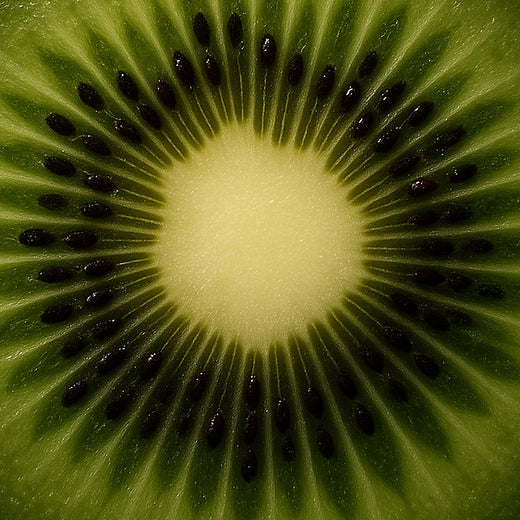
Kiwi is the fruit of several species of woody vines in the genus Actinidia, also called Chinese gooseberry. Its aroma joins fruity sweetness from esters with fresh grassy notes from aldehydes and alcohols.
- Olfactive family
- Fruity · 698 entries of the glossary in this family Subfamily: Green fruits · 22 entries in this subfamily Cluster: Mixed fruit notes · 346 entries in this cluster
- Material
- Fantasy/Concept Fruit
- Pyramid
- Top · Volatility: Top Note
- Strength
- N/A — no measured strength for a fantasy accord Not on the graded scale
- Also called
- Chinese gooseberry, kiwifruit, green kiwifruit, fuzzy kiwifruit
Kiwi · Facets
Entries of the glossary that carry each facet, of 3,979:
- citrus 487
- green 1,442
- sweet 1,988
- fruity 1,301
- fresh 1,387
- tropical 189
Editorial note We own no rights to this material, its name or its trademark. This entry is independent editorial journalism, published under freedom of expression.
Kiwi · Scent
Esters are the compounds mainly responsible for the sweet and fruity notes of kiwifruit. Aldehydes are important contributors to the aroma volatiles of kiwifruit, being responsible for the fresh, grassy, and green notes perceived by consumers. Ethyl butanoate, which is fruity and sweet, is found in many other fruits. Hayward kiwifruit has more green note compounds, while Hort16A kiwifruit has more tropic note compounds.
Scent Evolution
With longer ripening, the green note aldehydes declined and the main fruity esters increased.
Evolution over time
Kiwi: scent over time.
- Immediately
N/A — no documented evolution for a fantasy accord
- After a few hours
N/A
- After a few days
N/A
Kiwi · In Perfumery
Ethyl butanoate, which can be considered a core aroma component of kiwifruit, is also one of the most common chemicals used in flavors and fragrances. Ethyl butyrate is used in a variety of flavourings, including orange (the most common), cherry, pineapple, mango, guava, bubblegum, peach, apricot, fig and plum.
Pyramid
Kiwi: Top. Entries of the glossary stored at each place of the pyramid, of 4,000 (36 store no place):
- Top 718
- Top · Heart 497
- Heart 1,641
- Heart · Base 514
- Base 594
Role in the formula
Kiwi: roles in the formula. Entries of the glossary that share each role, of 4,000:
- N/A — no documented formula role 361
Kiwi · Terroir & Origins
- Producing countries
- China, Italy, New Zealand
Kiwi · Extraction & Chemistry
Ethyl butyrate, an ester found in kiwifruit, can be synthesized by reacting ethanol and butyric acid. This is a condensation reaction, so water is produced as a byproduct.
Available as
Kiwi: available as.
- synthetic accord
- fantasy note
- Appearance
- Fruit with fuzzy, dull brown skin and bright green flesh
Kiwi · Did You Know?
Despite the name Chinese gooseberry, the kiwifruit, being from the genus Actinidia, is not related to the gooseberry family, Grossulariaceae. The Chinese cultivars are a rare example of crop development, where plants only a few generations removed from wild plants became commercial crops.
Kiwi · In Depth
The green kiwifruit, Actinidia chinensis var. deliciosa, is a fruiting vine native to central Southern China, growing naturally at altitudes between 800 and 1,400 metres. Botanically, kiwifruit is a berry. The fruit has a soft texture with a sweet, sour and unique flavour.
Origin and Production
Kiwifruit is native to central and eastern China. As of 2023, China accounted for 55% of the world’s total kiwifruit production, making it the largest global producer. In 2006 Italy was the leading producer of kiwifruit in the world, followed by New Zealand, Chile, France, Greece, Japan, and the United States. ‘Hayward’ is the most commonly available cultivar in stores.
Aroma Chemistry
A total of 172 aroma components were detected in 23 kiwifruit cultivars. Esters, aldehydes and alcohols are the main volatiles in kiwifruit. Ethyl butanoate, (E)-2-hexen-1-ol and (E)-2-hexenal could be considered the core aroma components in kiwifruit, but this still needs further confirmation. Ethyl butanoate, also known as ethyl butyrate, is an ester, and it had the highest ester content, at 7042.01 μg/L in the cultivar Jinhong No. 1. Kiwifruit cultivars with different flesh colors cannot be effectively distinguished by their aroma chemical compositions.
Names
The first known reference to the name Chinese gooseberry came from 1917 in New Zealand, but the name was likely in use before then. By the 1920s, Chinese gooseberry became the standard name for the fruit in English until the 1950s. The name kiwifruit was coined by Jack Turner of Turners & Growers, referencing kiwi, an informal name used to describe New Zealanders. The name was first registered by Turners & Growers on 15 June 1959, and by 1970 all exports from New Zealand used the name kiwifruit.
Kiwi · History
The first recorded description of the kiwifruit dates to 12th century China during the Song dynasty. As it was usually collected from the wild and consumed for presumed purposes in folk medicine, the plant was rarely cultivated or bred.
Cultivation spread from China in the early 20th century when seeds were introduced to New Zealand by Mary Isabel Fraser, the principal of Whanganui Girls’ College, who had been visiting mission schools in China. The seeds were planted in 1906 by a Wanganui nurseryman, Alexander Allison, with the vines first fruiting in 1910.
The familiar cultivar ‘Hayward’ was developed by Hayward Wright in Avondale, New Zealand, around 1924. From 1953, the fruit began to be exported to Britain and Australia.
Kiwi · Technical Sheet
Identity
- Botanical
- Actinidia chinensis var. deliciosa
- Taxonomy
- Ericales order › Actinidiaceae family › Actinidia genus · GBIF
- Botanical records
- Actinidia chinensis var. deliciosa: POWO, Actinidia chinensis var. deliciosa · IPNI, Actinidia chinensis var. deliciosa · GBIF, Actinidia chinensis var. deliciosa · Wikidata, Actinidia chinensis var. deliciosa · Wikipedia, Actinidia chinensis var. deliciosa
- IPNI
- Actinidia chinensis var. deliciosa (A.Chev.) A.Chev., Rev. Bot. Appl. Agric. Trop. 21: 241, t. 1 (1941) — Auguste Jean Baptiste Chevalier (1873–1956) · ≡ Actinidia latifolia var. deliciosa A.Chev. (1940)
- Type
- Accord
- Category
- Fruits, vegetables and nuts
- Note
- Kiwi scent in perfumery is always a synthetic reconstruction; no kiwi essential oil
In Nature
- Growth form
- Climber · POWO
- Native range
- China · POWO
- Introduced to
- 15 regions · Northern America 8 · Europe 5 · Australasia 2
- Recorded altitude
- 0–1,300 m · median 400 m · 64 records with an altitude · GBIF
- Wild or cultivated
- 27 introduced · 66 cultivated among 2,202 records (the rest carry no such mark) · GBIF
- Recorded in
- 30 of 512 squares of the world grid; a brighter dot holds more records · GBIF
- Also from this genus
- Actinidia: Kiwi blossom
Chemical data
- Formula
- Ethyl butyrate C₆H₁₂O₂ (characteristic kiwi aroma compound)
- CAS
- 92456-63-8 (Actinidia chinensis extract)
Performance and rules
- IFRA status
- No IFRA Standard for the material itself (51st Amendment)
Kiwi · See Also
Entries related to Kiwi, by their place in the pyramid. “shared” marks a scent word Kiwi has too.
Top notes

Lychee
fruity (shared) · floral · rosy Fruity / Same cluster / Natural
Rhubarb
green (shared) · tart · fruity (shared) Fruity / Same cluster / Fantasy/Concept
Hexyl Acetate
fruity (shared) · green (shared) · fresh (shared) Fruity / Same cluster / Natural & Synthetic
White Currant
fresh (shared) · fruity (shared) · sweet (shared) Fruity / Same cluster / Fantasy/Concept
Sauvignone 100
synthetic · complex · particular Green / Synthetic


Heart notes

Fig
green (shared) · fruity (shared) · woody Fruity / Same subfamily / Natural & Synthetic
Prickly Pear
fruity (shared) · fresh (shared) · sweet (shared) Fruity / Same subfamily / Fantasy/Concept
SugarLoaf Pineapple
fruity (shared) · tropical (shared) · sweet (shared) Fruity / Natural
Kiwi blossom
floral · fruity (shared) · fresh (shared) Florals / Fantasy/Concept


Kiwi · Sources
- Foods (2021) Analysis of the Aroma Chemical Composition of Commonly Planted Kiwifruit Cultivars in China
- RSC Advances (2019) Tracing internal quality and aroma of a red-fleshed kiwifruit during ripening by means of GC-MS and E-nose
- IFRA Standards, 51st Amendment
- Wikipedia Kiwifruit
- Wikipedia Actinidia deliciosa
- Wikipedia Ethyl butyrate
Cite as PREMIEREPEAU Glossary, “Kiwi”, https://premierepeau.com/
