


Ledum
Keywords: aromatic · sweet
Ledum is the old genus name of the Labrador tea shrubs, which now belong to the genus Rhododendron. The oil of Rhododendron groenlandicum (formerly Ledum groenlandicum) has a spicy, pine, cumin and caraway odour.
- Olfactive family
- Aromatic · 509 entries of the glossary in this family Subfamily: Classic aromatics · 164 entries in this subfamily Cluster: Herbal aromatics · 76 entries in this cluster
- Material
- Natural Aerial parts (leaves and inflorescences)
- Pyramid
- Heart · Volatility: Heart Note
- Strength
- Medium Step 3 of 5 · shared by 1,462 of 2,148 graded entries Graded entries at each step, from 1 to 5: 4, 118, 1,462, 500, 40. 24 more sit between two steps.
- Also called
- Wild rosemary, marsh Labrador tea, northern Labrador tea, marsh rosemary, marsh tea
Ledum · Facets
Entries of the glossary that carry each facet, of 3,979:
- floral 1,546
- green 1,442
- sweet 1,988
- fresh 1,387
- camphoraceous 140
- resinous 199
Ledum · Scent
The hydrodistilled oil of Rhododendron tomentosum has a sweet characteristic odor. The plant itself emits a strong characteristic smell, which may cause headaches in some people.
Evolution over time
Ledum: scent over time.
- Immediately
Fresh, green and herbaceous, with a spicy, pine-like opening.
Scent words: fresh · green · herbal · spicy - After a few hours
Spicy cumin and caraway tones come forward, with a sweet note.
Scent words: sweet · spicy - After a few days
Woody and bitter notes remain.
Scent words: woody · bitter
Ledum · In Perfumery
Ledum palustre extract belongs to the category of masking and tonic agents. Its cosmetic uses are fragrance and tonic. The extract is not for flavor use.
Pyramid
Ledum: Heart. Entries of the glossary stored at each place of the pyramid, of 4,000 (36 store no place):
- Top 718
- Top · Heart 497
- Heart 1,641
- Heart · Base 514
- Base 594
Role in the formula
Ledum: roles in the formula. Entries of the glossary that share each role, of 4,000:
- Modifier 1,167
- Signature note 897
- Blender 1,040
- Freshness 720
- Masking agent fewer than 40 entries
- Tonic fewer than 40 entries
Ledum · Terroir & Origins
- Producing countries
- Canada
- Other countries of origin
- Lithuania
No origin card: Canada.
Lithuanian Ledum
Eastern Lithuania — Lithuania
Facet scores, out of 100
- Floral 92 (also a facet of the entry)
- Green 81 (also a facet of the entry)
- Sweet 74 (also a facet of the entry)
- Woody 52
- Powdery 45
- Fruity 30
The oils of plants from Eastern Lithuania are dominated by palustrol and ledol.
Oil yield was lowest in April (0.59%) and peaked at 1.73% in June and 1.76% in July.
- Species
- Rhododendron tomentosum (formerly Ledum palustre)
- Harvest
- Shoots and inflorescences collected from April to October, at various vegetative stages
- Extraction
- Hydrodistillation of air-dried material, 2 h, Clevenger-type apparatus
Ledum · Extraction & Chemistry
The essential oil of Rhododendron tomentosum can be obtained by hydrodistillation from air-dried aerial parts, the leaves and inflorescences. The plant material is dried at room temperature, with leaves and inflorescences separated before drying. The distillation ran for 2 hours in a Clevenger-type apparatus, with a ratio of plant material to water of 1:20. Yields ranged from 0.59% to 1.76% (v/w, on a dry weight basis). The yield was lowest in April and reached its maximum in June and July, at the end of flowering. Labrador tea oil from Rhododendron groenlandicum is also made in Canada by distillation of the whole plant.
- Appearance
- Colorless to pale yellow liquid
Ledum · Did You Know?
The name ledol comes from the Greek word ledos, meaning robe, and likely refers to the woolly appearance of the plant.
Ledum · In Depth
The plant
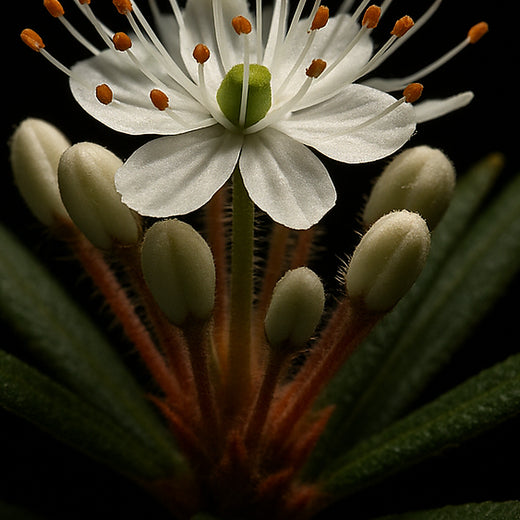
Rhododendron tomentosum, formerly Ledum palustre, is commonly called marsh Labrador tea, northern Labrador tea, marsh rosemary or wild rosemary. It is a low shrub growing to 50 cm, rarely up to 120 cm tall, with evergreen leaves. The flowers are small, with a five-lobed white corolla. They emit strong smell to attract bees and other pollinating insects. It grows in northern latitudes in North America, Greenland, Canada and Alaska, in the northern and central parts of Europe, and in Asia south to northern China, Korea and Japan.
Chemistry
Essential oil is located in all plant parts: leaves, shoots, inflorescences and seeds. The composition of the oil varies with the stage of plant growth. Palustrol and ledol are the compounds found in the largest amounts in these plants.
In oils of Rhododendron tomentosum from Lithuania, palustrol made up 24.6–33.5% and ledol 18.0–29.0%. Seeds hold more palustrol (38.3%) and less ledol (27.0%) than shoots, where ledol (36.5%) exceeds palustrol (21.0%). Ascaridol isomers, myrcene, lepalol and cyclocolorenone isomers were determined as the third main constituents.
Plants growing in central and northern Europe belong to the palustrol-ledol chemotype. In the Canadian chemotype of Rhododendron tomentosum the main compounds are ascaridole and p-cymene, while the European species mainly represents ledol and palustrol chemotypes. Ledol is a poisonous sesquiterpene with the formula C₁₅H₂₆O.
Uses and safety
Rhododendron tomentosum is used in herbalism to make an herbal tea called Labrador tea. No material benefit of the tea has been documented in any properly controlled study. The shoots, which hold the highest concentration of essential oil, have been studied for possible antidiabetic, antimicrobial and antioxidant uses. All parts of the plant contain poisonous terpenes that affect the central nervous system. Essential oils of Rhododendron tomentosum that contain ledol and palustrol as major compounds showed notable toxic activity in a brine shrimp bioassay.
Explore all seven extraits in the Discovery Set.
Ledum · History
The earliest known written record of Rhododendron plant toxicity dates back to 401 B.C. in China. Rhododendron tomentosum is recorded in traditional medicine for treating rheumatism, coughs, colds and insect bites. Marsh Labrador tea has traditionally been used as a gruit in brewing beer in the Middle Ages. Because of its strong fragrance, it was formerly used in Scandinavia and Eastern Europe as a natural deterrent against clothes moths, mosquitos and bugs in general.
Ledum · Technical Sheet
Identity
- Botanical
- Rhododendron tomentosum (syn. Ledum palustre)
- Taxonomy
- Ericales order › Ericaceae family › Rhododendron genus · GBIF
- Botanical records
- Rhododendron tomentosum: POWO, Rhododendron tomentosum · IPNI, Rhododendron tomentosum · GBIF, Rhododendron tomentosum · Wikidata, Rhododendron tomentosum · Wikipedia, Rhododendron tomentosum
- IPNI
- Rhododendron tomentosum Harmaja, Ann. Bot. Fenn. 27(2): 204 (1990) — Harri Harmaja (1944-)
- Type
- Ingredient
- Category
- Greens, herbs and fougeres
- Note
- Essential oil obtained by steam distillation of aerial parts
In Nature
- Growth form
- Shrub · POWO
- Native range
- Northern Europe · Middle Europe · Eastern Europe · Siberia · Russian Far East · Middle Asia · China · Mongolia · 4 more regions · POWO
- Flowering
- peak in June · north of the equator · iNaturalist
- Recorded altitude
- 0–1,250 m · median 150 m · 2,371 records with an altitude · GBIF
- Wild or cultivated
- 13 native · 71 cultivated among 171,602 records (the rest carry no such mark) · GBIF
- Recorded in
- 91 of 512 squares of the world grid; a brighter dot holds more records · GBIF
- Also from this genus
- Rhododendron: Azalea · Rhododendron · Siberian Rhododendron
- Also from this botanical family
- Ericaceae: Arbutus (Madrona, Bearberry Tree) · Bearberry · Blueberry · Chinese Wintergreen · Cranberry · Heather · 5 more entries
In Print
- Timeline
- first described 1990 · earliest aroma paper in Europe PMC, 2012
- In English books
- most mentioned in the 2010s · Google Books Ngram
Classification
- Chemical class
- Essential oil, mainly sesquiterpenes
Chemical data
- Formula
- Complex natural mixture (key constituents: ledol C₁₅H₂₆O; palustrol C₁₅H₂₆O; myrcene C₁₀H₁₆)
- Most reported compounds
- Myrcene (3 papers; one: DOI) · Para-Cymene (2 papers; one: DOI) · Geranyl Acetate (2 papers; one: DOI) · LOTUS
- CAS
- 90063-39-1
- EC
- 289-997-3
- INCI names (CosIng)
- LEDUM PALUSTRE LEAF OIL (ANTIOXIDANT, FRAGRANCE, SKIN PROTECTING, PERFUMING)LEDUM PALUSTRE EXTRACT (FRAGRANCE, TONIC)
Labelling
- EU allergens reported
- Geraniol · Geranyl Acetate · Carvone
Physical properties
- Specific gravity
- 0.900–0.930 at 20 °C
Performance and rules
- Available as
- essential oil
- IFRA status
- No IFRA Standard for the material itself (51st Amendment)
Ledum · See Also
Entries related to Ledum, by their place in the pyramid. “shared” marks a scent word Ledum has too.
Top notes

Shishito Pepper
green (shared) · spicy · vegetal Aromatic / Natural & Synthetic
Rosemary
aromatic (shared) · herbal · camphorous Aromatic / Top · Heart / Natural
Petitgrain
citrus · fresh (shared) · green (shared) Florals / Natural


Heart notes

Tea
green (shared) · aromatic (shared) · dry Aromatic / Heart · Base / Same cluster / Natural
French Marigold
floral (shared) · warm · fresh (shared) Aromatic / Same cluster / Natural
Sage
aromatic (shared) · herbal · amber Aromatic / Natural
Myrica
herbal · minty · medicinal Aromatic / Natural
Rhododendron
herbal · sweet (shared) · balsamic Florals / Natural
Arbutus (Madrona, Bearberry Tree)
woody · fruity · warm Woods / Natural
Azalea
floral (shared) · fresh (shared) · sweet (shared) Florals / Fantasy/Concept
Heather
earthy · floral (shared) · sweet (shared) Florals / Natural
Siberian Rhododendron
floral (shared) · fresh (shared) · woody Florals / Natural


Ledum · Sources
Read the science
- Nat Prod Commun (2012) Composition of seed essential oils of Rhododendron tomentosum
- GBIF Ledum groenlandicum Oeder, name record of the World Checklist of Vascular Plants (Kew)
- Molecules (2020) Toxic, Radical Scavenging, and Antifungal Activity of Rhododendron tomentosum H. Essential Oils
- Plants (2024) Phytochemical Profiling and Biological Activities of Rhododendron Subsect. Ledum: Discovering the Medicinal Potential of Labrador Tea Species in the Northern Hemisphere
- IFRA Standards, 51st Amendment
- The Good Scents Company Ledum palustre extract
- Wikipedia Rhododendron tomentosum
- Wikipedia Ledol
- Wikipedia Rhododendron groenlandicum
Cite as PREMIEREPEAU Glossary, “Ledum”, https://premierepeau.com/
