


Lemon Tea Tree
Keywords: fresh · strong · lemon
Lemon tea tree oil is the essential oil of Leptospermum petersonii, a shrub or small tree of the family Myrtaceae. Its scent is a fresh, strong, cleansing lemon.
- Olfactive family
- Citrus · 156 entries of the glossary in this family Subfamily: Zesty citrus · 115 entries in this subfamily Cluster: Lemon-lime sharp citrus · 83 entries in this cluster
- Material
- Natural Leaves and branchlets
- Pyramid
- Top Note
- Strength
- Strong Step 4 of 5 · shared by 501 of 2,149 graded entries Graded entries at each step, from 1 to 5: 4, 118, 1,462, 501, 40. 24 more sit between two steps.
- Also called
- lemon-scented tea tree, Australian Rose
Lemon Tea Tree · Facets
Entries of the glossary that carry each facet, of 3,979:
- citrus 488
- fresh 1,390
- sharp 43
- clean 64
Lemon Tea Tree · Scent
The oil has a fresh, strong, cleansing lemon scent. Its scent is also described as citrus, lemon fresh. The most common chemical variety has a pleasant odour, whereas the rare variety B has a rose-like odour. Citral, which is present in the oil, has a strong lemon (citrus) scent.
Evolution over time
Lemon Tea Tree: scent over time.
- Immediately
Fresh citrus and lemon.
Scent words: citrus · fresh - After a few hours
A strong, cleansing lemon.
- After a few days
A strong lemon, pleasant in the most common variety.
The rare variety B has a rose-like odour.
Lemon Tea Tree · In Perfumery
Citral, which is present in lemon tea-tree oil, is used as an aroma compound in perfumery. It is used to fortify lemon oil. The aldehydes citronellal and citral are considered key components responsible for the lemon note, with citral preferred.
Pyramid
Lemon Tea Tree: Top. Entries of the glossary stored at each place of the pyramid, of 4,000 (35 store no place):
- Top 718
- Top · Heart 496
- Heart 1,644
- Heart · Base 513
- Base 594
Role in the formula
Lemon Tea Tree: roles in the formula. Entries of the glossary that share each role, of 4,000:
- Top note fewer than 40 entries
- Freshness 720
- Modifier 1,168
Lemon Tea Tree · Terroir & Origins
- Producing countries
- Australia
Lemon Tea Tree · Extraction & Chemistry
The ability to be pruned regularly makes the plant well-suited to harvesting for distilled essential oils. Annual oil yields of L. petersonii ranged from 0.4% in February to 1.8% in March. Soil, season, temperature, geographic origin and the ecological role of the plant organs can cause quantitative and qualitative differences in essential oils.
- Appearance
- Clear to yellow in colour; watery consistency
Lemon Tea Tree · Did You Know?
The common name tea tree derives from the practice of early Australian settlers who soaked the leaves of several species in boiling water to make a herbal tea.
Lemon Tea Tree · In Depth
What it is
Leptospermum petersonii is commonly known as lemon-scented teatree. It is a species of shrub or small tree that is endemic to eastern Australia. Lemon scented tea tree is a different species from conventional tea tree, not conventional tea tree with a lemon scent added. Conventional tea tree oil is isolated from the leaves of Melaleuca alternifolia.
The plant
It typically grows to a height of about 5 m (16 ft) or more. The leaves are elliptical to narrow lance-shaped and often strongly-scented, and the flowers are white. It grows in sclerophyll forest or rainforest near creeks or on rocky escarpments, south from Mount Timbeerwah in south-east Queensland to near Port Macquarie in New South Wales. It is commonly grown as an ornamental and is regarded as a minor environmental weed in some areas.
Chemistry
Previous literature proposed the existence of three chemical varieties of this species, based on the composition of its essential oil. The most common variety, type A, consists mainly of aldehydes such as neral, geranial and citronellal, and monoterpene hydrocarbons. The rare variety B contains geraniol and geranyl acetate as main constituents, followed by γ-terpinene and terpinolene.
Geranial (34.7–29.9%) and neral (19.7–23.5%) have been reported as the main constituents of the oil. Citral is a collective term for two geometric isomers, geranial and neral. Citral is an acyclic monoterpene aldehyde. Citral is present in the volatile oil of lemon tea-tree at 70–80%.
Properties
The essential oil inhibits the pathological fungi Candida albicans and Aspergillus fumigatus.
Lemon Tea Tree · History
Frederick Manson Bailey first formally described Leptospermum petersonii in 1905 in the Queensland Agricultural Journal, from a specimen that Peterson collected on Wilsons Peak in January 1905. The shrub was introduced as a seed to KwaZulu-Natal, South Africa, in 1960, from a Kenyan plantation that had its origins in the rainforests of east coast Australia. No indigenous uses of L. petersonii are known.
Lemon Tea Tree · Technical Sheet
Identity
- Botanical
- Leptospermum petersonii
- IPNI
- Leptospermum petersonii F.M.Bailey, Queensland Agric. J. 15(6): 781 (1905) — Frederick Manson Bailey (1827–1915)
- Type
- Ingredient
- Category
- Citrus smells
In Nature
- Recorded altitude
- 0–1,050 m · median 400 m · 57 records with an altitude · GBIF
- Wild or cultivated
- 57 native · 43 introduced · 9 cultivated among 933 records (the rest carry no such mark) · GBIF
- Recorded in
- 10 of 512 squares of the world grid; a brighter dot holds more records · GBIF
- Also from this genus
- Leptospermum: Manuka
- Also from this botanical family
- Myrtaceae: Allspice · Anise Myrtle · Blue Mallee · Cajeput · Clove · Clove Leaf · 26 more entries
In Print
- Timeline
- first described 1905 · earliest aroma paper in Europe PMC, 2007
- In English books
- most mentioned in the 1990s · Google Books Ngram
Chemical data
- Formula
- Complex natural mixture (key constituents: citral; citronellal)
- Structure
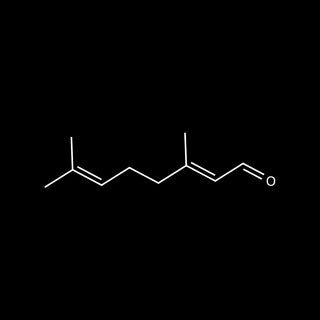
Citral
PubChem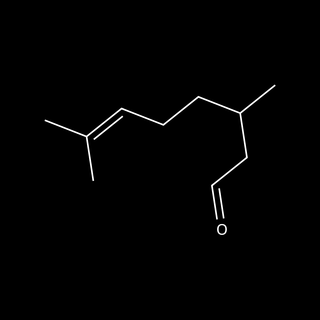
Citronellal
PubChem
Physical properties
- Specific gravity
- 0.881 (20 °C)
- Refractive index
- 1.484 (20 °C)
Performance and rules
- Available as
- essential oil
- IFRA status
- No IFRA Standard for the material itself (51st Amendment)
Lemon Tea Tree · See Also
Entries related to Lemon Tea Tree, by their place in the pyramid. « shared » marks a scent word Lemon Tea Tree has too.
Top notes

Lemon Myrtle
citrus (shared) · fresh (shared) · green Citrus / Same cluster / Natural
Guava
fruity · sweet · tropical Fruity / Natural & Synthetic


Lemon Tea Tree · Sources
- GBIF Leptospermum petersonii
- GBIF Leptospermum petersonii (GBIF species record)
- Frontiers in microbiology Chemical Composition and Biological Activities of the Essential Oils of Leptospermum petersonii and Eucalyptus gunnii
- IFRA Standards, 51st Amendment
- Wikipedia Leptospermum petersonii
- Wikipedia Citral
- Wikipedia Tea tree oil
- Wikipedia Leptospermum
Cite as PREMIEREPEAU Glossary, “Lemon Tea Tree”, https://premierepeau.com/pages/glossary-terms/lemon-tea-tree Updated 2026-11-18
