


Lichen
Keywords: earthy · woody · powdery
Lichen, in perfumery, refers to extracts of lichens such as oakmoss and tree moss, which are used as fragrance ingredients. Oakmoss has a distinct and complex odour, described as woody, sharp and slightly sweet.
- Olfactive family
- Woods · 363 entries of the glossary in this family Subfamily: Earthy woods · 119 entries in this subfamily
- Material
- Natural Lichen
- Pyramid
- Base · Volatility: Base Note
- Strength
- Medium Step 3 of 5 · shared by 1,462 of 2,148 graded entries Graded entries at each step, from 1 to 5: 4, 118, 1,462, 500, 40. 24 more sit between two steps.
- Also called
- oak moss absolute, moss oak absolute, mousse de chene absolute, Evernia prunastri lichen absolute
Lichen · Facets
Entries of the glossary that carry each facet, of 3,979:
- green 1,442
- earthy 660
- sweet 1,988
- musky 113
- fresh 1,387
- woody 792
- powdery 197
- sharp 44
Lichen · Scent
Oakmoss is described as moss-like, humus-earthy and woody. In the base notes of fragrances it adds a warm, woody, subtly powdery touch. Oakmoss growing on pines has a pronounced turpentine odour.
Evolution over time
Lichen: scent over time.
- Immediately
Sharp, with a mossy, humus-earthy character.
Scent words: earthy - After a few hours
Woody and slightly sweet.
Scent words: sweet · woody - After a few days
A warm, woody, subtly powdery base.
Scent words: powdery · warm · woody
Lichen · In Perfumery
Oakmoss absolutes and extracts are often used as perfume fixatives and form the base notes of many fragrances. They are also key components of Fougère and Chypre class perfumes. The concrete is used in soaps and the absolute in fine perfumery, in fougère, chypre, woody or oriental compositions.
Pyramid
Lichen: Base. Entries of the glossary stored at each place of the pyramid, of 4,000 (36 store no place):
- Top 718
- Top · Heart 497
- Heart 1,641
- Heart · Base 514
- Base 594
Role in the formula
Lichen: roles in the formula. Entries of the glossary that share each role, of 4,000:
- Fixative 340
- Modifier 1,167
- Backbone 196
- Signature note 897
- Blender 1,040
- Naturalizer 162
Lichen · Terroir & Origins
- Producing countries
- France, Macedonia, Morocco, Bulgaria, Algeria
No origin card: Bulgaria, Algeria, Morocco.
Lichen (Mousse)
France, Morocco, Yugoslavia
Earthy, damp, mossy-woody. Oakmoss and treemoss are lichens. The backbone of chypre and fougère.
- Botanical
- Various
Lichen · Extraction & Chemistry
Concretes are obtained from the moss through extraction with solvents, and absolutes are extracted from the concrete using alcohol. The extraction process is practiced mainly in France. The absolutes are the most popular form of oakmoss extract.
- Appearance
- Pale yellow to dark amber liquid
Lichen · Did You Know?
In ancient Egyptian embalming, Pseudevernia furfuracea was found packed into the body cavity of mummies. It is not certain whether this was done for the preservative or the aromatic properties of the lichen.
Lichen · In Depth
What lichen is
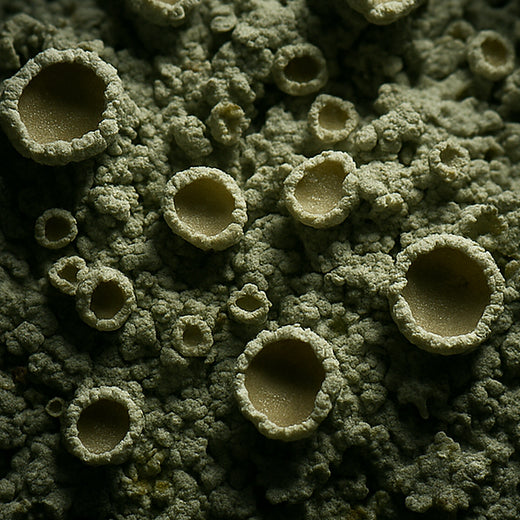
A lichen is a symbiotic association between a fungus and photosynthetic algae or cyanobacteria, often containing other fungi and bacteria. Lichens have been used in making dyes, perfumes and traditional medicines.
Oakmoss and tree moss
Oakmoss, Evernia prunastri, is a species of lichen found in many mountainous temperate forests throughout the Northern Hemisphere. It grows primarily on the trunk and branches of oak trees. Tree moss, Pseudevernia furfuracea, is a lichenized species of fungus that grows on the bark of firs and pines. Oakmoss is collected across central and southern Europe, and also in Morocco and Algeria.
Harvest and trade
Oakmoss is commercially harvested in countries of South-Central Europe and usually exported to the Grasse region of France, where its fragrant compounds are extracted as oakmoss absolutes and extracts. The lichen is collected especially in Macedonia and Bulgaria. Approximately 1900 tons of tree moss were processed in Grasse, France, in 1997.
Chemistry
Oakmoss absolute is a complex mixture of various constituents. Atranol and chloroatranol are constituents of oakmoss absolute. Atranol is 2,6-dihydroxy-4-methylbenzaldehyde, with the formula C₈H₈O₃. Atranorin, evernic acid, fumarprotocetraric acid, stictic acid and usnic acid are regarded as some of the responsible sensitisers in oakmoss extracts. Tree moss contains atranorin, oxyphysodic acid and virensic acid. Two commercial samples of treemoss absolute contained resin acids at 11.4% and 8.1% by weight, the major components being dehydroabietic acid with abietic acid and its isomers.
Regulation
Oakmoss is one of 26 allergens that since 2003 has to be included in the list of ingredients on cosmetic products sold in the European Union. The IFRA Standards set purity criteria limiting atranol and chloroatranol in the 43rd Amendment of 2008. In 2017 the EU adopted a regulation prohibiting atranol and chloroatranol as cosmetic ingredients beyond trace levels.
From 2019 on, no new products containing them above trace amounts, that is untreated oakmoss, may be introduced to the EU market. An IFRA Standard on treemoss extracts was published in January 2020, in the 49th Amendment.
Explore all seven extraits in the Discovery Set.
Related: Humus Ether
Lichen · History
The first industry risk-management intervention for oakmoss, in the form of an IFRA Standard, was issued in 1988. In 1992 the IFRA Code of Practice recommended that oakmoss and treemoss extracts should not be used, individually or in combination, at a level above 0.6% in consumer products. The guideline was amended in 1998 so that the total of oakmoss and treemoss extracts was restricted to 0.1% in consumer products.
Since April 2000 IFRA has recommended that oakmoss extracts used in perfume compounds must not contain treemoss. In 2012 the EU’s scientific advisory body issued an opinion suggesting a complete prohibition of atranol and chloroatranol. Many scents have been reformulated in recent years with other chemicals substituted for oakmoss.
Lichen · Technical Sheet
Identity
- Botanical
- Evernia prunastri (oakmoss) / Pseudevernia furfuracea (tree moss)
- Taxonomy
- Lecanorales order › Parmeliaceae family › Evernia genus · GBIF
- Botanical records
- Evernia prunastri: GBIF, Evernia prunastri · Wikidata, Evernia prunastri · Wikipedia, Evernia prunastri
- Type
- Ingredient
- Category
- Woods and mosses
- Note
- IFRA restricted due to atranol/chloroatranol sensitization potential; modern versions are atranol-free
In Nature
- Recorded altitude
- 50–1,300 m · median 500 m · 6,512 records with an altitude · GBIF
- Wild or cultivated
- 2,232 native · 29 cultivated among 133,442 records (the rest carry no such mark) · GBIF
- Recorded in
- 56 of 512 squares of the world grid; a brighter dot holds more records · GBIF
- Also from this genus
- Evernia: Oakmoss
In Print
- In English books
- most mentioned in the 1980s · Google Books Ngram
Classification
- Cluster
- Earthy woods · 238 entries in this cluster
- Chemical class
- Complex mixture
Chemical data
- Formula
- Complex natural mixture (key constituents: atranol C₈H₈O₃; chloroatranol; evernic acid)
- Most reported compounds
- Evernic Acid (5 papers; one: Plant Cell Rep 1987) · Atranorin (3 papers; one: Int J Cosmet Sci 1992) · Chloroatranorin (3 papers; one: Int J Cosmet Sci 1992) · Ethyl Hematommate (3 papers; one: Int J Cosmet Sci 1992) · LOTUS
- CAS
- 90028-68-5 (Evernia prunastri extract, oakmoss); 90028-67-4 (Pseudevernia furfuracea extract, tree moss)
- INCI names (CosIng)
- EVERNIA PRUNASTRI EXTRACT (PERFUMING)
Labelling
- EU cosmetics annexes
- EVERNIA PRUNASTRI EXTRACT · CosIng, Annex III, entry 91, EVERNIA PRUNASTRI EXTRACT · labelling
“The presence of the substance must be indicated in the list of ingredients referred to in Article 19(1)g when its concentration exceeds: – 0.001% in leave-on products – 0.01% in rinse-off products”
EVERNIA FURFURACEA EXTRACT · CosIng, Annex III, entry 92, EVERNIA FURFURACEA EXTRACT · labelling“The presence of the substance must be indicated in the list of ingredients referred to in Article 19(1)g when its concentration exceeds: – 0.001% in leave-on products – 0.01% in rinse-off products”
- EU allergens reported
- Carvone
Physical properties
- Flash point
- > 93.33 °C (> 200 °F, TCC)
Performance and rules
- Available as
- standard form
- IFRA status
- IFRA Standard “Oakmoss extracts” (Amendment 49); IFRA Standard “Treemoss extracts” (Amendment 49)
Lichen · See Also
Entries related to Lichen, by their place in the pyramid. “shared” marks a scent word Lichen has too.
Base notes

Patchouli
Woods / Same cluster / Natural
Patchouli (Green)
earthy (shared) · woody (shared) · balsamic Woods / Same cluster / Natural-
Mitti Attar
earthy (shared) · fresh (shared) · woody (shared) Woods / Same cluster / Natural 
Sandalwood
woody (shared) · floral Woods / Natural
Mousse de Saxe
earthy (shared) · rich · woody (shared) Woods / Accord
Evernyl
earthy (shared) · woody (shared) · warm Aromatic / Synthetic
Green Forest
green (shared) · fresh (shared) · earthy (shared) Aromatic / Fantasy/Concept


Lichen · Sources
- Science Advances (2024) Symbionts out of sync: Decoupled physiological responses are widespread and ecologically important in lichen associations
- European Commission Opinion concerning Oakmoss/Treemoss Extracts And Appropriate Consumer Information adopted by the SCCNFP during the 14th plenary meeting of 24 October 2000
- PubChem 2,6-Dihydroxy-4-Methylbenzaldehyde
- IFRA Standards, 51st Amendment
- Perflavory Oakmoss absolute
- Wikipedia Evernia prunastri
- Wikipedia Pseudevernia furfuracea
- Wikipedia Lichen
- IFRA Standards, 51st Amendment
Cite as PREMIEREPEAU Glossary, “Lichen”, https://premierepeau.com/
