


Linoleic Acid
Keywords: fatty · oily · cheese
Linoleic Acid is an omega-6 fatty acid, an octadecadienoic acid, and a colourless to pale yellow oily liquid with a faint fatty odour.
Linoleic Acid · Facets
Entries of the glossary that carry each facet, of 3,979:
- fatty 266
- oily 231
- cheese 15
- fruity 1,307
- vegetable 116
- herbaceous 51
Linoleic Acid · Scent
It has a faint, fatty and oily odour with cheese, fruity, vegetable and herbaceous facets.
Linoleic Acid · In Perfumery
It is a fragrance ingredient with a fatty, oily and cheese-like character.
Pyramid
Linoleic Acid: Base. Entries of the glossary stored at each place of the pyramid, of 4,000 (35 store no place):
- Top 718
- Top · Heart 501
- Heart 1,646
- Heart · Base 512
- Base 588
Linoleic Acid · In Depth
Identity
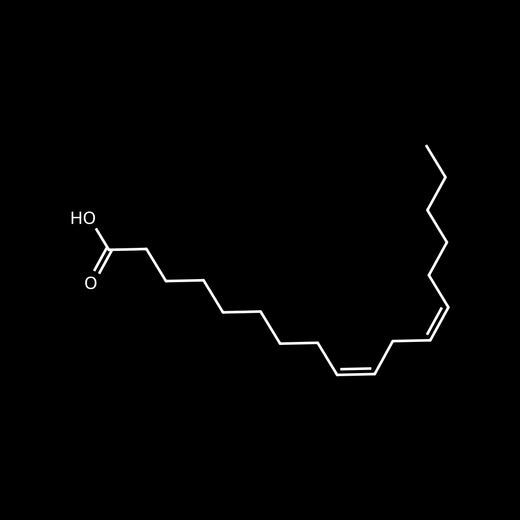
Linoleic Acid has the CAS number 60-33-3, the formula C₁₈H₃₂O₂ and a molecular weight of 280.4. Its IUPAC name is (9Z,12Z)-octadeca-9,12-dienoic acid. It is an octadecadienoic acid with two double bonds at positions 9 and 12, both with Z (cis) stereochemistry, and an omega-6 fatty acid.
Odour
Linoleic Acid smells fatty and oily, with cheese, fruity, vegetable and herbaceous facets. At 100 % its odour is faint and fatty.
Occurrence in nature
It occurs in Foeniculum vulgare, Cassia fistula, Gossypium hirsutum, Nigella sativa, Peganum harmala, Senegalia catechu, Abelmoschus esculentus, Abies pinsapo subsp. marocana, Abutilon ramosum, Acacia auriculiformis, Acacia mearnsii and Acacia mollissima. Its vegetable oil sources include cottonseed, soybean and peanut. It is a plant, algal and Daphnia galeata metabolite.
Use in perfumery
It is a fragrance ingredient.
Use in flavours
It is a flavouring agent or adjuvant with a dairy flavour profile.
Properties
It boils at 229 to 230 °C at 16 mmHg and melts at -6.9 °C. Its density is 0.9022 g per cubic centimetre at 20 °C. Its flash point is above 110 °C.
It dissolves in water to 1.59 mg/L at 25 °C, and is very soluble in acetone, benzene, ethyl ether and ethanol. It has a logP of 7.05. It is used to make paints, coatings, emulsifiers, vitamins, soaps, margarine and dietary supplements.
Safety and IFRA
In the 51st Amendment of the IFRA Standards, no IFRA Standard covers this material itself. Its INCI name is LINOLEIC ACID, and its functions in cosmetics are antistatic, cleansing, skin conditioning, emollient, hair conditioning and surfactant cleansing. Its EC number is 200-470-9.
Linoleic Acid · Technical Sheet
Molecular weight
280.4 g/mol Heavier than 205 of the 271 other entries at the same place of the pyramid that store a weight; 1 weigh the same
2,572 entries store a molecular weight. By place in the pyramid: Top 547, Top · Heart 411, Heart 888, Heart · Base 454, Base 272.
Identity
- Type
- Ingredient
- Category
- Aroma chemicals
- Also called
- cis,cis-Linoleic acid, alpha-Linoleic acid, 9Z,12Z-Linoleic acid, Linoleic, 14C-Linoleic acid
Classification
- Olfactive family
- Gourmand · 494 entries of the glossary in this family
- Subfamily
- Creamy gourmands · 93 entries in this subfamily
- Cluster
- Classic gourmands · 182 entries in this cluster
- Chemical class
- Carboxylic acid
Chemical data
- Formula
- C18H32O2
- CAS
- 60-33-3
- PubChem CID
- 5280450, compound record on PubChem
- InChIKey
- OYHQOLUKZRVURQ-HZJYTTRNSA-N
- Appearance
- Colourless to pale yellow oily liquid
Physical properties
- Boiling point
- 365 to 366 °C at 760 mmHg
- Melting point
- -5 °C at 760 mmHg
- Flash point
- > 110 °C (> 230 °F)
- Density
- 0.898-0.904
- Vapour pressure
- 1 mmHg at 180 °C
- Log P
- 7.05
Performance and rules
- Pyramid
- Base Note
- IFRA status
- No IFRA Standard for the material itself (51st Amendment)
Linoleic Acid · See Also


Linoleic Acid · Sources
- PubChem Linoleic Acid
- ChEBI Linoleic Acid: chemical classification record
- The Good Scents Company Information System Linoleic Acid: data sheet
- Pyrfume Good Scents odour data (Pyrfume archive)
- Pyrfume Leffingwell odour data (Pyrfume archive)
- Wikidata (LOTUS natural products data) Linoleic Acid: organisms it is reported in, with the papers
- IFRA Standards, 51st Amendment
- European Commission, CosIng Linoleic Acid: cosmetic ingredient record
- European Chemicals Agency Linoleic Acid: substance record
Cite as PREMIEREPEAU Glossary, “Linoleic Acid”, https://premierepeau.com/pages/glossary-terms/linoleic-acid Updated 2026-11-18
