


O-Xylene
Keywords: gassy · geranium
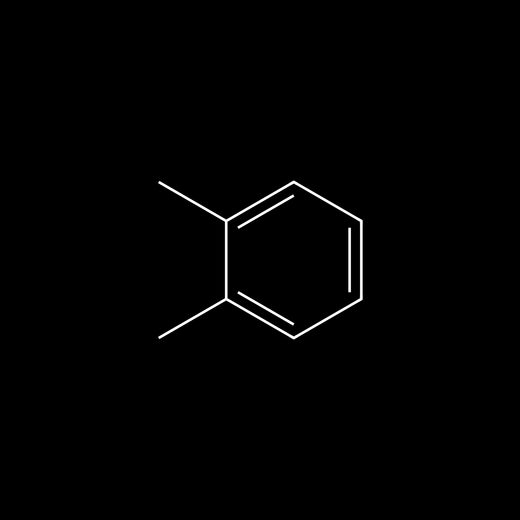
O-Xylene: The compound o-xylene is a xylene carrying methyl groups at positions 1 and 2, and it is a colourless liquid with a sweet, aromatic, gassy odour.
- Olfactive family
- Aromatic · 510 entries of the glossary in this family Subfamily: Classic aromatics · 165 entries in this subfamily Cluster: Herbal aromatics · 79 entries in this cluster
- Material
- Synthetic
- Pyramid
- Top · Volatility: Top Note
- Also called
- 1,2-Xylene, Ortho-Xylene, Dimethyl benzene
Family, subfamily and cluster: PREMIEREPEAU house classification, version 2026‑11.
O-Xylene · Facets
Entries of the glossary that carry each facet, of 3,979:
- gassy 34
- geranium 30
O-Xylene · Scent
The compound o-xylene smells sweet and aromatic, with a gassy, kerosene-like edge, milder than toluene or benzene.
O-Xylene · In Perfumery
The compound o-xylene has a gassy, kerosene-like odour that is sweeter and milder than toluene or benzene, and its cosmetic functions include fragrance and perfuming.
Pyramid
O-Xylene: Top. Entries of the glossary stored at each place of the pyramid, of 4,006 (42 store no place):
- Top 718
- Top · Heart 497
- Heart 1,641
- Heart · Base 514
- Base 594
O-Xylene · Extraction & Chemistry
It is isolated from mixed xylenes by distillation, or made by isomerisation of m-xylene. The commercial product called mixed xylenes generally contains approximately 40% m-xylene and 20% each of o-xylene, p-xylene and ethylbenzene, with small quantities of toluene. It is used in the manufacture of phthalic anhydride, dyes, insecticides and motor fuels, and in vitamin and pharmaceutical syntheses.
- Appearance
- Colourless watery liquid, less dense than water
O-Xylene · In Depth
Identity
The compound o-xylene has the CAS number 95-47-6, the molecular formula C₈H₁₀ and a molecular weight of 106.16 g/mol. Its IUPAC name is 1,2-xylene.
It is a xylene substituted by methyl groups at positions 1 and 2.
Odour
The compound o-xylene smells sweet and aromatic, with a gassy, kerosene-like edge and a hint of geranium. The odour is pungent, but not nearly as powerful as that of toluene and not as nauseating as that of benzene.
Occurrence in nature
The compound o-xylene is found in Actinidia chinensis, Basella alba, Carica papaya, Couroupita guianensis, Cynara cardunculus, Cynara scolymus, Festuca arundinacea, Festuca rubra, Garcinia mangostana, Gossypium hirsutum, Juglans nigra and Mangifera indica.
Production
It is isolated from mixed xylenes by distillation, or made by isomerisation of m-xylene. The commercial product called mixed xylenes generally contains approximately 40% m-xylene and 20% each of o-xylene, p-xylene and ethylbenzene, with small quantities of toluene. It is used in the manufacture of phthalic anhydride, dyes, insecticides and motor fuels, and in vitamin and pharmaceutical syntheses.
Use in perfumery
Under European cosmetic rules its functions include fragrance, solvent and perfuming.
Properties
It boils at 143 to 145 °C at 760 mmHg and melts at −25.16 °C. Its closed-cup flash point is 30 °C. It has a logP of 3.12. It dissolves in water at 180 mg/L at 25 °C. It is miscible with ethanol, ethyl ether, acetone, petroleum ether, benzene and carbon tetrachloride. Its estimated vapour pressure is 5.99 mmHg at 25 °C.
Safety and IFRA
In the 51st Amendment of the IFRA Standards, no standard covers this material itself. Its INCI name is XYLENE. Its EC number is 202-422-2 and it is registered under REACH.
O-Xylene · Technical Sheet
Molecular weight
106.16 g/mol Heavier than 237 of the 536 other entries at the same place of the pyramid that store a weight.
2,515 entries store a molecular weight. By place in the pyramid: Top 537, Top · Heart 403, Heart 861, Heart · Base 452, Base 262.
Identity
- Type
- Ingredient
- Category
- Aroma chemicals
Classification
- Chemical class
- Hydrocarbon
Chemical data
- Formula
- C8H10
- CAS
- 95-47-6
- Reported in plants
- Carica papaya (1 paper; one: J Agric Food Chem 1983) · Garcinia mangostana (1 paper; one: Phytochemistry 1982) · Juglans nigra (1 paper; one: Journal of essential oil research 1993) · Psidium guajava (1 paper; one: Flavour & Fragrance J 1991) · Sorghum bicolor (1 paper; one: J Nat Prod 1987) · LOTUS
- PubChem CID
- 7237, compound record on PubChem
- InChIKey
- CTQNGGLPUBDAKN-UHFFFAOYSA-N
- Wikidata · Wikipedia
- O-Xylene: Q2988108, item on Wikidata · Wikipedia, English article
Physical properties
- Boiling point
- 143 to 145 °C at 760 mmHg
- Melting point
- −25.16 °C
- Flash point
- 30 °C
- Vapour pressure
- 5.99 mmHg at 25 °C (estimated)
- Log P
- 3.12
Performance and rules
- Odour threshold
- 380 ppb in air · Abraham et al. 2012
- Available as
- synthetic
- IFRA status
- No IFRA Standard for the material itself (51st Amendment)
O-Xylene · See Also
Entries related to O-Xylene, by their place in the pyramid. “shared” marks a scent word O-Xylene has too.
Top notes

1-Octene
gasoline · ethereal · cheese Aromatic / Same cluster / Synthetic / 112.21 g/mol
Mesitylene
aromatic · ethereal · gassy (shared) Aromatic / Same cluster / Synthetic / 120.19 g/mol
Styrene
balsamic · floral · plastic Resinous / Synthetic / 104.15 g/mol


O-Xylene · Sources
- PubChem O-Xylene
- ChEBI O-Xylene: chemical classification record
- Pyrfume Arctander, Perfume and Flavor Chemicals: odour descriptions (Pyrfume archive)
- Pyrfume Good Scents odour data (Pyrfume archive)
- European Commission, CosIng O-Xylene: cosmetic ingredient record
- The Good Scents Company Information System O-Xylene: data sheet
- Wikidata (LOTUS natural products data) O-Xylene: organisms it is reported in, with the papers
- IFRA Standards, 51st Amendment
- European Chemicals Agency O-Xylene: substance record
Cite as PREMIEREPEAU Glossary, “O-Xylene”, https://premierepeau.com/

