


Perillyl acetate
Keywords: floral · fruity · herbal
Perillyl acetate is an acetate ester, an almost colourless or pale yellowish oily liquid with a warm, herbaceous, spicy odour.
- Olfactive family
- Florals · 783 entries of the glossary in this family Subfamily: Classic florals · 312 entries in this subfamily
- Pyramid
- Heart Note
- Strength
- Medium Step 3 of 5 · shared by 1,462 of 2,149 graded entries Graded entries at each step, from 1 to 5: 4, 118, 1,462, 501, 40. 24 more sit between two steps.
- Also called
- Dihydro cuminyl acetate
Perillyl acetate · Facets
Entries of the glossary that carry each facet, of 3,979:
- floral 1,547
- fruity 1,299
- herbal 757
- spicy 473
- woody 790
- geranium 28
Perillyl acetate · Scent
It has a fruity and floral odour with herbal, spicy, woody and geranium facets.
Perillyl acetate · In Perfumery
It is a fragrance ingredient with a fruity, floral and warm herbaceous spicy odour.
Pyramid
Perillyl acetate: Heart. Entries of the glossary stored at each place of the pyramid, of 4,000 (35 store no place):
- Top 718
- Top · Heart 496
- Heart 1,644
- Heart · Base 513
- Base 594
Perillyl acetate · In Depth
Identity
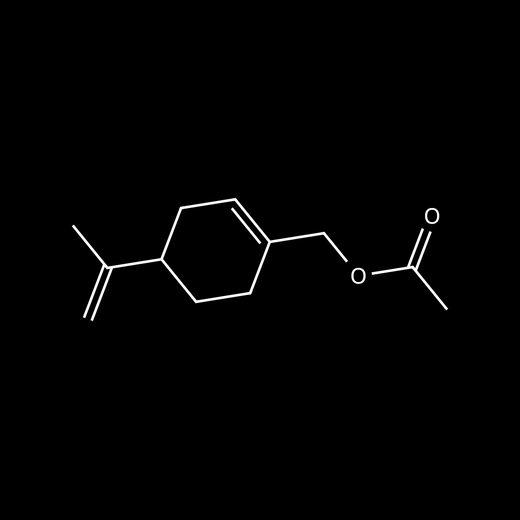
Perillyl acetate has the CAS number 15111-96-3 and the formula C₁₂H₁₈O₂. Its molecular weight is 194.27 g/mol and its IUPAC name is (4-prop-1-en-2-ylcyclohexen-1-yl)methyl acetate. It is also named 1,8-p-menthadien-7-yl acetate.
Odour
It smells fruity and floral, with herbal, spicy, woody and geranium facets. At 100 %, the odour also shows dried fruit, phenolic and green notes. Its odour strength is medium, and its substantivity is 143 hours at 100 %.
Occurrence in nature
It occurs in Citrus iyo, Helianthus annuus, Leonurus japonicus and Salvia dorisiana.
Use in perfumery
It is a fragrance ingredient, and its function in cosmetics is perfuming.
Use in flavours
It is a flavouring agent with a fruit flavour profile. Its taste is green, geranium, phenolic, fruity, herbal, berry, floral and tropical. The Joint FAO/WHO Expert Committee on Food Additives found no safety concern at current levels of intake when used as a flavouring agent.
Properties
It boils at 218 to 223 °C and has a density of 0.972 to 0.980. Its refractive index is 1.476 to 1.487 and its flash point is 93.33 °C. It is insoluble in water, soluble in oils and miscible with ethanol at room temperature. It has an estimated logP of 3.61 and an estimated vapour pressure of 0.014 mmHg at 25 °C.
Safety and IFRA
No IFRA Standard covers this material itself, as of the 51st Amendment. Its INCI name is 4-METHYLVINYLCYCLOHEXENE-1-METHYL ACETATE and its EC number is 239-162-4. None of the 116 hazard reports places it in a GHS hazard class.
Perillyl acetate · Technical Sheet
Molecular weight
194.27 g/mol Heavier than 835 of the 885 other entries at the same place of the pyramid that store a weight; 10 weigh the same.
2,572 entries store a molecular weight. By place in the pyramid: Top 547, Top · Heart 406, Heart 886, Heart · Base 455, Base 278.
Identity
- Type
- Ingredient
- Category
- Aroma chemicals
Classification
- Cluster
- Classic florals · 243 entries in this cluster
- Chemical class
- Ester
Chemical data
- Formula
- C12H18O2
- CAS
- 15111-96-3
- PubChem CID
- 61780, compound record on PubChem
- InChIKey
- WTXBCFKGCNWPLS-UHFFFAOYSA-N
- Wikidata
- Perillyl acetate: Q81984803, item on Wikidata
- Appearance
- Almost colourless or pale yellowish oily liquid
Physical properties
- Boiling point
- 218 to 223 °C at 760 mmHg
- Flash point
- 93.33 °C (200 °F)
- Density
- 0.972–0.980
- Refractive index
- 1.476–1.487
- Vapour pressure
- 0.014 mmHg at 25 °C (estimated)
- Log P
- 3.61 (estimated)
- Tenacity
- 143 hour(s) at 100 %
Performance and rules
- IFRA status
- No IFRA Standard for the material itself (51st Amendment)
Perillyl acetate · See Also
Entries related to Perillyl acetate, by their place in the pyramid.
Top notes

Citron Leaf
fresh · green · citrus Green / Natural

Perillyl acetate · Sources
- PubChem Perillyl acetate
- Pyrfume Good Scents odour data (Pyrfume archive)
- Pyrfume Leffingwell odour data (Pyrfume archive)
- The Good Scents Company Information System Perillyl acetate: data sheet
- Wikidata (LOTUS natural products data) Perillyl acetate: organisms it is reported in, with the papers
- European Commission, CosIng Perillyl acetate: cosmetic ingredient record
- IFRA Standards, 51st Amendment
Cite as PREMIEREPEAU Glossary, “Perillyl acetate”, https://premierepeau.com/
