Poinsettia

AccordFLOWERSfloral · green · fresh
HeartPyramid
3/5Strength
—Tenacity
1Origins

Editorial noteWe own no rights to this material, its name or its trademark. This entry is independent editorial journalism, published under freedom of expression.
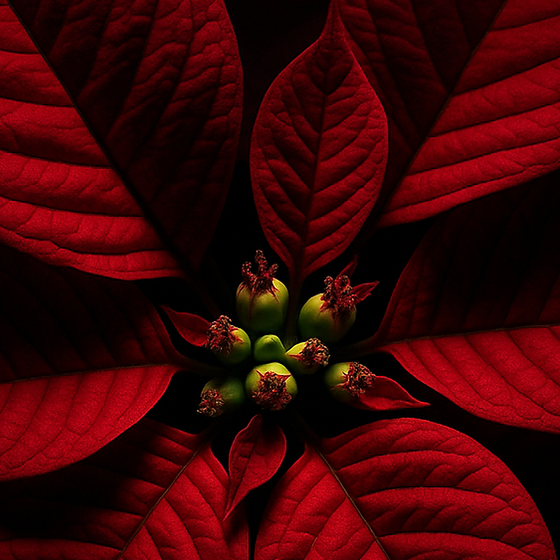
Specimen
Poinsettia perfume ingredient
Heart
Euphorbia pulcherrima
Fantasy/Concept
Definition

A barely-there green whisper. Poinsettia smells like sap from a broken stem, vegetal and watery, with a faint latex undertone.

FLORAL GREEN SWEET WARM FRESH
CHRISTMAS STAR EUPHORBIA
Type
Accord
Olfactive family
Florals
Subfamily
Green florals
Cluster
Green-fresh florals
Source
flowers
Instruments
Pyramid
TTop
HHeart
BBase
3/5Strength
Medium
odour strength
Producing countries
Central America

Scent

Faintly green and vegetal, with a watery transparency. The scent suggests broken plant stems more than flowers. A subtle milky-latex quality sits underneath, neither sweet nor bitter. Less aromatic than a geranium leaf, less sweet than a lily.

The Full Story

Poinsettia (Euphorbia pulcherrima) is a tropical shrub native to Mexico and Central America, famous for its red bracts rather than its insignificant flowers. The plant belongs to the Euphorbiaceae family and produces a milky latex sap when stems are broken.

In perfumery, poinsettia is a fantasy note. The actual plant has minimal fragrance: a faint green-vegetal scent from the sap and leaves, nothing floral in the conventional sense. The fantasy accord attempts to capture what one imagines a poinsettia might smell like: something green, watery, slightly sweet, with a subtle tropical warmth.

Perfumers who use this note typically build it from light green materials, watery florals, and a touch of milky lactonic sweetness to carries the latex sap. It functions as a modifier in green-floral compositions, adding a tropical-greenhouse quality. The note is rare and primarily conceptual, appearing in fragrances that reference winter holidays or tropical botanicals.

—

Related: Abelia · Almond Blossom · Alpha Terpineol · Alstroemeria · Alumroot · Amarillys · Amazon Moonflower · Amethyst Flower

Did You Know?

The red parts of a poinsettia are not petals but modified leaves called bracts. The actual flowers are the small yellow structures at the center, called cyathia.

Extraction & Chemistry

Extraction method

No commercial extraction. Poinsettia is a fantasy accord in perfumery. The plant produces minimal volatile compounds; the milky latex sap contains diterpene esters but no usable aromatic oil.

Formula
N/A (no commercial essential oil)
CAS
N/A (no commercial essential oil)
Botanical
Euphorbia pulcherrima
Appearance
Pale yellow to amber liquid
Odour strength
Medium
Synonyms
CHRISTMAS STAR EUPHORBIA
IFRA status
See note

Not applicable: accord or concept, not a single material

Physical properties
Note
No commercial essential oil or absolute. Scent note based on headspace analysis or accord reconstruction. Mild, green-floral, slightly soapy.

In Perfumery

Poinsettia is a fantasy modifier used sparingly in green-floral and tropical compositions. It provides a greenhouse-vegetal quality, evoking living plants rather than cut flowers. The note is conceptual: the actual plant has minimal fragrance, so the accord is a perfumer's interpretation built from green, watery, and lactonic materials. It appears in holiday-themed and botanical concept fragrances.

Role in the formula
01diffusion enhancer
02modifier
03signature note
04lifting agent
05blender
06freshness
Available as
synthetic accord fantasy note

See Also

8 notes