


Pyrrolidine
Keywords: animal · shellfish · eggy
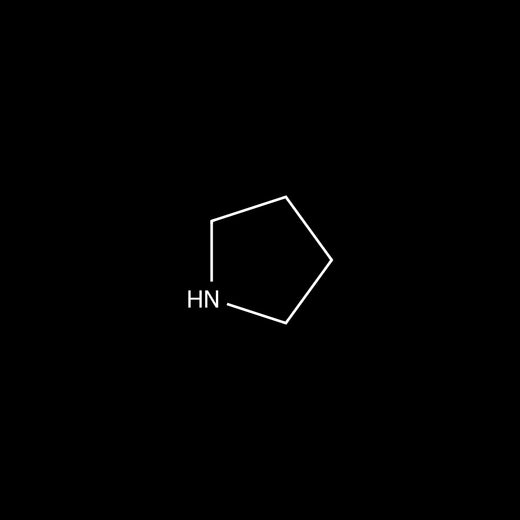
Pyrrolidine is a cyclic amine with a five-membered ring, a colourless to pale yellow liquid with a penetrating, ammoniacal smell.
- Olfactive family
- Animalic · 28 entries of the glossary in this family Subfamily: Animalic notes · 26 entries in this subfamily
- Material
- Synthetic
- Pyramid
- Heart · Base · Volatility: Heart · Base
Family, subfamily and cluster: PREMIEREPEAU house classification, version 2026‑11.
Pyrrolidine · Facets
Entries of the glossary that carry each facet, of 3,979:
- animal 68
- shellfish 2
- eggy 3
- fishy 43
- seaweed 4
- ammoniacal 14
Pyrrolidine · Scent
It smells ammoniacal and animal, with eggy, fishy and shellfish facets.
Pyrrolidine · In Perfumery
Its odour is penetrating and amine-type, ammoniacal and nauseating.
Pyramid
Pyrrolidine: Heart · Base. Entries of the glossary stored at each place of the pyramid, of 4,006 (42 store no place):
- Top 718
- Top · Heart 497
- Heart 1,641
- Heart · Base 514
- Base 594
Pyrrolidine · Extraction & Chemistry
It is made by reacting 1,4-butanediol and ammonia over a dehydration catalyst. It is usually prepared by reduction of pyrrole.
- Appearance
- A colourless to pale yellow liquid
Pyrrolidine · In Depth
Identity
Pyrrolidine has the CAS number 123-75-1, the formula C₄H₉N and a molecular weight of 71.12 g/mol. It is a cyclic amine whose five-membered ring contains four carbon atoms and one nitrogen atom, the parent compound of the pyrrolidine family.
It is used as an intermediate for pharmaceuticals, fungicides, insecticides and rubber accelerators, and as a curing agent for epoxy resins.
Odour
It smells ammoniacal and animal, with eggy, fishy and shellfish facets. The odour is penetrating and amine-type, reminiscent of ammonia and piperidine, nauseating and diffusive, and of very poor tenacity.
Occurrence in nature
It has been reported in Cannabis sativa, Phaseolus vulgaris, Piper nigrum and Vitis vinifera.
Production
It is made by reacting 1,4-butanediol and ammonia over a dehydration catalyst. It is usually prepared by reduction of pyrrole.
Use in flavours
It is used as a flavouring agent and is useful in tobacco flavours. Its taste is ammoniacal and fishy, amine-like, with seaweed and shellfish nuances. No safety concern arises at current levels of intake when it is used as a flavouring agent.
Properties
It is a colourless to pale yellow liquid, and its vapours are heavier than air. It boils at 87 to 89 °C and melts at −63 °C. Its flash point is 3 °C. It is miscible with water and soluble in ethanol and ethyl ether.
Safety and IFRA
No IFRA Standard covers this material itself. Its EC number is 204-648-7, and it is registered under REACH. It produces toxic oxides of nitrogen during combustion.
Pyrrolidine · Technical Sheet
Molecular weight
71.12 g/mol Heavier than 0 of the 451 other entries at the same place of the pyramid that store a weight.
2,515 entries store a molecular weight. By place in the pyramid: Top 537, Top · Heart 403, Heart 861, Heart · Base 452, Base 262.
Identity
- Type
- Ingredient
- Category
- Aroma chemicals
Classification
- Cluster
- Animalic notes · 52 entries in this cluster
Chemical data
- Formula
- C4H9N
- CAS
- 123-75-1
- PubChem CID
- 31268, compound record on PubChem
- InChIKey
- RWRDLPDLKQPQOW-UHFFFAOYSA-N
- Wikidata · Wikipedia
- Pyrrolidine: Q408898, item on Wikidata · Wikipedia, English article
Physical properties
- Boiling point
- 87 to 89 °C
- Melting point
- −63 °C
- Flash point
- 3 °C
- Vapour pressure
- 58.582001 mmHg at 25 °C (estimated)
- Log P
- 0.46
Performance and rules
- Available as
- synthetic
- IFRA status
- No IFRA Standard for the material itself (51st Amendment)
Pyrrolidine · See Also
Entries related to Pyrrolidine, by their place in the pyramid. “shared” marks a scent word Pyrrolidine has too.
Top notes

Cocaine
tropane alkaloid · coca leaf Aromatic / Fantasy/Concept / 303.35 g/mol

Heart notes

1-Methylpyrrolidine
animal (shared) · floral · herbal Animalic / Heart · Base / Same cluster / 85.15 g/mol
Coca
alkaloid-bearing leaf · tea · flavouring Green / Natural


Pyrrolidine · Sources
- PubChem Pyrrolidine
- ChEBI Pyrrolidine: chemical classification record
- Pyrfume Arctander, Perfume and Flavor Chemicals: odour descriptions (Pyrfume archive)
- Pyrfume Good Scents odour data (Pyrfume archive)
- Wikidata (LOTUS natural products data) Pyrrolidine: organisms it is reported in, with the papers
- The Good Scents Company Information System Pyrrolidine: data sheet
- IFRA Standards, 51st Amendment
- European Chemicals Agency Pyrrolidine: substance record
Cite as PREMIEREPEAU Glossary, “Pyrrolidine”, https://premierepeau.com/

