


Sansevieria
Keywords: fresh · green · earthy
Sansevieria is a historically recognized genus of flowering plants, native to Africa, notably Madagascar, and southern Asia, now included in the genus Dracaena.
- Olfactive family
- Aromatic · 510 entries of the glossary in this family Subfamily: Green notes · 93 entries in this subfamily Cluster: Green leafy notes · 420 entries in this cluster
- Material
- Synthetic Leaves and flowering tops
- Pyramid
- Heart · Volatility: Heart Note
- Strength
- Medium Step 3 of 5 · shared by 1,473 of 2,156 graded entries Graded entries at each step, from 1 to 5: 4, 119, 1,473, 498, 39. 23 more sit between two steps.
- Producing countries
- West Africa
- Also called
- snake plant, mother-in-law’s tongue, Saint George’s sword, viper’s bowstring hemp, devil’s tongue, jinn’s tongue
Family, subfamily and cluster: PREMIEREPEAU house classification, version 2026‑11.
Sansevieria · Facets
Entries of the glossary that carry each facet, of 3,979:
- woody 792
- floral 1,546
- green 1,442
- fresh 1,387
Editorial note We own no rights to this material, its name or its trademark. This entry is independent editorial journalism, published under freedom of expression.
Sansevieria · Scent
Some flowers of Dracaena trifasciata are fragrant at night, others not at all.
Sansevieria · In Perfumery
The IFRA Standards library holds no standard under the names sansevieria or snake plant.
Pyramid
Sansevieria: Heart. Entries of the glossary stored at each place of the pyramid, of 4,006 (42 store no place):
- Top 718
- Top · Heart 497
- Heart 1,641
- Heart · Base 514
- Base 594
Role in the formula
Sansevieria: roles in the formula. Entries of the glossary that share each role, of 4,006:
- Modifier 1,167
- Blender 1,040
- Naturalizer 162
- Volume builder 780
- Freshness 720
Sansevieria · Extraction & Chemistry
The material is often defatted with a hydrocarbon solvent before the alcohol extraction.
Available as
Sansevieria: available as.
- synthetic accord
- fantasy note
- Appearance
- Pale yellow to amber liquid
Sansevieria · Did You Know?
In Brazil, where Dracaena trifasciata is known as espada de São Jorge, it is grown outside houses to ward off evil that might harm the home. The NASA Clean Air Study found that it has the potential to filter indoor air. Its rate of filtration is too slow for practical indoor use.
Sansevieria · In Depth
Common names and family
Common names for the 70 or so species formerly placed in the genus include mother-in-law’s tongue, devil’s tongue, jinn’s tongue, bow string hemp, snake plant and snake tongue. The species range from succulent desert plants such as Dracaena pinguicula to thinner leafed tropical plants such as Dracaena trifasciata. Dracaena trifasciata is a species of flowering plant in the family Asparagaceae, native to tropical West Africa from Nigeria east to the Congo.
The Plant
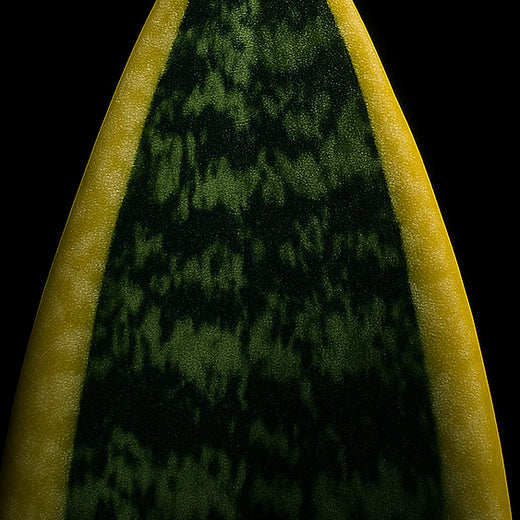
Dracaena trifasciata is an evergreen perennial plant forming dense strands, spreading by way of its creeping rhizome. Its stiff leaves grow vertically from a basal rosette. Mature leaves are dark green with light gray-green cross-banding and usually range from 70–90 centimetres long and 5–6 centimetres wide. Its flowers vary from greenish white to cream-colored.
The flowers have a sticky texture. The plant uses the crassulacean acid metabolism process, opening its leaf pores only at night, which lets it withstand drought. The species is often kept as a houseplant because it can survive with very little water and sun.
Uses
In Africa, the leaves of former Sansevieria species are used for fiber production. Dracaena trifasciata yields bowstring hemp, a strong plant fiber once used to make bowstrings. The leaf fiber of many Sansevieria is also used for making fine matting, rope or cordage, and articles of clothing. Several former Sansevieria species are popular houseplants in temperate regions, with Dracaena trifasciata the most widely sold. The plant contains saponins which are mildly toxic to dogs and cats and can lead to gastrointestinal upset if consumed.
Chemistry
The most characteristic secondary metabolites isolated from Dracaena and Sansevieria are steroids, flavonoids, stilbenes, and saponins; flavonoids and saponins form the largest groups. Spirostanol and furostanol saponins are largely predominant in Dracaena and Sansevieria species. Saponins are a group of plant glycosides characterized by their high surfactant properties.
Explore all seven extraits in the Discovery Set.
Sansevieria · History
The genus was first named Sanseverinia by Vincenzo Petagna in 1787, in honor of his patron Pietro Antonio Sanseverino, Count of Chiaromonte. In 1794, Carl Peter Thunberg used the name Sansevieria. Molecular phylogenetic studies later showed that Sansevieria was nested within Dracaena. Until 2017, Dracaena trifasciata was known under the synonym Sansevieria trifasciata.
Sansevieria · Technical Sheet
Identity
- Botanical
- Dracaena trifasciata (syn. Sansevieria trifasciata)
- Taxonomy
- Asparagales order › Asparagaceae family › Dracaena genus · GBIF
- Botanical records
- Dracaena trifasciata: POWO, Dracaena trifasciata · IPNI, Dracaena trifasciata · GBIF, Dracaena trifasciata · Wikidata, Dracaena trifasciata · Wikipedia, Dracaena trifasciata
- IPNI
- Dracaena trifasciata (hort. ex Prain) Mabb., Mabberley’s Pl.-Book 1101 (2017) — David John Mabberley (1948-) · ≡ Sansevieria trifasciata Prain (1903)
- Type
- Accord
- Category
- Greens, herbs and fougeres
- Note
- No commercial essential oil. The green, slightly succulent note is a perfumery reconstruction.
In Nature
- Growth form
- Herb · POWO
- Native range
- West Tropical Africa · West-Central Tropical Africa · East Tropical Africa · POWO
- Introduced to
- 45 regions · Southern America 12 · Africa 11 · Pacific 10 · Tropical Asia 7 · Northern America 3 · Australasia 2
- Recorded altitude
- 0–1,400 m · median 150 m · 370 records with an altitude · GBIF
- Wild or cultivated
- 84 introduced · 52 cultivated among 3,530 records (the rest carry no such mark) · GBIF
- Recorded in
- 109 of 512 squares of the world grid; a brighter dot holds more records · GBIF
- Also from this genus
- Dracaena: Snake Plant · Dragon Blood Resin
Classification
- Chemical class
- Fantasy note
Chemical data
- Formula
- N/A — no commercial essential oil
- INCI names (CosIng)
- SANSEVIERIA TRIFASCIATA LEAF EXTRACT (SKIN CONDITIONING)
Performance and rules
- IFRA status
- No IFRA Standard for the material itself (51st Amendment)
Sansevieria · See Also
Entries related to Sansevieria, by their place in the pyramid. “shared” marks a scent word Sansevieria has too.
Top notes

Shishito Pepper
green (shared) · spicy · vegetal Aromatic / Same cluster / Natural & Synthetic-
Fresh note
fresh (shared) · citrus · green (shared) Aromatic / Same cluster / Fantasy/Concept 
Black Pepper
spicy · warm · aromatic Aromatic / Natural


Sansevieria · Sources
Cite as PREMIEREPEAU Glossary, “Sansevieria”, https://premierepeau.com/
