


Tejpat
Keywords: spicy · clove-like · peppery
Tejpat, also called Indian bay leaf, is a name of Cinnamomum tamala, a tree of the family Lauraceae whose leaves are used in cooking. The leaves have a clove-like aroma with a hint of peppery taste.
- Olfactive family
- Spicy · 155 entries of the glossary in this family Subfamily: Warm spices · 145 entries in this subfamily Cluster: Clove-nutmeg spices · 14 entries in this cluster
- Material
- Natural Leaves of Cinnamomum tamala
- Pyramid
- Heart · Volatility: Heart Note
- Also called
- Indian bay leaf, Tejapatta, Malabar leaf, Indian bark, Indian cassia, Malabathrum
Tejpat · Facets
Entries of the glossary that carry each facet, of 3,979:
- spicy 474
- warm 1,108
- clove 14
- peppery 46
- aromatic 102
Tejpat · Scent
The oil has a spicy odor at 100%. In cooking, there are five types or grades of tej leaves, which give various strong cassia- or cinnamon-like aroma profiles to dishes.
Tejpat · In Perfumery
Tejpat oil is placed in the category of information only, not used for fragrances or flavors. The recommendation for tejpat oil is not for fragrance use and not for flavor use. Linalool, the main component of the leaf oil in two analyses, is in high demand in the fragrance and flavor industries.
Pyramid
Tejpat: Heart. Entries of the glossary stored at each place of the pyramid, of 4,000 (36 store no place):
- Top 718
- Top · Heart 497
- Heart 1,641
- Heart · Base 514
- Base 594
Role in the formula
Tejpat: roles in the formula. Entries of the glossary that share each role, of 4,000:
- Fragrance ingredient 51
- Warmth 53
Tejpat · Extraction & Chemistry
The essential oil is obtained by hydro-distillation of the fresh leaves.
- Appearance
- Pale yellow to yellow clear liquid (est)
Tejpat · Did You Know?
The Roman cookbook De Re Coquinaria uses malabathrum leaves in several recipes. It also uses them for distilling an oil used in a caraway-sauce for oysters.
Tejpat · In Depth
Botanical origin
Cinnamomum tamala is a tree in the family Lauraceae. It is native to northern India (Assam and the Western Himalayas), Bangladesh, Nepal, Myanmar, Laos, Vietnam, and southwestern China. It can grow up to 20 m (66 ft) tall.
The leaf
The leaves are used for culinary purposes and for medicinal purposes. English-language marketplaces often label tejapatta as “Indian bay leaves” or just “bay leaf”, causing confusion with the botanically and aromatically different Mediterranean bay laurel (Laurus nobilis).
Bay laurel leaves are shorter and light- to medium-green in color, with one large vein down the length of the leaf. Tej leaves are about twice as long and wider, usually olive green in color, with three veins down the length of the leaf. The aroma of the bay laurel leaf is more reminiscent of pine and lemon.
Leaf oil
Hydro-distillation of fresh leaves gave an oil in which L-linalool (66.85%) was the major component, followed by cinnamaldehyde (14.62%). Hydrodistillation of fresh leaves cultivated in the North Cachar Hills of North East India gave an oil in which linalool was the main component (60.73%). In that oil, eugenol and cinnamic aldehyde were detected only in trace amounts (<1%), and alpha-pinene made up 10.54%. Its aroma attributes include beta-caryophyllene, linalool, caryophyllene oxide and eugenol.
Names of the oil
The oil is also called Indian bay leaf oil, Indian cassia leaf oil, Cinnamomum tamala oil, Laurus cassia oil, Laurus tamala oil, Malabar leaf oil and malabathrum leaf oil.
Tejpat · History
Malabathrum, malabathron or malobathrum is the name used in classical and medieval texts for certain cinnamon-like aromatic plant leaves and an ointment prepared from those leaves. Cinnamomum tamala is thought to be a notable source of these leaves. In ancient Greece and Rome, the leaves were used to prepare a fragrant oil, called oleum malabathri. Malabathrum is mentioned in the first century Greek text Periplus Maris Erythraei. The word malabathrum is the Hellenization of the Sanskrit word tamālapattram, literally meaning “dark tree leaves”.
Tejpat · Technical Sheet
Identity
- Botanical
- Cinnamomum tamala
- Taxonomy
- Laurales order › Lauraceae family › Cinnamomum genus · GBIF
- Botanical records
- Cinnamomum tamala: POWO, Cinnamomum tamala · IPNI, Cinnamomum tamala · GBIF, Cinnamomum tamala · Wikidata, Cinnamomum tamala · Wikipedia, Cinnamomum tamala · IUCN Least concern (LC), Cinnamomum tamala
- IPNI
- Cinnamomum tamala (Buch.-Ham.) T.Nees & C.H.Eberm., Handbuch der medicinisch-pharmaceutischen Botanik 2 (1831)
- Type
- Ingredient
- Category
- Spices
In Nature
- Recorded altitude
- 750–2,150 m · median 1,850 m · 61 records with an altitude · GBIF
- Wild or cultivated
- 1 native · 1 cultivated among 477 records (the rest carry no such mark) · GBIF
- Recorded in
- 14 of 512 squares of the world grid; a brighter dot holds more records · GBIF
- Also from this genus
- Cinnamomum: Cassia · Cinnamon · Cinnamon Leaf · Culilawan · Ho Wood · Orange Cassia Tree · Ravintsara · Sugandha Kokila
- Also from this botanical family
- Lauraceae: Avocado · Bay Essence · Bay Leaf · Ishpink, Ocotea Quixos · Laurel Blossom · Laurissilva Forest · 5 more entries
In Print
- Timeline
- first described 1831 · earliest aroma paper in Europe PMC, 2008
- In English books
- most mentioned in the 2000s · Google Books Ngram
Chemical data
- Formula
- Complex natural mixture (key constituents: linalool; cinnamaldehyde; beta-caryophyllene)
- Most reported compounds
- Cinnamaldehyde (2 papers; one: Phytother Res 2011) · Eugenol (1 paper; one: JOURNAL OF FOOD SCIENCE AND TECHNOLOGY 1994) · Linalool (1 paper; one: JOURNAL OF FOOD SCIENCE AND TECHNOLOGY 1994) · Beta-Pinene (1 paper; one: JOURNAL OF FOOD SCIENCE AND TECHNOLOGY 1994) · Para-Cymene (1 paper; one: JOURNAL OF FOOD SCIENCE AND TECHNOLOGY 1994) · LOTUS
- Structure
- Linalool, Cinnamaldehyde, Beta-Caryophyllene:
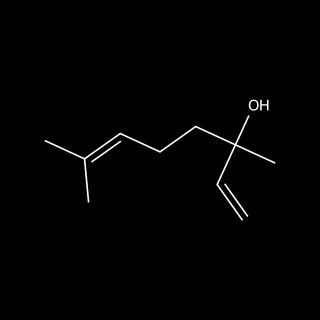
Linalool
PubChem, Linalool
Cinnamaldehyde
PubChem, Cinnamaldehyde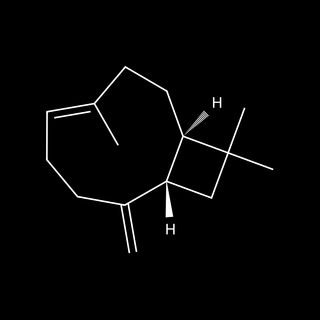
Beta-Caryophyllene
PubChem, Beta-Caryophyllene

Labelling
Physical properties
- Refractive index
- 1.4791 (nD 28)
Performance and rules
- Available as
- essential oil
- IFRA status
- No IFRA Standard for the material itself (51st Amendment)
Tejpat · See Also
Entries related to Tejpat, by their place in the pyramid. “shared” marks a scent word Tejpat has too.
Heart notes
-
Culilawan
clove (shared) · cajeput · spicy (shared) Spicy / Same cluster / Natural 
Cinnamon
spicy (shared) · warm (shared) · sweet Spicy / Same subfamily / Natural
Orange Cassia Tree
spicy (shared) · bark Spicy / Same subfamily / Natural
Safrole
sweet · woody · spicy (shared) Spicy / Natural
Ho Wood
woody · warm (shared) · creamy Woods / Natural


Tejpat · Sources
- GBIF Cinnamomum tamala
- Book Database on Medicinal Plants Used in Ayurveda (2000)
- FAO AGRIS Cinnamomum tamala (Buch.-Ham.) T. Nees & Eberm.: An Alternative Source of Natural Linalool
- IFRA Standards, 51st Amendment
- The Good Scents Company Tejpat oil
- Wikipedia Cinnamomum tamala
- Wikipedia Malabathrum
- Journal of Spices and Aromatic Crops Essential oil of leaves of Cinnamomum tamala Nees. & Eberm. from North East India (1994)
- Amrit Research Journal (NepJOL), Dec 2022 GC-MS Profiling and Bioactivities of Essential Oil and Extracts of Cinnamomum tamala (Buch.-Ham.) Nees & Eberm. Leaves from Kathmandu Valley, Nepal
- ICAR-Indian Institute of Spices Research Bay Leaf (Tejpat) – Cinnamomum tamala
Cite as PREMIEREPEAU Glossary, “Tejpat”, https://premierepeau.com/
