


Laurissilva Forest
Keywords: green · aromatic · earthy
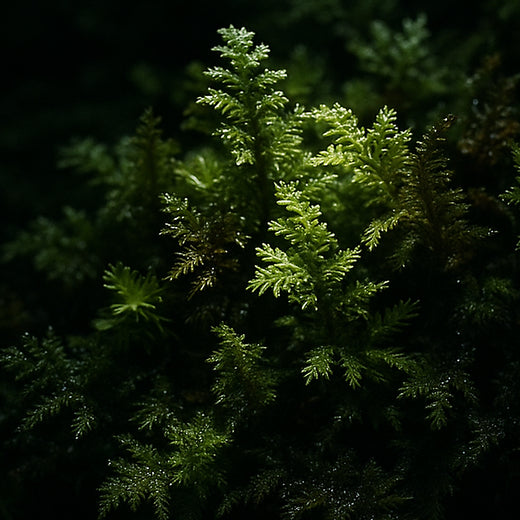
Laurissilva Forest: Laurissilva is a type of subtropical laurel forest. Laurel forests are found on the islands of Macaronesia in the eastern Atlantic, in particular the Azores, Madeira and the Canary Islands.
- Olfactive family
- Aromatic · 510 entries of the glossary in this family Subfamily: Herbal aromatics · 230 entries in this subfamily Cluster: Green-herbal notes · 155 entries in this cluster
- Material
- Fantasy/Concept
- Pyramid
- Heart · Volatility: Heart Note
- Strength
- N/A — no measured strength for a fantasy accord Not on the graded scale
- Also called
- laurel forest, laurisilva
Family, subfamily and cluster: PREMIEREPEAU house classification, version 2026‑11.
Laurissilva Forest · Facets
Entries of the glossary that carry each facet, of 3,979:
- green 1,442
- sweet 1,988
- herbal 757
- warm 1,108
- fresh 1,387
Editorial note We own no rights to this material, its name or its trademark. This entry is independent editorial journalism, published under freedom of expression.
Laurissilva Forest · Scent
The leaves of Laurus novocanariensis have a much finer aroma than the strongly scented leaves of Laurus nobilis. Ocotea foetens is rich in essential oils, which give an unpleasant odor to the wood when freshly cut.
Evolution over time
Laurissilva Forest: scent over time.
- Immediately
N/A — no documented evolution for a fantasy accord
- After a few hours
N/A
- After a few days
N/A
Laurissilva Forest · In Perfumery
Pyramid
Laurissilva Forest: Heart. Entries of the glossary stored at each place of the pyramid, of 4,006 (42 store no place):
- Top 718
- Top · Heart 497
- Heart 1,641
- Heart · Base 514
- Base 594
Role in the formula
Laurissilva Forest: roles in the formula. Entries of the glossary that share each role, of 4,006:
- N/A — no documented formula role 361
Available as
Laurissilva Forest: available as.
- synthetic accord
- fantasy note
PREMIEREPEAU collection: Extrait de parfum
Laurissilva Forest · Terroir & Origins
- Producing countries
- Portugal
Laurissilva Forest · Did You Know?
The Laurisilva forest of Madeira is a remnant of a laurel forest that once covered much of Southern Europe and the Mediterranean during the early Cenozoic Era. Over 20 million years old, this ancient ecosystem survived major geological, oceanographic and climatic changes and glaciations.
Laurissilva Forest · In Depth
The forest type
The forest is characterized by broadleaf tree species with evergreen, glossy and elongated leaves. Plants from the laurel family (Lauraceae) may or may not be present, depending on the location. Laurel and laurophyll forests have a patchy distribution in warm temperate regions, often occupying topographic refugia where the moisture from the ocean condenses so that it falls as rain or fog. Some laurel forests are a type of cloud forest. Laurel forests are characterized by evergreen and hardwood trees, reaching up to 40 m (130 ft) in height.
Macaronesia
Trees of the genera Apollonias, Ocotea, Persea, Clethra, Dracaena, Picconia and Heberdenia are characteristic of the laurel forests of Macaronesia. Garajonay National Park, on the island of La Gomera, and the Laurisilva on Madeira Island were designated World Heritage Sites by UNESCO in 1986 and 1999, respectively. They are considered the best remaining examples of the Atlantic laurel forest, due to their intact nature.
Madeira
On Madeira, moist laurisilva is found on north-facing slopes and canyons. The predominant trees of the moist laurisilva of Madeira are Laurus novocanariensis, Ocotea foetens, Persea indica and Clethra arborea. Laurissilva on Madeira grows between 300 and 1,300 metres on the wet north-facing slopes and between 700 and 1,600 metres on the south-facing slopes.
Approximately 15,000 hectares of laurissilva remain on Madeira, mostly on the northern side of the island. Of the laurissilva, 90% is primary forest, and it includes trees up to 800 years old that predate settlement of the islands.
The remaining 10% is secondary growth in areas that were last cut during the mid-20th century. The Madeira site covers an area of 150 square kilometres. The paleobotanical record of Madeira reveals that laurissilva forests have existed on the island for at least 1.8 million years.
Human impact on Madeira
Portuguese settlers arrived after 1420, and are the first known settlers. The islands’ trees were cut for their timber, and Persea indica was the most sought after. In the 16th and 17th centuries the southern side of Madeira was converted to sugarcane plantations. Forests and shrublands were denuded to provide charcoal for the islands’ sugar mills. Madeira Natural Park, established in 1982, covers most of Madeira, including the island’s remaining laurissilva forests.
Garajonay, La Gomera
Garajonay National Park is in the center and north of La Gomera, one of the Canary Islands. The park provides the best example of Canarian laurisilva, a humid subtropical forest. Most humid and protected valleys oriented to the North have the richest and most complex forests, known as valley laurisilva. At higher altitudes, with less protection from wind and sun, the forest loses some of its more delicate species.
Characteristic trees
Laurus novocanariensis is a species characteristic of the laurisilva forests of Macaronesia, but only native to the archipelagos of Madeira and the western and central Canary Islands. Ocotea foetens, commonly called til or stinkwood, is a common constituent of the laurisilva forests of Madeira and the Canary Islands. Persea indica is a large, evergreen tree in the laurel family, native to humid uplands on Madeira and the Canary Islands.
The bay laurel as a relict
Laurus nobilis is a widespread relict of the laurel forests that originally covered much of the Mediterranean Basin when the climate of the region was more humid.
Explore all seven extraits in the Discovery Set.
Related: Sage · Basil · Black Pepper · Shishito Pepper · Tea · Ginseng
Laurissilva Forest · Technical Sheet
Identity
- Botanical
- Laurus novocanariensis, Ocotea foetens, Persea indica
- Taxonomy
- Laurales order › Lauraceae family › Laurus genus · GBIF
- Botanical records
- Laurus novocanariensis: POWO, Laurus novocanariensis · IPNI, Laurus novocanariensis · GBIF, Laurus novocanariensis · Wikidata, Laurus novocanariensis · Wikipedia, Laurus novocanariensis
- IPNI
- Laurus novocanariensis Rivas Mart., Lousã, Fern.Prieto, E.Días, J.C.Costa & C.Aguiar, Itinera Geobot. 15(2): 703 (2002) (2002) — Salvador Rivas Martínez (1935–2020); Mário Fernandes Lousã (1940-); José Antonio Fernández Prieto (1950–2019); Eduardo Días (1958-); José Carlos Augusta da Costa (1955-); Carlos Aguiar (1963-)
- Source
- Fantasy/conceptual accord
- Type
- Accord
- Category
- Greens, herbs and fougeres
- Note
- Olfactory accord inspired by Macaronesian laurel forests (Madeira, Azores, Canaries). Green, mossy, humid, woody character
In Nature
- Growth form
- Tree · POWO
- Native range
- Macaronesia · POWO
- Recorded altitude
- 50–1,250 m · median 750 m · 208 records with an altitude · GBIF
- Wild or cultivated
- 10 native · 37 introduced · 1 cultivated among 2,126 records (the rest carry no such mark) · GBIF
- Recorded in
- 10 of 512 squares of the world grid; a brighter dot holds more records · GBIF
- Also from this genus
- Laurus: Bay Essence · Bay Leaf · Laurel Blossom
In Print
- Timeline
- first described 2002 · earliest aroma paper in Europe PMC, 2006
- In English books
- most mentioned in the 2010s · Google Books Ngram
Chemical data
- Formula
- N/A — olfactory accord
- GC-MS study
- Journal of essential oil research 2006, Composition and acaricidal activity of Laurus novocanariensis and Laurus nobilis essential oils against Psoroptes cuniculi
Physical properties
- Appearance
- N/A — olfactory concept in perfumery
Performance and rules
- IFRA status
- No IFRA Standard for the material itself (51st Amendment)
Laurissilva Forest · See Also
Entries related to Laurissilva Forest, by their place in the pyramid. “shared” marks a scent word Laurissilva Forest has too.
Top notes

Basil
aromatic (shared) · green (shared) · herbal (shared) Aromatic / Top · Heart / Natural
Black Pepper
spicy · warm (shared) · aromatic (shared) Aromatic / Natural
Shishito Pepper
green (shared) · spicy · vegetal Aromatic / Natural & Synthetic


Heart notes

Ginseng
earthy (shared) · warm (shared) · sweet (shared) Aromatic / Same cluster / Natural
Vanilla Leaves
green (shared) · leaf Aromatic / Same cluster / Natural
Khella
green (shared) · fresh (shared) · sweet (shared) Aromatic / Same cluster / Natural
Sage
aromatic (shared) · herbal (shared) · amber Aromatic / Same subfamily / Natural
Tea
green (shared) · aromatic (shared) · dry Aromatic / Heart · Base / Same subfamily / Natural
Winter Tea
warm (shared) · spicy · green (shared) Woods / Fantasy/Concept


Laurissilva Forest · Sources
- International Plant Names Index (IPNI) Laurus novocanariensis Rivas Mart., Lousã, Fern.Prieto, E.Días, J.C.Costa & C.Aguiar
- IFRA Standards, 51st Amendment
- Wikipedia Laurisilva of Madeira
- Wikipedia Laurisilva
- Wikipedia Garajonay National Park
- Wikipedia Laurus novocanariensis
- Wikipedia Ocotea foetens
- Wikipedia Persea indica
- Wikipedia Bay laurel
Cite as PREMIEREPEAU Glossary, “Laurissilva Forest”, https://premierepeau.com/
