


Tomato Sauce
Keywords: rich · warm · green
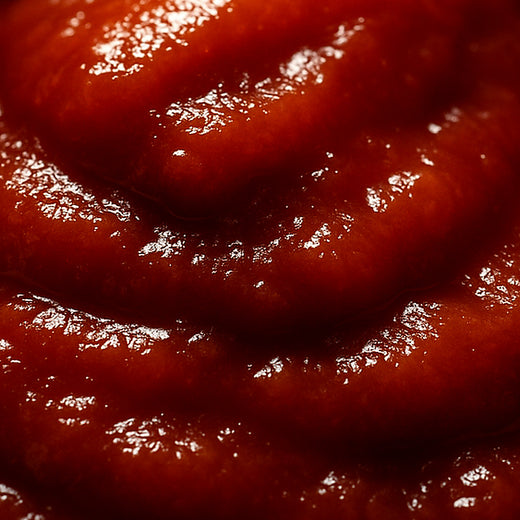
Tomato sauce is a sauce made from tomatoes. In some countries it is served as part of a dish; in others, it is a condiment.
- Olfactive family
- Aromatic · 510 entries of the glossary in this family Subfamily: Herbal aromatics · 230 entries in this subfamily
- Material
- Fantasy/Concept N/A — olfactory concept evoking cooked tomato.
- Pyramid
- Heart · Volatility: Heart Note
- Strength
- Medium Step 3 of 5 · shared by 1,473 of 2,156 graded entries Graded entries at each step, from 1 to 5: 4, 119, 1,473, 498, 39. 23 more sit between two steps.
- Producing countries
- N/A — gourmand accord
- Also called
- sauce tomate
Family, subfamily and cluster: PREMIEREPEAU house classification, version 2026‑11.
Tomato Sauce · Facets
Entries of the glossary that carry each facet, of 3,979:
- sweet 1,988
- herbal 757
- warm 1,108
- fresh 1,387
Editorial note We own no rights to this material, its name or its trademark. This entry is independent editorial journalism, published under freedom of expression.
Tomato Sauce · Scent
The fatty acid-derived volatiles of tomato have green or grassy aromas. cis-3-Hexenal has an intense odor of freshly cut grass and leaves. The odor of pure 2-isobutylthiazole is rather unpleasant; added to tomato soup at 10–20 ppb, 2-isobutylthiazole gives an aroma like fresh tomatoes.
Evolution over time
Tomato Sauce: scent over time.
- Immediately
Green and grassy, like freshly cut grass and leaves.
Scent words: green
- Tenacity
- 200 hours
Tomato Sauce · In Perfumery
2-Alkylthiazoles such as 2-isobutylthiazole are effective flavor enhancers of tomato products at very low concentrations. In spaghetti sauce at approximately 13 ppb, 2-isobutylthiazole reduces tartness.
Pyramid
Tomato Sauce: Heart. Entries of the glossary stored at each place of the pyramid, of 4,006 (42 store no place):
- Top 718
- Top · Heart 497
- Heart 1,641
- Heart · Base 514
- Base 594
Role in the formula
Tomato Sauce: roles in the formula. Entries of the glossary that share each role, of 4,006:
- Signature note 897
- Volume builder 780
- Freshness 720
Tomato Sauce · Extraction & Chemistry
Tomatoes have soft flesh that breaks down easily and the right composition to thicken into a sauce when stewed, without the need for thickeners such as roux or masa. Basic Mexican tomato sauce was traditionally prepared using a molcajete to puree the tomatoes.
- Appearance
- Colorless to pale yellow clear liquid
Tomato Sauce · Did You Know?
The Provençals who went to Paris for the National Federation Day of July 14, 1790, demanded tomatoes everywhere they went.
Tomato Sauce · In Depth
Tomato sauce typically has a thinner consistency than tomato paste and tomato purée. Tomato sauce is perhaps best known as a base for Italian pasta or pizza dishes, or in Mexican salsas. Many pasta sauces in Italy are based on raw, uncooked tomatoes. In France, sauce vierge is made from raw tomato, basil, lemon juice and olive oil.
Origin and History
The tomato originated in western South America and may have been domesticated there, in Mexico or in Central America. The Spanish introduced tomatoes to Eurasia in the Columbian exchange in the 16th century. Tomato sauces are presumed to have been in use since antiquity by the peoples of Central and South America as bases for many dishes.
Bernardino de Sahagún, a Franciscan friar from the Kingdom of Spain, is believed to be the first European to write about tomato sauce after encountering it for sale in the markets of Tenochtitlan. The first Italian recipe of tomato sauce was published as “Spanish tomato sauce” in Lo Scalco alla Moderna, written by the Italian chef Antonio Latini. The use of tomato sauce with pasta appeared for the first time in 1790 in the Italian cookbook L’Apicio moderno, by the Roman chef Francesco Leonardi.
Varieties
Sauce tomate is one of the five mother sauces of classical French cooking, as codified by Auguste Escoffier in the early 20th century. Tomato ketchup is made from tomatoes, sugar and vinegar, with seasonings and spices. In Australia, New Zealand and South Africa, tomato sauce is a popular, commercially produced table sauce, similar to tomato ketchup.
Chemistry of Tomato Aroma
cis-3-Hexenal is one of the major volatile compounds in ripe tomatoes. In ripe tomato fruit, fatty acid-derived volatiles account for more than half of the total volatiles, and C6 volatiles predominate. In tomato, 2-isobutylthiazole is among the most important branched chain volatiles. 2-Isobutylthiazole is largely responsible for the unique flavor of certain varieties of tomatoes.
The apocarotenoid volatiles are generally described as having fruity/floral aroma notes. Geranylacetone and β-ionone are among the most common apocarotenoids in tomato fruit. Many tomato flavor volatiles increase with ripening, with low levels in green fruit and high levels in ripe fruit.
Taste
The tomato has a strong savory umami flavor. Ripe tomatoes are an example of foods rich in umami components.
Explore all seven extraits in the Discovery Set.
Tomato Sauce · Technical Sheet
Identity
- Botanical
- Solanum lycopersicum (tomato)
- Taxonomy
- Solanales order › Solanaceae family › Solanum genus · GBIF
- Botanical records
- Solanum lycopersicum: POWO, Solanum lycopersicum · IPNI, Solanum lycopersicum · GBIF, Solanum lycopersicum · Wikidata, Solanum lycopersicum · Wikipedia, Solanum lycopersicum
- IPNI
- Solanum lycopersicum L., Sp. Pl. 1: 185 (1753) — Carl Linnaeus (1707–1778)
- Type
- Accord
- Category
- Accords and curiosities
- Note
- Tomato sauce is a gourmand-green note. Key tomato volatiles: (Z)-3-hexenal, beta-ionone, 2-isobutylthiazole, 6-methyl-5-hepten-2-one. The green stem note uses tomato leaf accord.
In Nature
- Growth form
- Shrub · Climber · POWO
- Native range
- Western South America · POWO
- Introduced to
- 149 regions · Northern America 46 · Africa 25 · Pacific 20 · Tropical Asia 16 · Southern America 15 · Temperate Asia 13 · Europe 12 · Australasia 2
- Flowering
- peak in July–October · north of the equator · iNaturalist
- Recorded altitude
- 0–1,000 m · median 350 m · 7,920 records with an altitude · GBIF
- Wild or cultivated
- 316 native · 5,217 introduced · 22,230 cultivated among 130,983 records (the rest carry no such mark) · GBIF
- Recorded in
- 198 of 512 squares of the world grid; a brighter dot holds more records · GBIF
- Also from this genus
- Solanum: Tomato · Tomato Leaf
- Also from this botanical family
- Solanaceae: Belladonna · Blonde Tobacco · Carolina Reaper · Cuban Cigar · Ghost Pepper · Goldenberry · 13 more entries
In Print
- Timeline
- first described 1753 · earliest aroma paper in Europe PMC, 2007
- In English books
- most mentioned in the 2010s · Google Books Ngram
Classification
- Cluster
- Herbal aromatics · 79 entries in this cluster
Chemical data
- Formula
- Complex natural mixture (key constituents: (Z)-3-hexenal C₆H₁₀O; 2-isobutylthiazole C₇H₁₁NS)
- Most reported compounds
- Prolycopene (10 papers; one: J Chromatogr A 2001, Prolycopene) · Quercetin (8 papers; one: J Sci Food Agric 2004, Quercetin) · Kaempferol (7 papers; one: J Sci Food Agric 2004, Kaempferol) · Myricetin (6 papers; one: J Sci Food Agric 2004, Myricetin) · LOTUS
- Structure
- (Z)-3-Hexenal, 2-Isobutylthiazole:
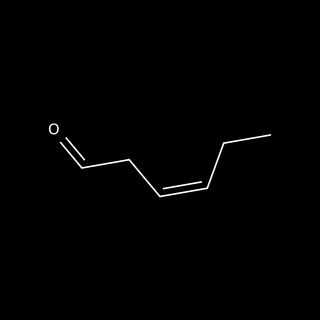
(Z)-3-Hexenal
PubChem, (Z)-3-Hexenal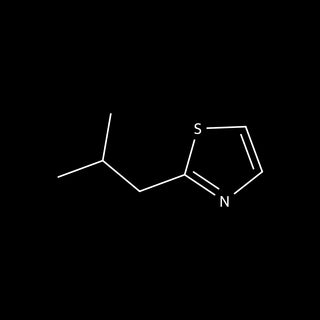
2-Isobutylthiazole
PubChem, 2-Isobutylthiazole - INCI names (CosIng)
- SOLANUM LYCOPERSICUM FRUIT OIL (SKIN CONDITIONING)SOLANUM LYCOPERSICUM SEED OIL (SKIN CONDITIONING – EMOLLIENT, SKIN CONDITIONING)SOLANUM LYCOPERSICUM CALLUS CULTURE EXTRACT (NOT REPORTED)SOLANUM LYCOPERSICUM CALYX EXTRACT (SKIN CONDITIONING)SOLANUM LYCOPERSICUM FLOWER EXTRACT (SKIN CONDITIONING – MISCELLANEOUS)SOLANUM LYCOPERSICUM FRUIT EXTRACT (ANTIOXIDANT)SOLANUM LYCOPERSICUM LEAF CELL CULTURE EXTRACT (SKIN CONDITIONING)SOLANUM LYCOPERSICUM LEAF CELL EXTRACT (ANTIOXIDANT, SKIN PROTECTING)
- Composition
- Key odorant: (Z)-3-hexenal (C₆H₁₀O), 2-isobutylthiazole (C₇H₁₁NS)
Labelling
- EU allergens reported
- Limonene · Linalool · Geraniol · Citronellol · Citral · Eugenol · Farnesol · Benzyl Alcohol · Pinene · Terpineol · Alpha-Terpinene · Beta-Caryophyllene · Camphor · Carvone · Benzaldehyde · Methyl Salicylate · Vanillin · Rose Ketones
Performance and rules
- Available as
- fragrance accord
- IFRA status
- No IFRA Standard for the material itself (51st Amendment)
Tomato Sauce · See Also
Entries related to Tomato Sauce, by their place in the pyramid. “shared” marks a scent word Tomato Sauce has too.
Top notes

Rosemary
aromatic · herbal (shared) · camphorous Aromatic / Top · Heart / Same subfamily / Natural
Black Pepper
spicy · warm (shared) · aromatic Aromatic / Natural


Heart notes

Immortelle
aromatic · honey · herbal (shared) Aromatic / Same cluster / Natural
Tea
green (shared) · aromatic · dry Aromatic / Heart · Base / Same cluster / Natural
Holy Water
fresh (shared) · floral · green (shared) Aromatic / Same cluster / Fantasy/Concept
Sage
aromatic · herbal (shared) · amber Aromatic / Same subfamily / Natural


Tomato Sauce · Sources
Read the science
- Front Plant Sci (2021) Ethylene and Auxin: Hormonal Regulation of Volatile Compound Production During Tomato (Solanum lycopersicum L.) Fruit Ripening
- Cells (2023) Toward the Analysis of Volatile Organic Compounds from Tomato Plants (Solanum lycopersicum L.) Treated with Trichoderma virens or/and Botrytis cinerea
- Food Chem (2025) Changes in volatile flavors during the fermentation of tomato (Solanum lycopersicum L.) juice and its storage stabilization
- International Plant Names Index (IPNI) Solanum lycopersicum L.
- Frontiers in Plant Science (2023) The dissection of tomato flavor: biochemistry, genetics, and omics
- PubChem 2-Isobutylthiazole
- PubChem (Z)-3-Hexenal
- IFRA Standards, 51st Amendment
- Google Patents Patent US3660112
- Wikipedia Tomato sauce
- Wikipedia Tomato
- Wikipedia Hexenal
- Wikipedia Ketchup
- Wikipedia Umami
Cite as PREMIEREPEAU Glossary, “Tomato Sauce”, https://premierepeau.com/
