


White Lace Flower
Keywords: floral · fresh · powdery
White lace flower is Orlaya grandiflora, a species of flowering plant in the family Apiaceae, native to Mediterranean Europe. It is widely cultivated as an ornamental.
- Olfactive family
- Florals · 779 entries of the glossary in this family Subfamily: White florals · 95 entries in this subfamily Cluster: Green-fresh florals · 135 entries in this cluster
- Material
- Fantasy/Concept Aerial parts of Orlaya grandiflora
- Pyramid
- Heart · Volatility: Heart Note
- Strength
- N/A — no measured strength for a fantasy accord Not on the graded scale
- Producing countries
- Mediterranean
- Also called
- Caucalis daucoides
Family, subfamily and cluster: PREMIEREPEAU house classification, version 2026‑11.
White Lace Flower · Facets
Entries of the glossary that carry each facet, of 3,979:
- floral 1,546
- green 1,442
- warm 1,108
- fresh 1,387
Editorial note We own no rights to this material, its name or its trademark. This entry is independent editorial journalism, published under freedom of expression.
White Lace Flower · Scent
Plants of the family Apiaceae, to which white lace flower belongs, are characterised by an aromatic smell due to the presence of essential oil or oleoresin. Their leaves commonly emit a marked smell when crushed, aromatic to fetid, though this is absent in some species.
White Lace Flower · In Perfumery
Other members of the Apiaceae family are used in these trades: many produce essential oils in their leaves or fruits and serve as aromatic herbs, and carrot seed is among the seeds commonly used in perfumery.
Pyramid
White Lace Flower: Heart. Entries of the glossary stored at each place of the pyramid, of 4,006 (42 store no place):
- Top 718
- Top · Heart 497
- Heart 1,641
- Heart · Base 514
- Base 594
Role in the formula
White Lace Flower: roles in the formula. Entries of the glossary that share each role, of 4,006:
- N/A — no documented formula role 361
White Lace Flower · Extraction & Chemistry
Essential oil is obtained by hydrodistillation of the aerial parts. The yield was 0.07% (v/w) for a sample from Serbia and 0.09% (v/w) for a sample from Montenegro.
Available as
White Lace Flower: available as.
- synthetic accord
- fantasy note
- Appearance
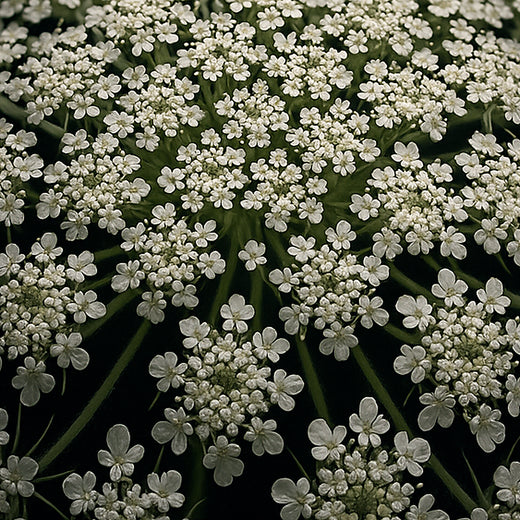
- White flowers in flattish umbels
White Lace Flower · Did You Know?
The uneven size of the individual florets gives the plant the appearance of lace, especially when planted in large swathes. The compound β-elemene makes up 22.7% of the oil from Montenegrin plants but only 1.1% of the oil from plants collected in Serbia.
White Lace Flower · In Depth
Botany
White lace flower (Orlaya grandiflora) is a plant of the Apiaceae (carrot/parsley) family. Apiaceae is a family of mostly aromatic flowering plants, also called Umbelliferae. It grows in southern, central and western Europe, in the Caucasus region and in central and southwestern Asia, in a dry and warm habitat.
It is a branching annual with jaggedly divided leaves and white flowers in flattish umbels, the inner flowers small and the outermost with enlarged rays, giving a lacy effect. Growing to 90 cm, it bears flattish panicles of pure white flowers over a long period in summer. The flowers are attractive to insects.
Cultivation
It is grown in a sunny open position in well-drained or poor soil. It is a recipient of the Royal Horticultural Society’s Award of Garden Merit. It is propagated by seed in spring for summer and autumn flowering, or sown in autumn for early-flowering large plants. It is suggested for cut flowers, cottage and informal gardens, and wildflower meadows.
Essential oil
The essential oil of the aerial parts was analysed in two samples, one collected in Serbia and one in Montenegro. The oils were analysed using GC-MS and GC-FID methods. In both samples the main class of volatiles was sesquiterpenes, at 47.5% in the Serbian sample and 70.1% in the Montenegrin one.
The main constituents of the Serbian oil were germacrene D (29.5%), sabinene (11.5%) and terpinen-4-ol (9.6%). In the Montenegrin oil the most abundant compounds were β-elemene (22.7%), germacrene D (14.3%) and germacrene A (12.5%). An earlier report gave sabinene (25.4%) and α-pinene (9.6%) as major compounds of the oil. Climate conditions, and also type of soil, have a big influence on the biosynthesis of individual terpenes.
Other uses
Ethnobotanical studies indicate a laxative effect of the aboveground part of the plant prepared in the form of a decoction. Research indicates that an extract of the plant has an insecticidal and inhibitory effect on the growth of Spodoptera littoralis larvae.
Explore all seven extraits in the Discovery Set.
Related: Carrot Seeds
White Lace Flower · History
The namesake of the genus Orlaya is Johann Orlay, a Hungarian-Russian surgeon who lived from 1770 to 1829. The German botanist Georg Franz Hoffmann dedicated the name Orlaya to Johann Orlay in 1814. Species of the Apiaceae family have been used by humans from ancient times for food and for medicinal purposes.
White Lace Flower · Technical Sheet
Identity
- Botanical
- Orlaya grandiflora
- Taxonomy
- Apiales order › Apiaceae family › Orlaya genus · GBIF
- Botanical records
- Orlaya grandiflora: POWO, Orlaya grandiflora · IPNI, Orlaya grandiflora · GBIF, Orlaya grandiflora · Wikidata, Orlaya grandiflora · Wikipedia, Orlaya grandiflora
- IPNI
- Orlaya grandiflora (L.) Hoffm., Gen. Pl. Umbell. 58 (1814) — Georg Franz Hoffmann (1760–1826) · ≡ Caucalis grandiflora L. (1753)
- Type
- Accord
- Category
- Flowers
- Note
- No commercial essential oil. Fragrance recreated synthetically in perfumery. Delicate, sweet, honeyed floral character
In Nature
- Growth form
- Herb · POWO
- Native range
- Middle Europe · Southwestern Europe · Southeastern Europe · Eastern Europe · Caucasus · Western Asia · POWO
- Introduced to
- 3 regions · Europe 1 · Africa 1 · Temperate Asia 1
- Flowering
- peak in May–June · north of the equator · iNaturalist
- Recorded altitude
- 50–700 m · median 250 m · 7,213 records with an altitude · GBIF
- Wild or cultivated
- 1,262 native · 121 introduced · 39 cultivated among 22,810 records (the rest carry no such mark) · GBIF
- Recorded in
- 23 of 512 squares of the world grid; a brighter dot holds more records · GBIF
- Also from this botanical family
- Apiaceae: Angelica · Angelica Root · Angelica Root Oil · Anise · Asafoetida · Caraway · 22 more entries
In Print
- Timeline
- first described 1753 · earliest aroma paper in Europe PMC, 2022
- In English books
- most mentioned in the 2010s · Google Books Ngram
Classification
- Chemical class
- Sesquiterpenes and monoterpenes (essential oil)
Chemical data
- Formula
- Complex natural mixture (key constituents: germacrene D; sabinene; terpinen-4-ol; β-elemene)
- GC-MS study
- Molecules 2022, Chemical Composition, Antitumor Potential, and Impact on Redox Homeostasis of the Essential Oils of Orlaya grandiflora from Two Climate Localities
- Structure
- Sabinene, Terpinen-4-ol:
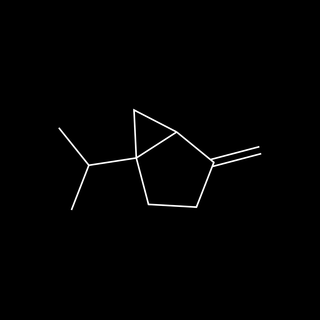
Sabinene
PubChem, Sabinene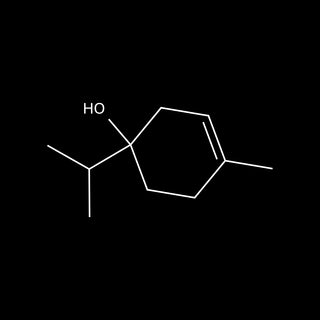
Terpinen-4-ol
PubChem, Terpinen-4-ol
Performance and rules
- Tenacity
- N/A — no measured tenacity for a fantasy accord
- IFRA status
- No IFRA Standard for the material itself (51st Amendment)
White Lace Flower · See Also
Entries related to White Lace Flower, by their place in the pyramid. “shared” marks a scent word White Lace Flower has too.
Heart notes

Bougainvillea
floral (shared) · fresh (shared) · warm (shared) Florals / Same cluster / Fantasy/Concept
Jasmine
floral (shared) Florals / Same subfamily / Natural
Orange Blossom
floral (shared) · honeyed · citrus Florals / Same subfamily / Natural
Portlandia
floral (shared) · vanilla · creamy Florals / Same subfamily / Natural
Violet
floral (shared) · violet Florals / Natural & Synthetic
Wild Carrot
earthy · woody · powdery (shared) Earthy / Natural


Base notes

Iris
powdery (shared) · earthy · violet Florals / Natural

Other entries · Place in the pyramid not stored

Carnation
floral (shared) · spicy · clove Florals / Natural

White Lace Flower · Sources
Read the science
- Molecules (2022) Chemical Composition, Antitumor Potential, and Impact on Redox Homeostasis of the Essential Oils of Orlaya grandiflora from Two Climate Localities
- GBIF Orlaya grandiflora
- International Plant Names Index (IPNI) Orlaya grandiflora (L.) Hoffm.
- Molecules (2022) Chemical Composition, Antitumor Potential, and Impact on Redox Homeostasis of the Essential Oils of Orlaya grandiflora from Two Climate Localities
- IFRA Standards, 51st Amendment
- Royal Horticultural Society Orlaya grandiflora
- Wikipedia Orlaya grandiflora
- Wikipedia Orlaya
- Wikipedia Apiaceae
- Wikipedia Perfume
Cite as PREMIEREPEAU Glossary, “White Lace Flower”, https://premierepeau.com/
