


White Tobacco
Keywords: hay · tobacco · sweet
White Tobacco: Tobacco leaf absolute has an odour of the hay type, sweet and tobacco-like.
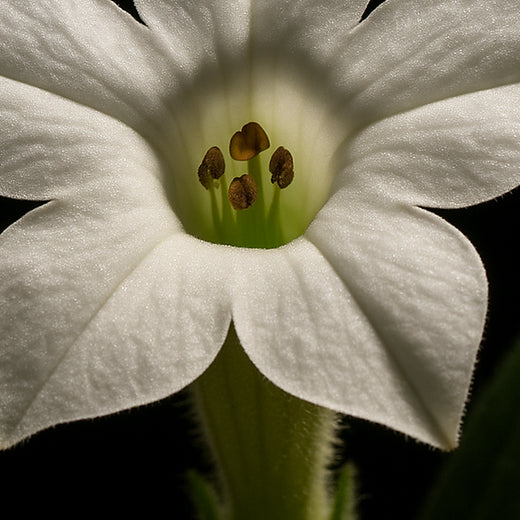
- Olfactive family
- Earthy · 87 entries of the glossary in this family Subfamily: Earthy woods · 68 entries in this subfamily
- Material
- Natural Tobacco leaves
- Pyramid
- Base · Volatility: Base Note
- Strength
- Medium Step 3 of 5 · shared by 1,473 of 2,156 graded entries Graded entries at each step, from 1 to 5: 4, 119, 1,473, 498, 39. 23 more sit between two steps.
- Also called
- Tobacco leaf absolute, Nicotiana tabacum leaf absolute
Family, subfamily and cluster: PREMIEREPEAU house classification, version 2026‑11.
White Tobacco · Facets
Entries of the glossary that carry each facet, of 3,979:
- floral 1,546
- earthy 660
- sweet 1,988
- warm 1,108
- fresh 1,387
- hay 38
- tobacco 67
- leafy 82
- herbal 757
White Tobacco · Scent
Its odour is described as brown, tobacco, sweet hay-like, leafy and herbal, with a dried fruit nuance. Other odour descriptions add moss, old wood, tea and honey. Further descriptions give warm tobacco with sweet, hay-like, mossy and woody tones. A burley absolute is described as warm, masculine and rich, with a faint caramel and tonka bean sweetness, drying out earthy. In its concentrated form the material has been described as a strong, almost repulsive odour faintly reminiscent of cigar tobacco, which in dilution becomes a typical cigar-tobacco fragrance.
Evolution over time
White Tobacco: scent over time.
- Immediately
Leafy and herbal, with a dried fruit nuance.
Scent words: herbal · fruity - After a few hours
Sweet hay and tobacco, with honey.
Scent words: sweet · honeyed - After a few days
Moss and old wood.
Scent words: woody
White Tobacco · In Perfumery
Tobacco concrete and absolute are used in fine perfumery for “tabac”, “dry” or “masculine” scented perfumes. Tobacco absolute obtained by supercritical CO2 extraction is offered for perfumery and as a tobacco flavor enhancer. Tobacco resinoid is used for casing or top flavoring of tobacco blends for cigarettes and other tobacco products.
Pyramid
White Tobacco: Base. Entries of the glossary stored at each place of the pyramid, of 4,006 (42 store no place):
- Top 718
- Top · Heart 497
- Heart 1,641
- Heart · Base 514
- Base 594
Role in the formula
White Tobacco: roles in the formula. Entries of the glossary that share each role, of 4,006:
- Diffusion enhancer 248
- Modifier 1,167
- Signature note 897
- Blender 1,040
- Volume builder 780
- Freshness 720
White Tobacco · Terroir & Origins
- Producing countries
- Bulgaria
White Tobacco · Extraction & Chemistry
Tobacco concrete and absolute are obtained from cured and aged tobacco leaves by extraction with polar or non-polar organic solvents. Tobacco absolute is also obtained by supercritical CO2 extraction.
Available as
White Tobacco: available as.
- essential oil
- absolute
- Appearance
- Red brown viscous liquid to paste
White Tobacco · Did You Know?
Around 1839 an enslaved man named Stephen accidentally produced the first true bright leaf tobacco. He used charcoal to restart a fire used to cure the crop, and the surge of heat turned the leaves yellow. In India, so-called “white” snuff is made by sun-curing varieties of burley and milling the leaf very finely into a dry, unusually potent powder.
White Tobacco · In Depth
Curing methods
Burley tobacco is a light, air-cured tobacco used primarily for cigarette production. Air-cured tobacco is hung in well-ventilated barns and allowed to dry over a period of four to eight weeks. Air-cured tobacco is low in sugar, which gives the tobacco smoke a light, sweet flavour.
Virginia tobacco that has been flue-cured is also called bright tobacco, because flue curing turns its leaves gold, orange, or yellow. Fire curing gives the leaves a distinctive smoky aroma and flavor.
Aroma, nicotine and sun-cured tobacco
Curing and subsequent aging allow for the slow oxidation and degradation of carotenoids in the tobacco leaf. This produces various compounds in the tobacco leaves that give cured tobacco its sweet aroma. Megastigmatrienone is the key flavor compound in tobacco. Solanone is an unsaturated ketone that is naturally present in tobacco leaves.
The carotenoid-derived compounds are not major constituents of tobacco essential oil, but their olfactory contribution is decisive for the development of tobacco fragrance. β-Damascenone is described as a powerful fruity-floral odor complex, with apple, plum, rose, raisin, tea, blackcurrant, and tobacco notes. Tobacco leaves contain 2 to 8% nicotine, combined as malate or citrate.
Oriental sun-cured tobacco is low in both sugar and nicotine but fragrant, herbal and spicy.
Explore all seven extraits in the Discovery Set.
White Tobacco · History
Nicotiana tabacum is a native of tropical and subtropical America. In 1586 the botanist Jaques Dalechamps gave the plant the name of Herba nicotiana. The origin of white burley tobacco was credited to George Webb and Joseph Fore in 1864. The seed yielded a different type of light leaf, shaded from white to yellow, that cured differently. In Bulgaria, tobacco concrete, resinoid and absolute have been obtained from high quality fermented Oriental tobacco since the late 1960s.
White Tobacco · Technical Sheet
Identity
- Botanical
- Nicotiana tabacum L.
- Taxonomy
- Solanales order › Solanaceae family › Nicotiana genus · GBIF
- Botanical records
- Nicotiana tabacum: POWO, Nicotiana tabacum · IPNI, Nicotiana tabacum · GBIF, Nicotiana tabacum · Wikidata, Nicotiana tabacum · Wikipedia, Nicotiana tabacum
- IPNI
- Nicotiana tabacum L., Sp. Pl. 1: 180 (1753) — Carl Linnaeus (1707–1778)
- Type
- Ingredient
- Category
- Accords and curiosities
- Note
- White tobacco refers to the lighter, air-cured varieties (Virginia/Burley). The absolute is obtained by solvent extraction of cured leaves.
In Nature
- Growth form
- Herb · POWO
- Native range
- Western South America · POWO
- Introduced to
- 179 regions · Africa 54 · Southern America 30 · Europe 25 · Tropical Asia 21 · Pacific 18 · Northern America 16 · Temperate Asia 13 · Australasia 2
- Flowering
- peak in August–June · north of the equator · iNaturalist
- Recorded altitude
- 0–1,650 m · median 250 m · 4,804 records with an altitude · GBIF
- Wild or cultivated
- 21 native · 470 introduced · 1,565 cultivated among 29,905 records (the rest carry no such mark) · GBIF
- Recorded in
- 152 of 512 squares of the world grid; a brighter dot holds more records · GBIF
- Also from this genus
- Nicotiana: Blonde Tobacco · Cuban Cigar · Naswar · Tobacco · Tobacco Absolute · Tobacco Blossom
- Also from this botanical family
- Solanaceae: Belladonna · Carolina Reaper · Ghost Pepper · Goldenberry · Green Chilli · Ground Cherry · 9 more entries
In Print
- Timeline
- first described 1753 · earliest aroma paper in Europe PMC, 1975
- In English books
- most mentioned in the 1980s · Google Books Ngram
Classification
- Cluster
- Earthy woods · 237 entries in this cluster
- Chemical class
- Plant absolute, a solvent extract of cured tobacco leaves
Chemical data
- Formula
- N/A — complex natural mixture
- Most reported compounds
- (+)-Capsidiol (9 papers; one: Phytochemistry 1979, (+)-Capsidiol) · Phytuberol (9 papers; one: Phytochemistry 1979, Phytuberol) · Nicotine (7 papers; one: Journal of Ethnopharmacology 1988, Nicotine) · LOTUS
- CAS
- 8037-19-2
- INCI names (CosIng)
- NICOTIANA TABACUM FLOWER OIL (PERFUMING)NICOTIANA TABACUM LEAF OIL (PERFUMING)NICOTIANA TABACUM CALLUS LYSATE EXTRACT (ANTIOXIDANT)NICOTIANA TABACUM FLOWER EXTRACT (PERFUMING)NICOTIANA TABACUM LEAF EXTRACT (SKIN CONDITIONING, PERFUMING)NICOTIANA TABACUM CALLUS EXTRACELLULAR VESICLES (HAIR CONDITIONING, SKIN PROTECTING, SKIN CONDITIONING – MISCELLANEOUS)
- Compound classes reported
- Monoterpenoids 3 % · Sesquiterpenoids 13 % · Nicotinic acid alkaloids 10 % · of 249 compounds reported, 8 % of them esters · LOTUS
Labelling
- EU allergens reported
- Limonene · Linalool · Geraniol · Eugenol · Isoeugenol · Farnesol · Benzyl Alcohol · Cinnamal · Pinene · Terpineol · Beta-Caryophyllene · Benzaldehyde · Vanillin · Santalol · Sclareol · Rose Ketones
Physical properties
- Flash point
- > 212.00 °F. TCC (> 100.00 °C.)
- Specific gravity
- 0.92000 to 0.94000 at 20.00 °C
- Refractive index
- 1.46100 to 1.46600 at 20.00 °C
Performance and rules
- Odour words (The Good Scents Company)
- sweet · hay · tobacco · moss · leafy · herbal · old wood · dried fruit (data sheet)
- IFRA status
- No IFRA Standard for the material itself (51st Amendment)
White Tobacco · See Also
Entries related to White Tobacco, by their place in the pyramid. “shared” marks a scent word White Tobacco has too.
Heart notes

Tuberose
floral (shared) · narcotic · creamy Florals / Natural
Orange Blossom
floral (shared) · honeyed · citrus Florals / Natural
Rose
floral (shared) · honeyed · waxy Florals / Natural
Jasmine
floral (shared) Florals / Natural
Tobacco Blossom
floral (shared) · sweet (shared) · warm (shared) Florals / Natural
Hay Absolute
green · sweet (shared) · herbal (shared) Aromatic / Heart · Base / Natural


Base notes


Other entries · Place in the pyramid not stored

Carnation
floral (shared) · spicy · clove Florals / Natural

White Tobacco · Sources
Read the science
- Molecules (2019) Carotenoid-Related Volatile Compounds of Tobacco (Nicotiana tabacum L.) Essential Oils
- International Plant Names Index (IPNI) Nicotiana tabacum L.
- Molecules (2019) Carotenoid-Related Volatile Compounds of Tobacco (Nicotiana tabacum L.) Essential Oils
- IFRA Standards, 51st Amendment
- The Good Scents Company Tobacco leaf absolute
- Wikipedia Common tobacco
- Wikipedia Tobacco curing
- Wikipedia Burley tobacco
- Wikipedia Virginia tobacco
- Wikipedia Solanone
Cite as PREMIEREPEAU Glossary, “White Tobacco”, https://premierepeau.com/
