


Yunnan Osmanthus
Keywords: floral · fruity · sweet
Yunnan Osmanthus: Osmanthus fragrans is an evergreen shrub or small tree of the family Oleaceae. Its smell is fruity and floral, with delicate apricot notes on a leathery base.

- Olfactive family
- Florals · 779 entries of the glossary in this family Subfamily: Fruity florals · 13 entries in this subfamily Cluster: Classic florals · 245 entries in this cluster
- Material
- Natural Flowers
- Pyramid
- Heart · Volatility: Heart Note
- Strength
- Medium Step 3 of 5 · shared by 1,473 of 2,156 graded entries Graded entries at each step, from 1 to 5: 4, 119, 1,473, 498, 39. 23 more sit between two steps.
- Also called
- osmanthus flower absolute, osmanthus flower extract
Family, subfamily and cluster: PREMIEREPEAU house classification, version 2026‑11.
Yunnan Osmanthus · Facets
Entries of the glossary that carry each facet, of 3,979:
- floral 1,546
- green 1,442
- sweet 1,988
- fruity 1,301
- warm 1,108
- fresh 1,387
- creamy 401
- honeyed 76
- leathery 43
- animalic 84
Yunnan Osmanthus · Scent
The odour is fruity, floral, animal-like and leathery. The flowers carry the scent of ripe peaches or apricots; it is reminiscent of dried apricot and white flowers with a leathery undertone. At 1.0% it is described as sweet, woody, herbal and floral, with aromatic fruity berry notes and citrus, juniper and gin-like nuances.
Evolution over time
Yunnan Osmanthus: scent over time.
- Immediately
Fruity and floral, with delicate apricot notes
Scent words: floral · fruity - After a few hours
Soft, creamy, lactonic and sweet floral facets
Scent words: floral · sweet · creamy - After a few days
Warm leather and animal-like facets
Scent words: warm · leather · animalic
Yunnan Osmanthus · In Perfumery
Osmanthus absolute is used in the heart of floral accords to add a sensual note. It gives a fruity and floral note to reconstitutions of yellow fruits, tobacco or syrupy accords. Its smoky and leathery facet can complement certain leathery accords. In fine perfumery and personal care products, it enhances fruity top notes and lends roundness to a composition. It combines well with woody, spicy, floral and tobacco accords. In feminine compositions it brings an exotic floral facet together with apricot fruity notes. The ingredient suits both perfumery and flavor applications.
Pyramid
Yunnan Osmanthus: Heart. Entries of the glossary stored at each place of the pyramid, of 4,006 (42 store no place):
- Top 718
- Top · Heart 497
- Heart 1,641
- Heart · Base 514
- Base 594
Role in the formula
Yunnan Osmanthus: roles in the formula. Entries of the glossary that share each role, of 4,006:
- Diffusion enhancer 248
- Modifier 1,167
- Signature note 897
- Blender 1,040
- Volume builder 780
- Freshness 720
Yunnan Osmanthus · Terroir & Origins
- Producing countries
- China
Yunnan Osmanthus
Yunnan Province — China
Facet scores, out of 100
- Floral 92 (also a facet of the entry)
- Fruity 85 (also a facet of the entry)
- Sweet 80 (also a facet of the entry)
- Honeyed 70 (also a facet of the entry)
- Creamy 65 (also a facet of the entry)
- Green 45 (also a facet of the entry)
Osmanthus fragrans is native to China, among several other countries.
The plant has been cultivated in China for over 2,500 years.
- Species
- Osmanthus fragrans
Yunnan Osmanthus · Extraction & Chemistry
The flowers are harvested by hand, by beating the branches with long sticks so that they fall onto a large sheet on the ground. Fresh flowers wither very quickly, so they are preserved in brine for a few weeks to develop the olfactory precursors. Fermentation in brine develops phenolic notes that give the animal and warm leather facet. The flowers are washed with water to remove salts and impurities before being extracted with a volatile solvent into concrete. Storage of the concrete is the final stage of the aging process, during which the tea notes are developed. To remove the waxes and concentrate the olfactory components, the concrete is washed with ethanol to obtain the absolute. Extraction with petroleum ether also gives a concrete, from which the absolute is prepared by alcohol extraction.
Available as
Yunnan Osmanthus: available as.
- essential oil
- absolute
- concrete
- Appearance
- Colorless to pale yellow liquid
Yunnan Osmanthus · Did You Know?
About 930 kg of fresh flowers, roughly 21 million blossoms, are needed to make 1 kg of osmanthus absolute.
Yunnan Osmanthus · In Depth
The plant
Osmanthus fragrans is an evergreen shrub or small tree of the family Oleaceae. In China it grows in the provinces of Guizhou, Sichuan, Hainan and Yunnan. Its flowers are small and white, pale yellow, yellow or orange-yellow, with a strong fragrance, and they are produced in small clusters in late summer and autumn. Osmanthus has been cultivated in China for more than 2,500 years and was often planted in the imperial gardens of the Forbidden City in Beijing.
Composition
The floral scent of O. fragrans cultivars includes α-ionone, β-ionone, linalool, cis- and trans-linalool oxide and γ-decalactone. The absolute contains lactones. It also contains, as a share of its volatiles, linolenic acid at 17.4%, linoleic acid at 8.7% and palmitic acid at 8.6%. Its volatiles also include β-ionone, dihydro-β-ionone at 6.4% and (+)-decan-4-olide at 4.0%.
Culinary use
In Chinese cuisine, the flowers may be infused with green or black tea leaves to make osmanthus tea. The flowers are also used for osmanthus jam, cakes, dumplings, soups and liquor. Osmanthus wine is made by infusing whole flowers in huangjiu or other rice wine and is traditionally drunk during the Mid-Autumn Festival. Sweet osmanthus and osmanthus tea are particularly associated with the city of Guilin, whose name translates to Forest of Sweet Osmanthus.
Explore all seven extraits in the Discovery Set.
Related: Ionones · Apricot Blossom · Beta-Damascone
Yunnan Osmanthus · Technical Sheet
Identity
- Botanical
- Osmanthus fragrans
- Taxonomy
- Lamiales order › Oleaceae family › Osmanthus genus · GBIF
- Botanical records
- Osmanthus fragrans: POWO, Osmanthus fragrans · IPNI, Osmanthus fragrans · GBIF, Osmanthus fragrans · Wikidata, Osmanthus fragrans · Wikipedia, Osmanthus fragrans · IUCN Least concern (LC), Osmanthus fragrans
- IPNI
- Osmanthus fragrans Lour., Fl. Cochinch. 1: 29 (1790) — João de Loureiro (1717–1791)
- Type
- Ingredient
- Category
- Flowers
- Note
- Absolute obtained by solvent extraction of Osmanthus fragrans flowers from Yunnan province
In Nature
- Native range
- China · Eastern Asia · Indian Subcontinent · Indo-China · POWO
- Introduced to
- 2 regions · Temperate Asia 1 · Pacific 1
- Flowering
- peak in October · north of the equator · iNaturalist
- Recorded altitude
- 0–900 m · median 150 m · 328 records with an altitude · GBIF
- Wild or cultivated
- 1 native · 1 introduced · 15 cultivated among 3,652 records (the rest carry no such mark) · GBIF
- Recorded in
- 41 of 512 squares of the world grid; a brighter dot holds more records · GBIF
- Also from this genus
- Osmanthus: Osmanthus · Osmanthus Absolute
- Also from this botanical family
- Oleaceae: Black Olive · Jasmine · Lilac · Melati · Olive · Olive flower · 2 more entries
In Print
- Timeline
- first described 1790 · earliest aroma paper in Europe PMC, 2009
- In English books
- most mentioned in the 1950s · Google Books Ngram
Classification
- Chemical class
- Natural absolute
Chemical data
- Formula
- Complex natural mixture (key constituents: linolenic acid; linoleic acid; palmitic acid; β-ionone)
- GC-MS study
- Food Chem 2025, Effect of various drying methods on the volatile compounds, metabolites, and sensory profile of Osmanthus fragrans flowers using GC-MS and UHPLC-MS/MS
- Structure
- Linolenic Acid, Linoleic Acid, Palmitic Acid:
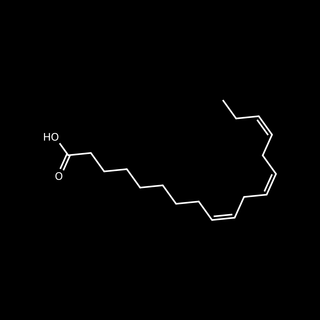
Linolenic Acid
PubChem, Linolenic Acid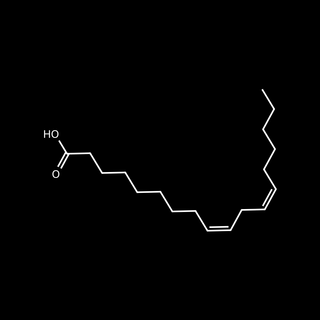
Linoleic Acid
PubChem, Linoleic Acid
Palmitic Acid
PubChem, Palmitic Acid - CAS
- 68917-05-5
- Odour-active compounds (GC-olfactometry)
- Ocimene · Beta-Ionone · Linalool · Cis-3-Hexenyl Butyrate · Gamma-Terpinene · Hexyl butyrate (J Zhejiang Univ Sci B 2014)
- INCI names (CosIng)
- OSMANTHUS FRAGRANS FLOWER OIL (FRAGRANCE)OSMANTHUS FRAGRANS EXTRACT (SKIN CONDITIONING)OSMANTHUS FRAGRANS FLOWER EXTRACT (FRAGRANCE)OSMANTHUS FRAGRANS LEAF EXTRACT (HUMECTANT, SKIN CONDITIONING)OSMANTHUS FRAGRANS FLOWER WATER (BLEACHING, SKIN PROTECTING, SKIN CONDITIONING – HUMECTANT)
- Compound classes reported
- Monoterpenoids 20 % · Lignans 30 % · Phenylethanoids (C6-C2) 14 % · of 44 compounds reported, 32 % of them esters · LOTUS

Labelling
- Forms in the EU cosmetic inventory
- Yunnan Osmanthus: OSMANTHUS FRAGRANS BRANCH/LEAF EXTRACT
Physical properties
- Flash point
- 73 °C
- Specific gravity
- 0.880 to 0.950 at 25 °C
- Refractive index
- 1.49 (n20/D)
Performance and rules
- IFRA status
- No IFRA Standard for the material itself (51st Amendment)
Yunnan Osmanthus · See Also
Entries related to Yunnan Osmanthus, by their place in the pyramid. “shared” marks a scent word Yunnan Osmanthus has too.
Heart notes

Jasmolactone
floral (shared) · fruity (shared) · sweet (shared) Florals / Same cluster / Synthetic
Lily
floral (shared) · green (shared) · waxy Florals / Synthetic
Rose
floral (shared) · honeyed (shared) · waxy Florals / Natural
Tuberose
floral (shared) · narcotic · creamy (shared) Florals / Natural
Bird cherry
floral (shared) · fruity (shared) · sweet (shared) Florals / Natural
Kadam
floral (shared) · sweet (shared) · green (shared) Florals / Natural


Base notes

Iris
powdery · earthy · violet Florals / Natural

Other entries · Place in the pyramid not stored

Carnation
floral (shared) · spicy · clove Florals / Same cluster / Natural

Yunnan Osmanthus · Sources
Read the science
- Hortic Res (2018) The chromosome-level quality genome provides insights into the evolution of the biosynthesis genes for aroma compounds of Osmanthus fragrans
- Hortic Res (2019) Mechanism of floral scent production in Osmanthus fragrans and the production and regulation of its key floral constituents, β-ionone and linalool
- Hortic Res (2022) Comparative methylomics and chromatin accessibility analysis in Osmanthus fragrans uncovers regulation of genic transcription and mechanisms of key floral scent production
- International Plant Names Index (IPNI) Osmanthus fragrans Lour.
- Molecules (2017) The Emission of the Floral Scent of Four Osmanthus fragrans Cultivars in Response to Different Temperatures
- Journal of Essential Oil Research (1989) Headspace Analysis of Osmanthus fragrans Lour.
- IFRA Standards, 51st Amendment
- Wikipedia Osmanthus fragrans
- Wikipedia Osmanthus
Cite as PREMIEREPEAU Glossary, “Yunnan Osmanthus”, https://premierepeau.com/
