


Stablo badema
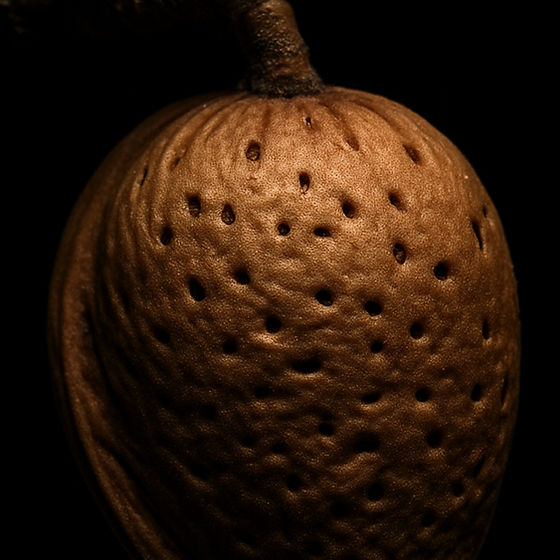
Green bark, bitter-kernel sharpness, and the dry rustling of Mediterranean orchard air. Almond tree in perfumery is the whole plant — not the nut, not the marzipan, but the living wood and leaf.
- Type
- Akord
- Olfactive family
- Drvenasti
- Source
- wood
Miris
Detaljno
Zanimljivosti
The bitter almond kernel contains amygdalin, a cyanogenic glycoside. When crushed and hydrolyzed, amygdalin releases benzaldehyde (the pleasant almond smell) and hydrogen cyanide (lethal poison). The same chemistry operates in cherry pits, apple seeds, and peach stones — every stone fruit kernel smells of almonds because it contains the same precursor to both fragrance and poison.
Dobijanje i hemija
Način dobijanja
No single 'almond tree' extract exists commercially. The note is typically constructed using benzaldehyde (CAS 100-52-7, synthetic or from bitter almonds via hydrolysis of amygdalin), green leaf notes (cis-3-hexenol, cis-3-hexenyl acetate), and dry woody materials (cedarwood, sandalwood bases). Bitter almond oil, obtained by pressing and hydrolysis of Prunus dulcis var. amara kernels, contains up to 95% benzaldehyde but also traces of hydrogen cyanide (HCN), which must be removed (rectified) before use.
- Formula
- N/A — key marker: benzaldehyde (C₇H₆O, CAS 100-52-7) and amygdalin (C₂₀H₂₇NO₁₁)
- CAS
- N/A — natural complex (wood and nut contain multiple compounds)
- Botanički naziv
- Prunus dulcis
- Izgled
- Pale yellow to dark amber liquid
- Jačina mirisa
- Srednji
- Sinonimi
- ALMOND SWEET ALMOND
Not applicable: accord or concept, not a single material
- Tačka ključanja
- ~178°C (benzaldehyde marker)
- Tačka paljenja
- 145°F TCC (62.8°C) for benzaldehyde
- Relativna gustina
- 0.910–0.960 @ 25°C (almond oil)
- Indeks prelamanja
- 1.4560–1.4680 @ 20°C (almond oil)
- Nota
- Data based on sweet almond oil and key marker benzaldehyde.
U parfemima
Almond tree as a perfumery note refers to the atmospheric impression of the whole plant (Prunus dulcis) rather than the isolated nut. It encompasses green leaf notes, bitter-almond kernel sharpness (benzaldehyde), dry bark, and the sun-warmed air of a Mediterranean orchard. Benzaldehyde (CAS 100-52-7) is the key molecule — it provides the characteristic bitter-almond scent, and is also found in cherry, peach, and apricot pits. In compositions, almond tree functions as a heart note that bridges green-floral accords to woody bases. It reads as naturalistic and arboreal rather than gourmand, distinguishing it from sweet almond or marzipan notes which center on lactones and heliotropin. works with fig leaf, heliotrope, and Mediterranean woods like cypress and stone pine.
Pogledajte i
7 nota