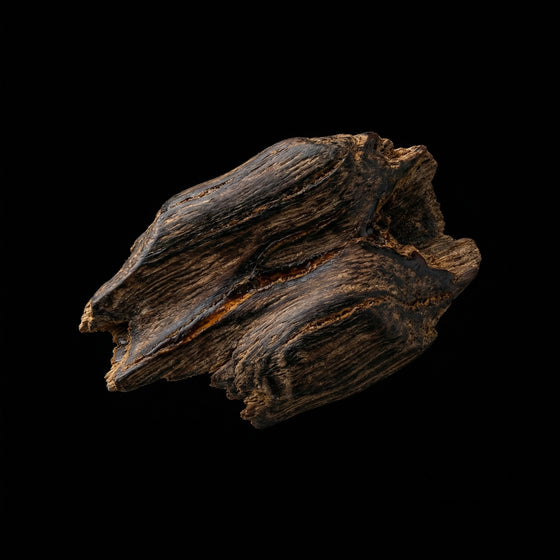
Agarwood is produced when the Aquilaria tree is infected by various fungi, or in naturally wounded wood. An Aquilaria tree may be infected by a mould, and in response it produces a self-defence material. The resin increases the mass and density of the affected wood and changes its colour from pale beige to yellow, orange, red, dark brown or black.
Origin
In Aquilaria malaccensis and Aquilaria crassna, the resin is produced in response to infection by the mould Phaeoacremonium parasitica. In natural forests, only about 7 out of 100 Aquilaria trees of the same species are infected and produce agarwood. Natural formation of agarwood is a slow process that occurs over several years. A common method in planted forestry is to inoculate trees with the fungus. Synthetically induced agarwood has aromas different from naturally formed agarwood. In one study, synthetic induction meant boring holes in the trunk with nails and filling them with an inoculation mixture that contained honey. Traditional artificial formation relies on physical methods such as cutting and digging holes, while modern techniques are mainly biochemical, such as chemical reagent invasion and bacteria inoculation.
Aquilaria malaccensis is the major source of agarwood. Aquilaria crassna and A. sinensis are the other two members of the genus that are commonly harvested. The Gyrinops tree can also produce agarwood. The aromatic qualities of agarwood vary with the species, the geographic location, the branch, trunk or root origin, the time since infection, and the methods of harvesting and processing. Aquilaria sinensis is found in China and Laos, Aquilaria rostrata in Malaysia, and Aquilaria subintegra in Cambodia and Thailand. Sri Lankan agarwood is known as Walla Patta and comes from Gyrinops walla.
Chemistry
The composition of agarwood oil is exceedingly complex, with more than 150 chemical compounds identified. Of the more than 150 compounds identified in the oil, at least 70 are terpenoids in the form of sesquiterpenes and chromones, and no monoterpenes have been detected. 2-(2-Phenylethyl)chromone derivatives and sesquiterpenes are the two predominant constituents of agarwood. Among 154 new compounds identified from Aquilaria plants, 2-(2-phenylethyl)-4H-chromen-4-one derivatives account for 57% and sesquiterpenes for 35%. Sesquiterpenes and their oxygenated derivatives are key components of agarwood oil. Other common classes of compounds include agarofurans, cadinanes, eudesmanes, valencanes, eremophilanes, guaianes, prezizanes and vetispiranes, together with simple volatile aromatic compounds. The exact balance of these materials varies with the age and species of the tree and the details of the oil extraction process.
Grades and trade
Kyara is the highest grade of agarwood in Japan. A wide range of qualities and products comes to market, varying with geographical location, botanical species, the age of the tree and the section of the tree the piece comes from. In practice, adulteration of the wood and oil is common. Since 1995, Aquilaria malaccensis has been listed in CITES Appendix II, and in 2004 all Aquilaria species were listed there. The 2004 listing also covered the agarwood-producing species of the genus Gyrinops. CITES Appendix II requires that international trade in agarwood be monitored, and the trade is also subject to controls meant to ensure that harvest and exports do not harm the survival of the species in the wild. Agarwood plantations have been established in India, Bangladesh and Bhutan, and reintroduced into Malaysia and Sri Lanka, as commercial plantation crops.
Uses
In traditional Chinese medicine, agarwood is used as a qi-regulating drug and carminative to relieve gastric problems, coughs, rheumatism and high fever. In traditional Arabian medicine, the essential oil is used for aromatherapy. Agarwood has also been used for centuries as incense in Buddhist, Hindu and Islamic ceremonies.
History
Agarwood has thousands of years of known use. Over 3,000 years ago, the ancient Egyptians used agarwood incense in their funeral rites. Agarwood was described as a fragrant product as early as 1400 BCE in the Vedas of India. In the Hebrew Bible, trees of lign aloes are mentioned in the Book of Numbers, and a perfume compounded of aloeswood, myrrh and cassia is described in Psalms 45. Agarwood is used for incense, perfume, traditional medicine, and other products in the world market.