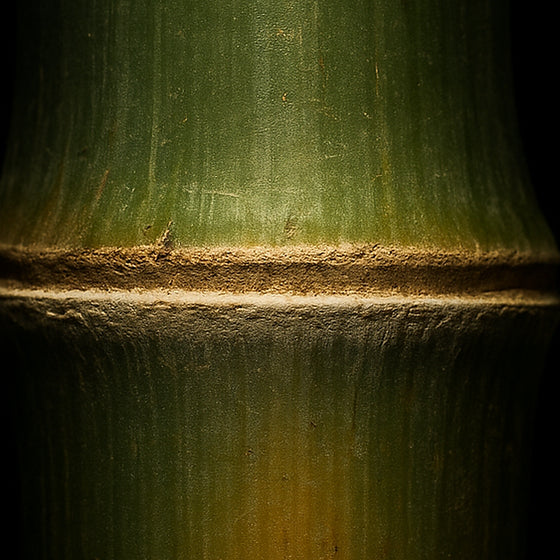
Bamboo is a long-stemmed, hollow, exotic reed-like grass native to Asia. It is a hardy perennial with an easily recognizable, jointed stem. Bamboos make up the subfamily Bambusoideae of the grass family Poaceae and are mostly evergreen perennial flowering plants. More than 1,400 species are placed in 115 genera.
Taxonomy and Distribution
The bamboos fall into three tribes that closely match geographic divisions: the herbaceous bamboos of the New World (Olyreae), the tropical woody bamboos (Bambuseae) and the temperate woody bamboos (Arundinarieae). Most species are native to warm, moist tropical and warm temperate climates, and the range also reaches cool mountainous regions and highland cloud forests. Giant bamboos are the largest members of the grass family: in Dendrocalamus sinicus, single stalks reach 46 meters in length, up to 36 centimeters in diameter and up to 450 kilograms in weight.
Growth, Strength and Use
Bamboos include some of the fastest-growing plants in the world. Certain species can grow 91 centimeters (36 inches) within 24 hours. As in other grasses, the stem is usually hollow between its nodes. Bambusa tulda, from Bangladesh and adjoining India, has tested as high as 60,000 psi (400 MPa) in tensile strength. Bamboo has economic and cultural significance in South Asia, Southeast Asia and East Asia, and is used for building materials and as a food source. In Asia, bamboo is used as a building material and for producing all sorts of household utensils.
Growth of up to 120 centimeters in 24 hours has been observed in Japanese giant timber bamboo (Phyllostachys bambusoides). The vascular bundles lie scattered through the walls of the stalk instead of in a cylindrical cambium layer, and the absence of secondary growth wood leaves the stems columnar rather than tapering. Like wood, bamboo is a natural composite material with a high strength-to-weight ratio, and its strength is generally similar to that of a strong softwood or hardwood timber.
Flowering
Bamboos seldom and unpredictably flower, and the frequency varies greatly from species to species. In gregarious flowering, all the individuals of a species growing over a wide area bloom within a brief interval and then die, whereas in sporadic flowering only a few culms of a population flower at a time. Seventy bamboo species undergo this massive synchronized flowering, and the large-scale death of bamboo forests that follows seriously affects the local economy and environment. Researchers agree that flowering is modulated by environmental conditions but rooted in internal genetic factors, and that it occurs when the bamboo reaches its physiologically mature age.
Culture and Name
Tender young sprouts can be eaten and are used for medical and cosmetic purposes, because the silica they contain has remineralizing powers.