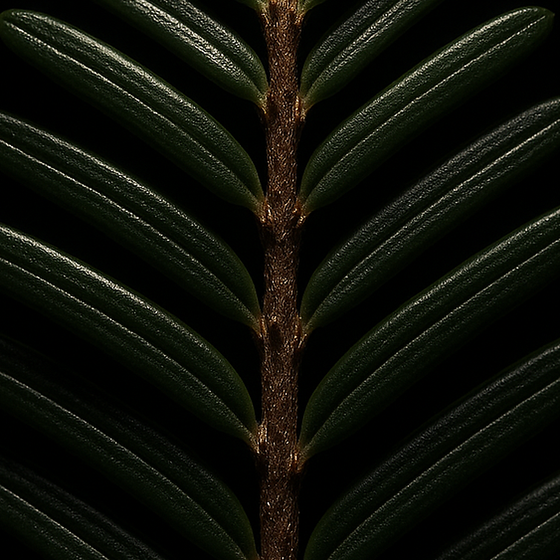
Kanadska čuga

PrirodnaDRVA I MAHOVINEdrvenast · topao · balzamski
Bazne notePiramida
3/5Jačina
—Trajnost
2Poreklo
Uzorak
Kanadska čuga kao sirovina za parfeme
Bazne note
Tsuga canadensis
Definicija

Tsuga canadensis, the eastern hemlock, is a coniferous tree in the pine family, native to eastern North America. Hemlock oil, steam-distilled from needles and twigs, has a pleasant pine-needle odor.

DRVENAST ZELEN SLADAK BALZAMSKI TOPAO PROHLADAN SVEŽ SMOLAST
Eastern hemlock, Canadian hemlock, Canada hemlock, hemlock spruce, pruche du Canada
Type
Sirovina
Olfactive family
Drvenasti
Source
needles and twigs
Chemical class
steam-distilled oil
Instrumenti
Piramida
GGornje note
SSrednje note
BBazne note
3/5Jačina
Srednja
jačina mirisa
Zemlje proizvođači
Kanada Sjedinjene Američke Države

Miris

The oil has a pleasant pine-needle odor. Spruce and hemlock oils, the group this oil belongs to, smell pleasantly of pine needles.

Teroar i zrelost

Detaljno

The hemlock of this entry is the conifer, not the poisonous herb Conium maculatum. Unlike that herb, Tsuga species are not poisonous. The herb is unrelated to the coniferous trees of the genus Tsuga. Tsuga is the Japanese name for hemlock.

The tree ranges from northeastern Minnesota eastward through southern Quebec and into Nova Scotia. It is found mostly in cool coves but can also be present on rock outcrops, especially on north-facing slopes. The tree can grow to heights of more than 30 metres and tolerates shade, moist soil and slopes. The oldest recorded specimen, found in Tionesta, Pennsylvania, was at least 554 years old. The needles are flat and green above, with shallow white bands on the underside. Hemlocks have shallow root systems that leave them susceptible to drought, wildland fire and wind fall. The dense, flat needles help regulate stream temperatures. The understory of hemlock forests is characterized as dark, damp and cool.

Hemlock wood is used in construction and for railroad ties. Eastern hemlocks are popular as ornamental trees. Eastern hemlock is the state tree of Pennsylvania.

The invasive hemlock woolly adelgid infests and eventually kills the trees. Declines caused by the adelgid have led to the species being listed as Near Threatened on the IUCN Red List. The adelgid is an insect native to East Asia that feeds by sucking sap from hemlock and spruce trees.

The ester content of spruce and hemlock oils, calculated as bornyl acetate, is 37-45%. Bornyl acetate has the molecular formula C₁₂H₂₀O₂ and a molecular weight of 196.29. One volume of the oil dissolves in at least one volume of 90% ethanol, and solutions may become hazy when more than two volumes of 90% ethanol are added.

Regulatory identifiers

Hemlock oil is registered under CAS number 8008-10-4 and carries the FEMA number 3034. It also appears in the list of substances added to food, under the entry for hemlock needles and twigs, oil (Tsuga spp.).

Zanimljivosti

Scientists have found eastern hemlocks that have persisted for 800 years or longer. By 2003, roughly 95% of the hemlocks in Shenandoah National Park had succumbed to the hemlock woolly adelgid.

Dobijanje i hemija

Način dobijanja

The oil is obtained by steam distillation of needles and twigs. Spruce and hemlock oils are produced in Canada and the northeast of the United States by steam distillation of needles and twigs from black spruce (Picea mariana), white spruce (Picea glauca var. glauca), hemlock spruce (Tsuga canadensis) and related species.

CAS
8008-10-4
Botanički naziv
Tsuga canadensis
Izgled
Very pale to light yellow liquid
Jačina mirisa
Srednji
Sinonimi
Eastern hemlock, Canadian hemlock, Canada hemlock, hemlock spruce, pruche du Canada
Status prema standardima IFRA
Pogledajte napomenu

No IFRA Standard for the material itself (51st Amendment)

Fizička svojstva
Relativna gustina
0.900-0.915 (d 25/25)
Indeks prelamanja
1.4670-1.4720 (n 20 D)

Pogledajte i

5 nota