Myrrh: The Bitter Resin of the Pharaohs, and What It Smells Like

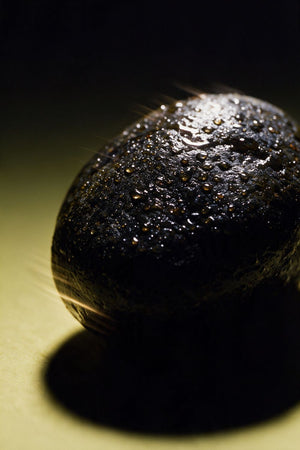
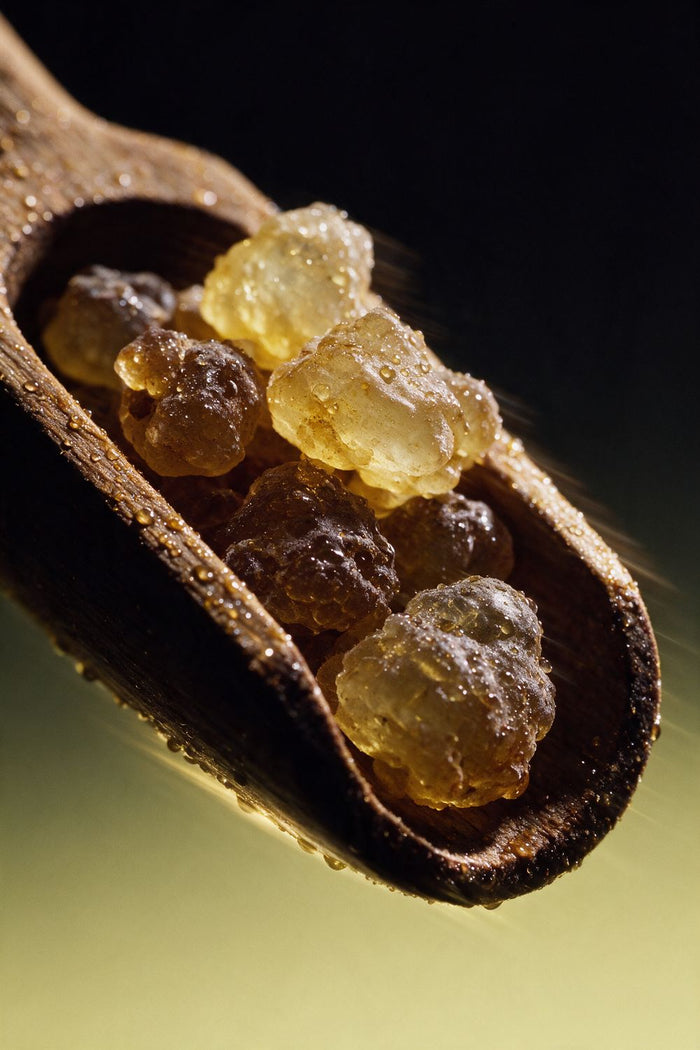
Myrrh is the hardened resin of Commiphora myrrha, a small thorny tree native to the Horn of Africa and the Arabian Peninsula. When the bark is wounded, a pale latex bleeds out and darkens into reddish-brown nodules. In Arabic the word is murr, in Hebrew mor. Myrrh smells warm and balsamic, with a bitter edge that keeps it from turning sweet.
Myrrh is named for what it tastes like. The word comes from the Semitic root m-r-r, meaning bitter. Arabic murr, Hebrew mor, Akkadian murru. In Somali the resin is molmol, very bitter. A language family looked at a dark, reddish-brown resin bleeding from a thorny desert shrub and called it what the tongue already knew. Bitter. Not sweet, not precious, not sacred. Bitter. Every civilization that later declared it holy, rubbed it into corpses, burned it in temples, or gifted it to newborn kings began with that honest assessment: this substance bites.
14 min
What is myrrh, exactly? It is the hardened oleoresin of Commiphora myrrha, a small thorny tree in the Burseraceae family, the same botanical family that produces frankincense. It grows wild in eight countries by Kew's count: Somalia, Ethiopia, Eritrea, Djibouti, Kenya, Saudi Arabia, Yemen and Oman. You wound the bark. A pale, viscous latex bleeds out. It darkens and hardens into irregular, reddish-brown nodules, oilier than frankincense tears, with a scent that is warm, resinous, faintly medicinal, and underneath it all, the bitterness its name records.
What follows traces the resin from desert shrub to pharaoh's tomb to perfumer's palette, its chemistry, its trade, its theology, and the science that is only now catching up to what ancient physicians claimed they already knew.
What is myrrh?
Myrrh is the hardened gum resin of Commiphora myrrha, a small thorny tree native to the Horn of Africa and Arabia. Cut the bark and a pale juice seeps out and dries into reddish-brown lumps. The name comes from a Semitic root meaning bitter. Since antiquity it has gone into incense, anointing oil, medicine and perfume.
The Tree: A Thorny Survivor in the Desert
Commiphora myrrha does not look like something worth fighting wars over. Botanists describe its genus as shrubs or small trees with thorny branches. It has carried its present name since 1883, when Engler moved into Commiphora a species first described as Balsamodendrum myrrha. Commiphora molmol is a synonym. Nothing about it signals value.
What signals value is the wound response. When the bark is cut, the tree secretes a pale, sticky latex that hardens on contact with air into dark, reddish-brown nodules, the "tears" of myrrh, though they look less like tears and more like dried blood. The resin is an oleogum resin. A 2022 analysis gives the make-up of Commiphora resins as 30 to 60% water-soluble fraction, 25 to 40% alcohol-soluble resin and 3 to 8% essential oil. A 2023 review counts differently: 57 to 61% gum and 7 to 17% volatile oil. The oil is where the scent lives. The gum is structural. The resin fraction is where the pharmacology concentrates.
The Commiphora genus is large: more than 200 species across north-eastern Africa, southern Arabia and India. C. myrrha is the main source of true myrrh today. The names of its neighbours are less settled. Our glossary, with much of the trade, gives opopanax, or sweet myrrh, to Commiphora guidottii, a species described in 1931 in an Italian journal of essences and perfumes. A 2022 paper in Molecules gives opopanax and bisabol myrrh to Commiphora erythraea, African opopanax to Commiphora kataf, and guggul, or false myrrh, to the Indian Commiphora mukul.
| Species | Trade name | Where | What tells it apart |
|---|---|---|---|
| Commiphora myrrha | True myrrh | Somalia, Ethiopia, Eritrea, Djibouti, Kenya, Saudi Arabia, Yemen, Oman | Carries furanoeudesma-1,3-diene: 87.7 micrograms per milligram of resin in a 2022 analysis |
| Commiphora erythraea | Opopanax or bisabol myrrh, in the 2022 paper | Mainly Somalia and Kenya | No furanoeudesma-1,3-diene. A frequent adulterant of true myrrh |
| Commiphora guidottii | Opopanax or sweet myrrh, in our glossary | Ethiopia, Somalia | Named in 1931 |
| Commiphora kataf | African opopanax | Mainly Somalia and Kenya | Named beside C. erythraea in the 2022 paper |
| Commiphora mukul | Guggul or false myrrh | India | Marked by guggulsterones |
Harvesting follows the same logic as frankincense: wound, wait, collect. Pliny, in the first century, has the incisions made twice a year, "all made the way up from the root as far as the branches which are able to bear it." He adds that the tree also gives without a cut. The liquid that drips first is stacte, "to which there is no myrrh that is superior."
The distinction between myrrh and frankincense is worth making early, because the two resins have walked side by side through history so consistently that many people confuse them. They are botanical siblings, same family, Burseraceae, but different genera, different chemistry, different scent profiles. Frankincense (Boswellia) is bright, citrus-pine, almost crystalline. Myrrh (Commiphora) is darker, heavier, warmer, with that medicinal bitterness underneath. If frankincense is the smell of prayer rising, myrrh is the smell of the body it leaves behind. The pair has its own article.
With Pharaohs and Priests: Myrrh in the Ancient World
Plutarch, the Greek historian writing in the first century CE, says the Egyptians made a triple offering of incense to the Sun every day: "an offering of resin at sunrise, of myrrh at midday, and of the so-called cyphi at sunset." Three fires a day, each keyed to the angle of the sun. Myrrh at the zenith: the harshest light, the bitterest resin.
Egyptologists have usually translated one Egyptian word, antiu, as myrrh. In 2023 a team working on a 26th-Dynasty embalming workshop at Saqqara published in Nature what was in the pots. They analysed 31 ceramic vessels that the embalmers had labelled with their contents. Antiu, "usually translated as 'myrrh' or 'incense'," turned out to name a mixture based on conifer oils or tars. The residues spoke of Pistacia and conifer products from the Mediterranean, and of dammar and elemi from tropical forests. Plutarch, for his part, reports another Egyptian name for myrrh altogether: bal.
That myrrh went into Egyptian bodies rests on a Greek. Herodotus, in the fifth century BC, describes the costliest embalming. The belly is emptied, rinsed with palm wine, and sewn up "after filling the belly with pure ground myrrh and casia and any other spices, except frankincense." Then seventy days in saltpetre. Even the dead kept the two resins apart.
Queen Hatshepsut, who reigned from about 1479 to 1458 BCE, first as coregent and then in her own right, sent a seaborne expedition to Punt, a trading centre on the East African coast beyond the southern end of the Red Sea. The walls of her temple at Deir el-Bahari show what came back: gold, ebony, animal skins, baboons, processed myrrh, and living myrrh trees, which were planted in the temple gardens. The Egyptians did not merely want to buy myrrh. They wanted to grow it. Whether the transplanted trees survived is uncertain. What survived is the record: a pharaoh mobilized a naval expedition for a bitter resin.
Myrrh also went into kyphi, the compound incense of the evening. Plutarch gives it sixteen ingredients: "honey, wine, raisins, cyperus, resin, myrrh, aspalathus, seselis, mastich, bitumen, rush, sorrel," two junipers, cardamom and calamus, compounded "while the sacred writings are being read to the perfumers as they mix the ingredients." He credits its smoke with loosening the day's cares "without the aid of wine," and says of the faculty of dreams that "it brightens like a mirror." The bitterness of myrrh served as counterpoint in these blends, the dry, resinous anchor that kept the sweetness of honey and raisins from cloying.
Myrrh has travelled with frankincense since antiquity. For the full story of its brighter sibling, the crisis it faces, the chemistry of its smoke, start here.
No gardenia essential oil exists. Every gardenia fragrance is a molecular forgery built from ten components. The impossible flower.
Tuberose contains the same molecule found in faeces. At the right dose, it becomes the most seductive flower in perfumery. The night-blooming flower that divides.
Fewer than 600 perfumers exist worldwide. They train 5-7 years and win maybe 1 in 20 briefs. The real job explained.
Myrrh in the Bible: The Third Gift
Myrrh appears in the Gospel of Matthew as one of three gifts brought by the Magi to the infant Jesus, alongside gold and frankincense. The passage (Matthew 2:11) does not explain why these specific gifts were chosen. Explanation came later, from theologians.
Irenaeus of Lyon, in the second century, read myrrh as the sign of one "who should die and be buried for the mortal human race." Origen, in the third, fixed the formula in Contra Celsum: gold for kingship, frankincense for divinity, myrrh for mortality. The tripartite reading persists in Christian theology to this day. The logic is material, not arbitrary. Gold is the substance of crowns. Frankincense is the substance of temple smoke, the medium through which prayers rise to God. Myrrh is the substance rubbed into dead bodies. A birth gift that foreshadows a death, the Magi announcing, in three objects, the complete arc of a life they believed was divine.
Myrrh reappears at the Crucifixion. Mark 15:23 records that Jesus was offered "wine mingled with myrrh," often read as a painkiller, though Pliny's translators of 1855 note that the ancients also used myrrh simply "to flavour their wines." He refused it. After the death, the Gospel of John (19:39) records that Nicodemus brought "a mixture of myrrh and aloes, about an hundred pound weight" for the burial. The gift that announced mortality at birth performed the final office at death.
In the Hebrew Bible, myrrh is mor, from a root meaning bitter, and concordances count the word twelve times. In the Song of Solomon it is an erotic metaphor: "my hands dropped with myrrh, and my fingers with sweet smelling myrrh" (5:5). It leads the recipe for the holy anointing oil in Exodus 30:23, pure myrrh, cinnamon, calamus, cassia, and olive oil. The same resin that went into the tomb opened the sanctuary. Bitterness as sanctification.
| Verse (King James Version) | What myrrh is doing there |
|---|---|
| Genesis 37:25 | Trade: Ishmaelites carry "spicery and balm and myrrh" from Gilead down to Egypt |
| Genesis 43:11 | A present for Joseph: "a little balm, and a little honey, spices, and myrrh" |
| Exodus 30:23 | The holy anointing oil: "pure myrrh five hundred shekels" |
| Esther 2:12 | Preparing the women for the king: "six months with oil of myrrh" |
| Psalm 45:8 | "All thy garments smell of myrrh, and aloes, and cassia" |
| Proverbs 7:17 | "I have perfumed my bed with myrrh, aloes, and cinnamon" |
| Song of Solomon 1:13 | "A bundle of myrrh is my wellbeloved unto me" |
| Matthew 2:11 | The third gift: "gold, and frankincense, and myrrh" |
| Mark 15:23 | At the cross: "wine mingled with myrrh" |
| John 19:39 | For the burial: "a mixture of myrrh and aloes, about an hundred pound weight" |
The gifts were not unique to Christianity. In 288/7 BC the kings Seleucus and Antiochus sent offerings to the temple of Apollo at Didyma, near Miletus, and the letter that lists them survives: gold vessels weighing 3,248 drachmas, a silver wine cooler of 9,000, "ten talents of frankincense, one talent of myrrh," and two minas each of cassia, cinnamon and costus. Gold, frankincense and myrrh on one list, nearly three centuries before the Magi. These were the currency of the sacred across the ancient Near East.
The word "perfume" derives from per fumum, through smoke. The history of scent begins with burned resin, not sprayed alcohol. It took 4,000 years to get from temple smoke to glass bottles.
The Incense Road: Moving Bitterness Across Continents
Myrrh travelled north with frankincense, but the two were not taxed alike. Pliny has frankincense carried under guard to Sabota, where the priests took a tenth for their god. Of myrrh he writes: "They give no tithes of myrrh to the god, because it is the produce of other countries as well; but the growers pay the fourth part of it to the king of the Gebanitæ." It grew, he says, "in many parts of Arabia," and the Sabæi "even cross the sea to procure it in the country of the Troglodytæ." From the Gebanite capital to Gaza on the Mediterranean he counts sixty-five days by camel. The road has its own article.
The two resins served different markets. Frankincense was burned in temples. Myrrh was used in medicine, embalming, and as a component of anointing oils and cosmetics. The demand was complementary, not competitive.
What did myrrh cost?
Pliny gives the Roman prices by kind, with a warning: "The price of myrrh varies according to the number of purchasers."
| Kind, in Rome, first century AD | Silver denarii per pound | Pounds bought by one pound of gold |
|---|---|---|
| Cultivated myrrh, highest price | 11 | 91 |
| Odoraria, the odoriferous kind | 14 | 71 |
| Erythraean myrrh, said to be the Arabian | 16 | 63 |
| Troglodytic myrrh | 16 | 63 |
| Stacte, the unprompted drip | 3 to 40 | 333 to 25 |
| The best frankincense, for comparison | 6 | 167 |
A pound of gold was struck into forty coins of twenty-five denarii, about 1,000 denarii, so even stacte on its dearest day cost a twenty-fifth of its weight in gold. Pliny also lists the frauds: mastic and other gums slipped in, the juice of wild cucumber for bitterness, litharge for weight. His test for the real thing is small uneven pieces that, "when broken," show "white marks like the finger-nails" and taste slightly bitter.
The price reflects a material that is valuable but not precious. What makes it historically significant is ubiquity, available at a scale that allowed it to embed itself in the daily practices of entire civilizations.
The burning of aromatic resins, myrrh, frankincense, oud, is not a relic of antiquity. In the Gulf, it is daily practice. The West barely knows this tradition exists.
What is myrrh used for?
The list has changed less than the centuries would suggest. It is rubbed on, burnt, drunk, and worn.
| Use | Where it is written |
|---|---|
| Holy anointing oil | Exodus 30:23 |
| A twelve-month preparation of the body, six of them with oil of myrrh | Esther 2:12 |
| Scent for clothes and for the bed | Psalm 45:8, Proverbs 7:17 |
| Embalming: the belly filled with ground myrrh and cassia | Herodotus, Histories 2.86 |
| Midday offering to the Sun in Egyptian temples | Plutarch, Isis and Osiris 52 |
| Flavouring for wine | Mark 15:23. Bostock and Riley's note to Pliny, 1855 |
| Burial spices | John 19:39 |
| Tincture and mouthwash for gums, mouth ulcers and sore throat | British Herbal Pharmacopoeia, as cited in a 2023 review |
| Fragrance ingredient: the resin, the oil and the gum oil are registered | European CosIng database |
| Base note in perfume and incense | PREMIEREPEAU glossary |
The Chemistry: Why Myrrh Acts on Opioid Receptors
The essential oil of Commiphora myrrha is dominated by sesquiterpenes, heavier, more complex volatile molecules than the monoterpenes that dominate frankincense. This chemical difference explains the olfactory difference: frankincense opens with bright, citrus-pine notes (alpha-pinene, limonene), while myrrh opens warm, dark, balsamic, medicinal.
A 2022 analysis by gas chromatography names the main components of the oil: curzerene, beta-elemene, lindestrene and furanoeudesma-1,3-diene. Three of them share a furan ring.
| Compound | CAS number | Share of one standardised extract, 2017 | Odour words in the trade databases |
|---|---|---|---|
| Curzerene | 17910-09-7 | 17.93% | None |
| Furanoeudesma-1,3-diene | 115526-32-4 | 27.44% | None |
| Lindestrene | 2221-88-7 | 9.08% | None |
In raw resin the 2022 analysis measured furanoeudesma-1,3-diene at 87.7 micrograms per milligram, close to 9% by weight, the most abundant compound it quantified. The same paper credits the typical myrrh odour mainly to that molecule together with lindestrene.
These three compounds, all sharing a furanodiene skeleton, are credited with myrrh's most remarkable property: an action on opioid receptors, the receptors of morphine.
In 1996 Dolara and seven co-authors published a letter in Nature under the title "Analgesic effects of myrrh." Later reviews trace to it the report that furanoeudesma-1,3-diene and curzerene act on opioid receptors in the central nervous system.
A 2017 pilot study (Germano and colleagues, BioMed Research International) tested a standardised myrrh extract in 184 volunteers, 95 women and 89 men, with headache, fever-related pain, joint pain, muscle aches, lower back pain and menstrual cramps. One group took 200 or 400 milligrams a day for 20 days and the other a placebo, with the physicians, the assessor and the statistician blinded to the groups. The authors report "significant analgesic properties."
It gives a second reading to the wine mixed with myrrh in Mark's Gospel, and to the old physicians a 2023 review lists, who used the resin for wounds, aches and inflamed joints.
The resin fraction, the part soluble in alcohol and heavier than the oil, holds commiphoric acids, heerabomyrrhols and other terpenoids.
Insuline Safrine works with the same taste. It opens on bitter almond and saffron before its vanilla and cinnamon.
Medicine: What the Evidence Actually Says
Myrrh has been a medicine since antiquity. The question is not whether people believed in it, they demonstrably did, but whether modern clinical evidence supports the belief. The answer is: partially, and with caveats.
Oral health is where the trials are. A 2026 systematic review pooled 15 studies of myrrh in gum disease, eight of them randomised trials. It found "a small yet statistically significant reduction in plaque," while effects on gingival inflammation and healing "were not significant." Reported adverse effects were minimal. A 2023 review cites the British Herbal Pharmacopoeia for myrrh tincture as a mouthwash in gingivitis and ulcers, and a 1999 monograph that approved it for mild inflammation of the mouth and throat.
Analgesic effects have the 1996 letter and the placebo-controlled pilot described above. One trial of 184 volunteers is a beginning.
Antimicrobial activity is steady in the laboratory. The 2026 review notes that in vitro studies "consistently demonstrated strong antimicrobial effects of myrrh." Its one animal study showed dose-dependent toxicity with prolonged use.
The honest summary: myrrh has genuine biological activity. In the mouth, the pooled trials show a small effect on plaque. The analgesic effect has one controlled pilot behind it. The antimicrobial properties are real in the lab. The marketing of myrrh supplements and essential oils has, as with frankincense, outpaced the clinical data. The resin does things. Not everything the wellness industry claims it does.
What does myrrh smell like?
Myrrh smells warm and balsamic with a bitter edge that keeps it from turning sweet. The core is resinous and faintly medicinal, with a dry mineral undertone. Burned, it turns smokier and denser. It reads darker and heavier than frankincense, with less citrus lift.
Over time, our glossary records three stages. At once: sharp, balsamic, medicinal, a bitter resinous attack with an antiseptic, iodine-like edge and a faint metallic undertone. After a few hours the bitterness recedes. After a few days, what remains on fabric is warm, dry and dark, sweet-balsamic and lightly smoky. The glossary gives the undiluted material a tenacity of 400 hours, nearly seventeen days.
Myrrh in Perfumery: The Bitter Base Note
In perfumery, myrrh occupies the base register, warm, dense, long-lasting, with a drydown that can persist on skin and fabric for hours. But calling it simply a "base note" undersells what the material does. Myrrh is not just heavy. It is complex: simultaneously balsamic and bitter, sweet and medicinal, warm and dry. It creates a kind of tension in a composition.
The scent, unburned: a sharp balsamic opening with a medicinal edge. A warm, resinous body, earthy and lightly spicy. And underneath, that Semitic-named bitterness, a dry edge that prevents the sweetness from collapsing into warmth alone. Burned, the smoke adds density and incense-like heaviness.
Myrrh is available to perfumers in several forms:
- Essential oil (steam-distilled): dominated by the sesquiterpene fraction, lighter and more aromatic than the raw resin, with a warm-balsamic character and moderate staying power.
- CO2 extract: captures heavier molecular fractions than steam distillation, producing a darker, more complete profile closer to the raw resin's full character.
- Absolute (solvent-extracted): the richest version, preserving the resin's complete aromatic signature, including the bitter and medicinal facets that steam distillation partially loses.
- Tincture: raw resin dissolved in alcohol, a traditional preparation that retains the material's full complexity but can be cloudy and difficult to work with at scale.
In compositional terms, myrrh pairs naturally with other resinous and balsamic materials: frankincense (its eternal sibling), benzoin, labdanum, amber. It deepens oud compositions and softens harsh animalic notes. It supports saffron's metallic dryness with its own warmth. It provides a dark counterpoint to sandalwood's creamy smoothness. In sacred-register compositions, incense-forward, resinous, contemplative, myrrh is structural. It holds the chord together.
In small doses, myrrh acts as a modifier. A trace of myrrh absolute in a floral composition adds a dry, mineral undertone that extends the drydown without announcing itself. The bitterness serves as ballast. The fragrance settles closer to skin, reads less decorative and more physical. Old as the trade, and still doing invisible structural work.
If you want to feel what resins do on skin, frankincense runs through three of the seven compositions in our Discovery Set: Albâtre Sépia, Gravitas Capitale and Simili Mirage.
Frequently Asked Questions
What is myrrh used for?
Today myrrh tincture is used as a mouthwash for the gums, mouth ulcers and sore throats, and the resin and its oil are registered fragrance ingredients in Europe. In the old texts it goes into the holy anointing oil of Exodus, a twelve-month preparation of the body in Esther, Egyptian embalming in Herodotus and the burial spices of John's Gospel.
What is myrrh in the Bible?
An aromatic resin, in Hebrew mor, from a root meaning bitter. It leads the recipe of the holy anointing oil (Exodus 30:23), scents clothes and beds in the Psalms and Proverbs, is one of the three gifts of the Magi (Matthew 2:11), is mixed into wine at the cross (Mark 15:23) and is brought for the burial (John 19:39).
Why was Jesus given myrrh?
Matthew 2:11 lists the gift and gives no reason. Irenaeus of Lyon, in the second century, read myrrh as the sign of one who would die and be buried. Origen repeated the formula in the third century: gold for a king, incense for a God, myrrh for one who was mortal.
Is myrrh the same thing as frankincense?
No. Both are resins of the family Burseraceae, from different trees: myrrh from Commiphora, frankincense from Boswellia. Frankincense smells bright, lemony and piney. Myrrh is darker, bitter and balsamic. Herodotus notes that Egyptian embalmers filled the body with myrrh and any other spices, except frankincense.
What does myrrh smell like?
Warm and balsamic with a bitter edge. Our glossary records a sharp, medicinal, iodine-like opening, then a bitterness that recedes within hours and a warm, dry, sweet-balsamic and lightly smoky trace that stays for days. A 2022 paper credits the typical myrrh odour mainly to two molecules, furanoeudesma-1,3-diene and lindestrene.
What does myrrh do for the human body?
The evidence is narrow. A 2026 review of 15 studies found a small but significant reduction in dental plaque and no significant effect on gum inflammation. A 2017 placebo-controlled pilot in 184 volunteers reported analgesic effects from a standardised extract taken for 20 days. Laboratory studies show antimicrobial activity.
What is murr?
Murr is the Arabic word for myrrh, and it means bitter. The Hebrew word is mor, from a root with the same meaning, and the Somali name of the resin, molmol, means very bitter. The English word myrrh comes from that Semitic family: the resin is named for its taste.
What does myrrh look like?
Small, uneven, reddish-brown lumps, oilier than the pale tears of frankincense. Pliny's test in the first century was to break one: good myrrh shows white marks like fingernails inside and tastes slightly bitter. He ranked a mottled interior second, and myrrh that is black inside and out last.
Sources
- International Plant Names Index and World Checklist of Vascular Plants, Royal Botanic Gardens, Kew: Commiphora myrrha (T.Nees) Engl., 1883, and its native range. GBIF for Commiphora guidottii Chiov. ex Guid., 1931.
- J. Ulrich and others, "Phytochemical Composition of Commiphora Oleogum Resins and Their Cytotoxicity against Skin Cancer Cells", Molecules 27(12), 3903, 2022. DOI 10.3390/molecules27123903.
- "Commiphora myrrh: a phytochemical and pharmacological update", Naunyn-Schmiedeberg's Archives of Pharmacology 396, 405 to 420, 2023. DOI 10.1007/s00210-022-02325-0.
- A. Germano and others, "A Pilot Study on Bioactive Constituents and Analgesic Effects of MyrLiq", BioMed Research International, 2017, article 3804356. DOI 10.1155/2017/3804356.
- P. Dolara and others, "Analgesic effects of myrrh", Nature 379, 29, 1996. DOI 10.1038/379029a0.
- "Myrrh in the Management of Periodontal Disease and Gingival Healing: A Systematic Review and Meta-Analysis", Journal of International Society of Preventive and Community Dentistry, 2026. DOI 10.4103/jispcd.jispcd_160_25.
- M. Rageot and others, "Biomolecular analyses enable new insights into ancient Egyptian embalming", Nature 614, 287 to 293, 2023. DOI 10.1038/s41586-022-05663-4.
- Herodotus, Histories, book 2, chapter 86, translated by A. D. Godley, 1920. Read at the Perseus Digital Library.
- Plutarch, Isis and Osiris, sections 52 and 79 to 80, translated by F. C. Babbitt, Loeb Classical Library, 1936. Read at LacusCurtius, University of Chicago.
- Pliny the Elder, Natural History, book 12, chapters 32, 33 and 35, and book 33, chapter 13, translated by John Bostock and H. T. Riley, London, 1855. Read at the Perseus Digital Library.
- C. B. Welles, Royal Correspondence in the Hellenistic Period, letter 5, Seleucus I to Miletus, 288/7 BC (OGIS 214). Read at attalus.org.
- The Holy Bible, King James Version: Genesis 37:25 and 43:11, Exodus 30:23, Esther 2:12, Psalm 45:8, Proverbs 7:17, Song of Solomon 1:13 and 5:5, Matthew 2:11, Mark 15:23, John 19:39. Hebrew word: Brown-Driver-Briggs lexicon, entry mor.
- Irenaeus, Against Heresies 3.9.2, and Origen, Against Celsus 1.60, in the Ante-Nicene Fathers.
- Encyclopaedia Britannica, "Hatshepsut", for the dates of the reign and the expedition to Punt.
- European Commission, CosIng database of cosmetic ingredients: Commiphora myrrha resin, oil and gum oil. Read on 19 November 2026.
- PREMIEREPEAU glossary, entries myrrh and opoponax, for the smell over time, the tenacity and the trade names.
Insuline Safrine
Extrait de parfum at 20%. 8 notes, including bitter almond, clove and saffron liqueur.
Read also
3
Labdanum: The Resin That Goats Harvest Without Knowing
Labdanum is the sticky resin that rockroses of the genus Cistus give off from their leaves and stems, and the perfumery material made from it. Two shrubs supply it, Cistus ladanifer of Spain, Portugal, France and Nort...
Benzoin: The Incense of Churches That Became a Base Note
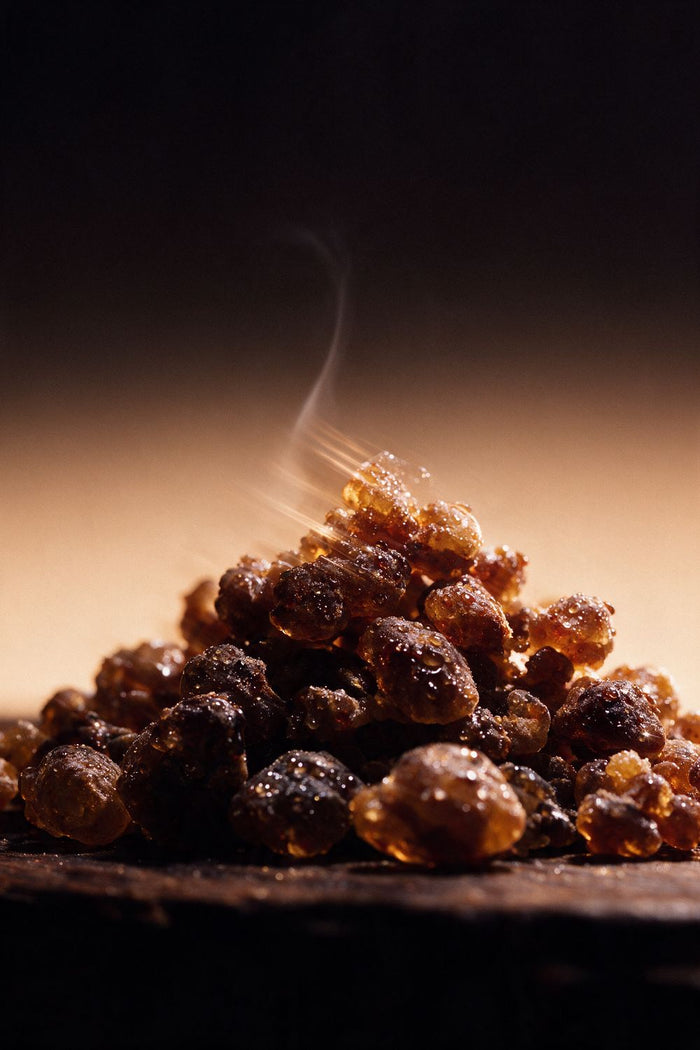
In the highland forests of Laos, along the slopes of mountains that receive enough rainfall to sustain dense tropical canopy but enough altitude to cool the air to near-temperate mildness, there grows a tree that has ...
Frankincense: 5,000 Years of Sacred Commerce
Before silk, before spices, before tea, before opium, there was resin.
Next
Perfumery Journal
Rose Water: Ancient Persia to Your Skin
19.11.25