Flowers That Bloom at Night: Ten Species, Accepted Names and Scent
Flowers that bloom at night open after dusk, often pale and scented. Ten species return on every list, among them tuberose, moonflower, angel's trumpet and queen of the night. Moths and bats visit many, but a 2025 review of 135 studies covering 139 plants found that 90% were pollinated about equally by day and night. Night-blooming jasmine is a nightshade, not a jasmine.
What are flowers that bloom at night?
Flowers that bloom at night, such as tuberose, open after dusk and give off their scent in the dark, usually on pale petals. Moths and bats visit many of them. A global review of 2025 found, though, that most plants studied were pollinated about as well by day as by night.
Every list of night flowers tells the same story: a pale flower, a heavy scent, a moth. Epic Gardening says of angel's trumpet that "They emit their fragrance at night and are pollinated predominantly by moths." The extension service of South Dakota State University writes that "Many moths take wing at night, and some prefer the night garden blooms and fragrances." The Pioneer Woman has "pollinators such as moths are hard at work at night, too." The record is wider. In 2025 Kendall and Nicholson pooled 135 studies of 139 flowering plants, all tested by shutting pollinators out by day or by night. They found "an overall lack of difference in pollination between day and night." Moths are real. They are not the rule.
Night blooming flowers and their accepted names
Ten species come back on every list. Names are the first trap. The table gives the name accepted by GBIF, the Kew name where it differs, and the first publication as the botanical registers record it.
| Common name | Accepted name | Authority and first publication | Family |
|---|---|---|---|
| Tuberose | Agave amica (GBIF), Polianthes tuberosa (Kew) | (Medik.) Thiede and Govaerts, Phytotaxa 306(3): 237, 2017, and L., Sp. Pl. 1: 316, 1753 | Asparagaceae |
| Night-blooming jasmine | Cestrum nocturnum | L., Sp. Pl. 1: 191, 1753 | Solanaceae |
| Queen of the night (cactus) | Selenicereus grandiflorus | (L.) Britton and Rose, Contr. U.S. Natl. Herb. 12: 430, 1909 | Cactaceae |
| Queen of the night (houseplant) | Epiphyllum oxypetalum | (DC.) Haw., Philos. Mag. Ann. Chem. ser. 2, 6: 109, 1829 | Cactaceae |
| Moonflower | Ipomoea alba | L., Sp. Pl. 1: 161, 1753 | Convolvulaceae |
| Evening primrose | Oenothera biennis | L., Sp. Pl. 1: 346, 1753 | Onagraceae |
| Four o'clock | Mirabilis jalapa | L., Sp. Pl. 1: 177, 1753 | Nyctaginaceae |
| Flowering tobacco | Nicotiana alata | Link and Otto, Icon. Pl. Rar. 63, t. 32, 1830 | Solanaceae |
| Angel's trumpet | Brugmansia suaveolens | (Humb. and Bonpl. ex Willd.) Bercht. and J.Presl, Prir. Rostlin Aneb. Rostl. 1: 45, 1823 | Solanaceae |
| Sacred datura | Datura wrightii | Regel (IPNI: hort. ex Regel, Gartenflora 1859, t. 260) | Solanaceae |
Tuberose has two accepted names. Kew's World Checklist of Vascular Plants accepts Polianthes tuberosa L., published by Linnaeus in 1753, and lists Agave amica as a synonym. GBIF reads it the other way: it accepts Agave amica, published in Phytotaxa in 2017, and lists Polianthes tuberosa as the synonym. Both put the plant in Asparagaceae. This page does not choose between them. Our tuberose article uses the common name, as the trade does.
A smaller disagreement touches angel's trumpet: Kew's checklist accepts the same species with Sweet as the last author of the name, where GBIF prints Bercht. and J.Presl. Two plants share the name queen of the night, and they are different cacti, which the two chapters on that plant take up.
How a flower knows it is night
The night opening is not a reaction to the dark. It is a clock. In coyote tobacco, a wild Nicotiana, the flowers "open at night, close the following morning, and repeat this movement over 2 d, synchronized with nighttime scent emission." That is how a 2026 paper in The Plant Cell opens. Its authors, Choi and colleagues, found one transcription factor, COL5, that runs both the opening and the scent. Plants without it showed "incomplete flower opening and lacked emission of the major floral scent, benzylacetone." Silencing the same gene in the large white petunia gave similar results. Benzylacetone is recorded as floral and balsamic in the Good Scents list, and as floral, fresh, green and jasmine in the Leffingwell list.
The rhythm is old knowledge. In 2001 Kolosova and colleagues measured methyl benzoate in snapdragon, which gives its scent by day when bumblebees forage, and suggested that "similar molecular mechanisms" regulate it in snapdragon and in the night-scented tobacco and petunia.
The visitor has a clock too. In 2018 Fenske and colleagues showed that moths whose clock was aligned with the plant's showed stronger flower-foraging activity on petunia, and that "moth antennal responsiveness to the floral scent compounds exhibits a 24-hour rhythm." A night flower and its moth keep the same time.
Queen of the night: a 200-fold rise in scent
The clearest measurement of a night scent was made on Epiphyllum oxypetalum, the cactus most often sold as queen of the night. Zhang and colleagues recorded in Horticulture Research in 2025 that "Starting after 8 p.m. local time, volatile emission increased 200-fold within 6 h." They describe the blooms as "infrequent, transient, and nocturnal." At full bloom three compounds made up most of what the flower released.
| Compound | Share of total emission | Odour words, Good Scents list |
|---|---|---|
| Geraniol (CAS 106-24-1) | 72.54% | sweet, floral, rose, fruity, citrus, waxy |
| Benzyl alcohol (CAS 100-51-6) | 12.96% | sweet, floral, rose, fruity, phenolic, balsamic, chemical |
| Methyl salicylate (CAS 119-36-8) | 3.75% | sweet, root beer, camphoreous, phenolic, minty, wintergreen, aromatic |
The authors place the source in the petals and sepals. The odour words are the trade's descriptors for each molecule alone. They are not a description of the flower.
Does the queen of the night bloom once a year?
Three popular pages say so. Oddity Central writes of "large, fragrant, white flowers only one night per year." Burpee tells of Mississippi enthusiasts in the 1930s who gathered for "the flower's annual single night bloom." The claim stays unproven here. The NC State plant database says the cactus blooms "at night annually, each flower lasting a few hours," adds that it typically blooms in late spring to early summer, and says that "houseplants tend to bloom sporadically." Zhang and colleagues say "infrequent." None of these counts the nights on which one plant flowers.
The wording may also mix up the flower and the plant. Burpee writes that "Some unfurl every night of their flowering season, while others bloom for just a single night." A flower that lasts one night is documented. A plant that blooms once a year is not. The two cacti sharing the name add to the doubt: Kew and GBIF both accept Selenicereus grandiflorus and Epiphyllum oxypetalum as separate species, and GBIF lists the name queen of the night for both.
In the wild, Epiphyllum oxypetalum is native, by the NC State list, to Belize, El Salvador, Guatemala, Honduras, Mexico and Nicaragua, and "In the wild, the flowers are pollinated by bats and moths."
Are night flowers moth flowers?
For some, yes. The scent of Guettarda scabra, a night-blooming shrub of the Florida pine rocklands, "consists entirely of benzenoid and terpenoid compounds," with benzeneacetaldehyde (phenylacetaldehyde) and (E)-beta-ocimene dominant, and Pimienta and colleagues read it as consistent with hawkmoth pollination. For petunia, the 2018 moth study above shows it directly. The question is how far this goes.
| Source | Plant | What it says |
|---|---|---|
| Epic Gardening, a garden page | Angel's trumpet | Fragrance at night, "pollinated predominantly by moths" |
| Pimienta and others, 2023 | Guettarda scabra | Scent of benzenoids and terpenoids, consistent with hawkmoths |
| Fenske and others, 2018 | Petunia | Moths visit more when their clock matches the plant's |
| NC State plant database | Epiphyllum oxypetalum | In the wild, bats and moths |
| Kendall and Nicholson, 2025 | 139 flowering plants | 90% pollinated about equally by day and night |
The last row is the one the garden lists leave out. The review pooled 135 studies with pollinators excluded, and "many plant species (90% of studied spp.) exhibit similar pollination success across the diel cycle." Where the differences appeared, "nocturnal pollination success was greater at low elevations, whereas diurnal pollination was more beneficial at higher elevations." Odour, colour and the time of opening "influenced diel pollination differences." The abstract gives no figure for each trait. This is a result for the plants studied, not for every flower in the table above. The authors write of "the diel complementarity of pollinators for many flowering plants," which is to say that day and night visitors both count.
South Dakota State University adds a distance: "Sometimes moths will travel over 900 yards following the strong scents of the night-blooming flowers." It is a gardening extension page, not a paper, and it is given as such.
Why do flowers bloom at night?
Moths are the usual answer on garden pages. A 2018 review in the Yale Journal of Biology and Medicine by Borges describes the setting: "The night is a special niche characterized by dim light, lower temperatures, and higher humidity compared to the day." It adds two other reasons, and hedges both: "Several plant species have opted to bloom at night, possibly as a response to aridity to prevent excessive water loss through evapotranspiration since flowering is often a water-demanding process, or to protect pollen from heat stress."
The review also says nocturnal pollinators "may use CO2 and humidity cues emanating from freshly-opened flowers." The words "possibly" and "may" are the authors'. The reasons are proposals.
Do any flowers glow at night?
Garden pages explain the glow as reflection. Burpee writes of "their petals reflecting against the moonlight to set the garden aglow." South Dakota State University writes of "white-colored flowers that look like they are glowing in the moonlight." No source reports a flower that makes its own light.
The same lists blur a second line, between plants that open at night and plants that merely look pale. The Pioneer Woman's 13 flowers for the night include the Shasta daisy, whose entry reads "These sunny-faced flowers are a cheery addition to your garden in mid to late summer." Its impatiens entry says "This low-maintenance night bloom." Its evening primrose entry, by contrast, says the blooms open in the evening and "stay open until around noon the next day." A white flower is not a night flower. A night flower opens after dark and, in the cases measured, releases its scent then.
Is night-blooming jasmine a jasmine?
No. Night-blooming jasmine is Cestrum nocturnum, named by Linnaeus in Species Plantarum in 1753. GBIF and Kew both place it in Solanaceae, the nightshade family, order Solanales. The true jasmine Jasminum sambac is in Oleaceae, order Lamiales, in the same database. The two plants share a name, not a family. For the jasmine picked at night, see our article on jasmine sambac.
What light and air do to night flowers
Borges writes that the signals that evolved in the dark are "being threatened by artificial light at night." That is a review's statement, not a measurement. A measurement exists for the air. In a 2024 paper in Science, Chan and colleagues used a nocturnal flower and moth system and found that "atmospherically relevant concentrations of NO3 eliminate flower visitation by moths." Nitrate radicals are an air pollutant. Their reaction with a subset of monoterpenes is what lowers the scent's attractiveness. These are results from a laboratory system and from models.
What night flowers smell of
Phenylacetaldehyde, dominant in the Guettarda scent, reads sweet, fermented, floral, honey, rose, clover, cocoa, powdery, green, earthy, hyacinth and chocolate in the Good Scents list. Benzenoids, a class of scent compounds, are named in the work on tobacco and in the scent of the shrub.
For another white flower whose scent is hard to take from the plant, read our article on gardenia.
Frequently Asked Questions
Which flowers bloom at night only?
Few are strictly night only. Queen of the night, Epiphyllum oxypetalum, has flowers that bloom at night and wither by the next morning, and coyote tobacco opens at night and closes the following morning. Many listed plants, such as angel's trumpet and moonflower, open at dusk. The accepted names of ten species are in the table above.
Are there flowers that bloom in darkness?
Yes. Coyote tobacco opens at night, closes the following morning and repeats this over two days, its scent timed to the dark. Queen of the night begins to release scent after 8 p.m., and its emission rises 200-fold within six hours. Both were measured, in papers of 2026 and 2025.
What kind of flowers glow at night?
No source shows a flower that makes its own light. Pale flowers seem to glow because their petals reflect moonlight, as one garden page puts it, and a university extension page says the same of white flowers. No paper on petal reflectance was found.
Why do flowers bloom at night?
Garden pages answer moths and bats. A 2018 review also proposes that plants may bloom at night to save water or to protect pollen from heat, and the authors write possibly. A global analysis of 139 plants found that most were pollinated about equally by day and night.
Why do flowers smell stronger at night?
The plant's clock switches the scent on. In coyote tobacco the transcription factor COL5 controls both the opening and the main scent compound, benzylacetone. In queen of the night, emission rose 200-fold within six hours after 8 p.m. Moth antennae also answer scent compounds on a 24-hour rhythm.
Does the queen of the night bloom only once a year?
It is unproven. Popular pages say one night a year, a plant database says annually and sporadically on houseplants, and a 2025 paper says infrequent. None counts the nights on which one plant flowers. A single flower lasting one night is documented, and the claim about the plant is not.
Is night-blooming jasmine a jasmine?
No. It is Cestrum nocturnum, named by Linnaeus in 1753, in Solanaceae, the nightshade family, order Solanales. True jasmines such as Jasminum sambac are in Oleaceae, order Lamiales, in the GBIF record. Kew's checklist agrees on the nightshade family for Cestrum nocturnum. The two plants share a name, not a family.
What is the scientific name of tuberose?
Two databases give two accepted names. Kew's World Checklist accepts Polianthes tuberosa L., published in 1753, with Agave amica as a synonym. GBIF accepts Agave amica (Medik.) Thiede and Govaerts, published in 2017, with Polianthes tuberosa as a synonym. Both place it in Asparagaceae. This page does not choose.
Sources
- L. Kendall and C. C. Nicholson, "Pollination Across the Diel Cycle: A Global Meta-Analysis", Ecology Letters, 2025. DOI 10.1111/ele.70036. Abstract read on Europe PMC.
- Y. Choi and others, "CONSTANS-LIKE 5 facilitates flower opening and scent biosynthesis in Solanaceae", The Plant Cell, 2026. DOI 10.1093/plcell/koag016. Abstract read on Europe PMC.
- Y. Zhang and others, "Floral scent emission of Epiphyllum oxypetalum: discovery of its cytosol-localized geraniol biosynthesis", Horticulture Research, 2025. DOI 10.1093/hr/uhaf039. Abstract read on Europe PMC.
- M. P. Fenske and others, "Circadian clocks of both plants and pollinators influence flower seeking behavior of the pollinator hawkmoth Manduca sexta", Scientific Reports, 2018. DOI 10.1038/s41598-018-21251-x. Abstract read on Europe PMC.
- N. Kolosova and others, "Regulation of circadian methyl benzoate emission in diurnally and nocturnally emitting plants", The Plant Cell, 2001. DOI 10.1105/tpc.010162. Abstract read on Europe PMC.
- M. C. Pimienta, D. Salazar and S. Koptur, "The Nighttime Fragrance of Guettarda scabra (Rubiaceae): Flower Scent and Its Implications for Moth Pollination", Molecules, 2023. DOI 10.3390/molecules28176312. Abstract read on Europe PMC.
- R. M. Borges, "Dark Matters: Challenges of Nocturnal Communication Between Plants and Animals in Delivery of Pollination Services", Yale Journal of Biology and Medicine, 2018. Abstract read on Europe PMC.
- J. K. Chan and others, "Olfaction in the Anthropocene: NO3 negatively affects floral scent and nocturnal pollination", Science, 2024. DOI 10.1126/science.adi0858. Abstract read on Europe PMC.
- IPNI and Kew's World Checklist of Vascular Plants (WCVP), and GBIF backbone records, for the names, authorities, first publications and families of the ten species and of Jasminum sambac. Read 19 November 2026.
- Good Scents and Leffingwell odour lists for geraniol, benzyl alcohol, methyl salicylate, phenylacetaldehyde and benzylacetone, through the Pyrfume data and PubChem. Read 19 November 2026.
- Garden and extension pages read in full text on 19 November 2026: Epic Gardening, "Night-Blooming Flowers"; South Dakota State University Extension, "Night-Blooming Flowers and Host Plants for Moths"; The Pioneer Woman, "13 Best Flowers That Bloom at Night Under the Moonlight" (updated 15 April 2024); Burpee, "Enjoy an Evening Garden With Night-Blooming Flowers" (13 January 2022); NC State Extension Gardener Plant Toolbox, "Epiphyllum oxypetalum"; Oddity Central, "Queen of the Night: The Rare Flower That Only Blooms One Night a Year".
- Google's first page for "flowers that bloom at night" in the United States, read on 19 November 2026.
Nuit Élastique
Extrait de parfum at 20%. 8 notes, including magnolia, black olive and green olive.
Read also
3
Tuberose: The Night-Blooming Flower That Divides
Tuberose is not a rose. It is not a tuber. The name misleads twice, and the flower itself misleads a third time, by smelling so intensely of sex, cream, and funeral parlour that half the people who encounter it fall i...
Moonflower: The Vine That Opens in Minutes at Dusk
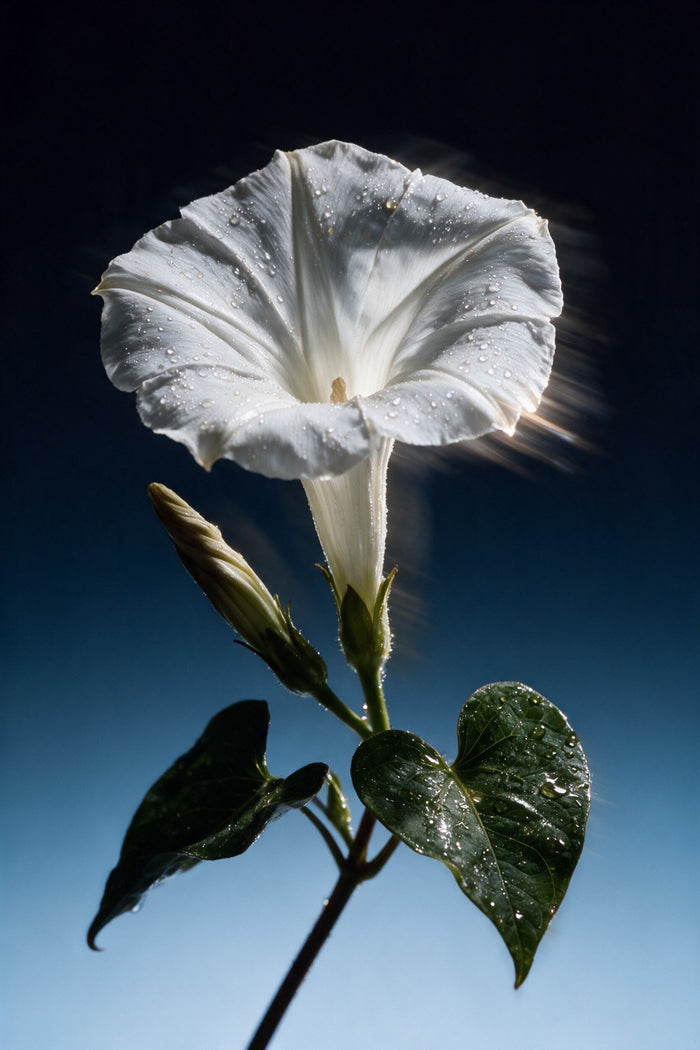
The moonflower is a morning glory that opens in minutes at dusk and has been confused with other plants since at least 1889. What the sources say of its nectar, its seeds and its namesakes.

Gardenia: Why Perfumers Call It The Impossible Flower
A gardenia absolute was made by enfleurage in 2015 and judged close to the fresh flower, so the flower is not beyond extraction. Its names, its range, the molecules of the accord and the growers' advice, from sources ...
Next
Perfumery Journal
Tuberose: The Night-Blooming Flower That Divides
05.11.25