


2-Phenylpropionic acid
Mots-clés : floral · honey · balsamic
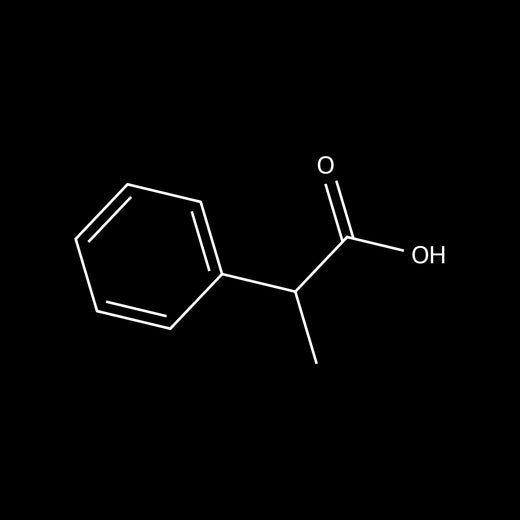
2-Phenylpropionic acid is a 2-arylpropionic acid with a phenyl group at position 2, and it smells floral, honey-like and balsamic.
2-Phenylpropionic acid · Facettes
Entrées du glossaire portant chaque facette, sur 3 979 :
- floral 1 547
- honey 97
- balsamic 344
- green 1 442
- mimosa 8
- woody 790
2-Phenylpropionic acid · Sentir
2-Phenylpropionic acid smells floral, honey-like and balsamic, with green and woody touches.
2-Phenylpropionic acid · En parfumerie
It is a fragrance ingredient with a floral, honey-like and balsamic character.
Pyramide
2-Phenylpropionic acid : Cœur. Entrées du glossaire classées à chaque étage de la pyramide, sur 4 000 (35 n'en classent aucun) :
- Tête 718
- Tête · Cœur 496
- Cœur 1 644
- Cœur · Fond 513
- Fond 594
2-Phenylpropionic acid · En profondeur
Identity
2-Phenylpropionic acid has the CAS number 492-37-5 and the formula C₉H₁₀O₂. Its molecular weight is 150.17 g/mol and its IUPAC name is 2-phenylpropanoic acid. It is a 2-arylpropionic acid carrying a phenyl group at position 2, and it is also called hydratropic acid. It is a metabolite of α-methylstyrene, a volatile hydrocarbon, and acts as a human xenobiotic metabolite.
Odour
It smells floral, honey-like and balsamic, with green and woody touches. Its odour can be powerful and dry, green-floral and balsamic-woody, of the mimosa-gardenia type, with moderate to poor tenacity. It can also be a heavy-sweet floral, honey-like odour of good tenacity but not very powerful.
Occurrence in nature
It occurs in Aloe africana, Alpinia officinarum, Escherichia coli, Fragaria, Glycyrrhiza glabra, Hoya australis, Hoya bandaensis, Hoya bella, Hoya cinnamomifolia, Hoya coronaria, Hoya crassipes and Hoya diversifolia.
Use in flavours
It is used as a flavouring agent.
Properties
Its logP is 1.8.
Safety and IFRA
In the 51st Amendment in force, no IFRA Standard covers this material itself. Its EC number is 207-752-0. It causes skin irritation (H315, 98% of reports) and serious eye irritation (H319, 98%), and may cause respiratory irritation (H335, 86%).
2-Phenylpropionic acid · Fiche technique
Masse moléculaire
150.17 g/mol Plus lourd que 36 des 885 autres entrées au même niveau de la pyramide pour lesquelles un poids est enregistré; 16 pèsent le même poids
2 572 entrées enregistrent un poids moléculaire. Par place dans la pyramide : Tête 547, Tête · Cœur 406, Cœur 886, Cœur · Fond 455, Fond 278.
Identité
- Type
- Ingrédient
- Catégorie
- Molécules aromatiques
Classification
- Famille olfactive
- Gourmand · 495 entrées du glossaire dans cette famille
- Sous-famille
- Notes miellées · 23 entrées de cette sous-famille
- Cluster
- Gourmands miellés · 22 entrées de ce groupe
- Classe chimique
- Carboxylic acid
Données chimiques
- Formule
- C9H10O2
- Numéro CAS
- 492-37-5
- PubChem CID
- 10296, compound record on PubChem
- InChIKey
- YPGCWEMNNLXISK-UHFFFAOYSA-N
- Wikidata
- Q27121253, item on Wikidata
Propriétés physiques
- Log P
- 1.8
Performances et règles
- Pyramide
- Note de cœur
- Statut IFRA
- No IFRA Standard for the material itself (51st Amendment)
2-Phenylpropionic acid · Voir aussi
Entrées liées à 2-Phenylpropionic acid, selon leur place dans la pyramide. « partagé » signale un mot olfactif que 2-Phenylpropionic acid possède aussi.
Notes de cœur

Éthyl 3-phénylpropionate
fruité · miel · jacinthe Floraux / 178.23 g/mol
Isobutyrate de diméthylphényléthylcarbinyle
fruité · tropical · herbacé Fruité / Cœur · Fond / 234.33 g/mol
1-Ethyl-1-methyl-3-phenylpropyl acetate
floral (partagé) · vert (partagé) · jacinthe Floraux / Cœur · Fond / 220.31 g/mol


2-Phenylpropionic acid · Sources
- PubChem 2-Phenylpropionic acid
- ChEBI 2-Phenylpropionic acid: chemical classification record
- Pyrfume Arctander, Perfume and Flavor Chemicals: odour descriptions (Pyrfume archive)
- Pyrfume Leffingwell odour data (Pyrfume archive)
- European Chemicals Agency 2-Phenylpropionic acid: substance record
- Wikidata (LOTUS natural products data) 2-Phenylpropionic acid: organisms it is reported in, with the papers
- IFRA Standards, 51st Amendment
Citer comme Glossaire PREMIEREPEAU, « 2-Phenylpropionic acid », https://premierepeau.com/
