


Erythorbic Acid
Mots-clés : vanilla · woody
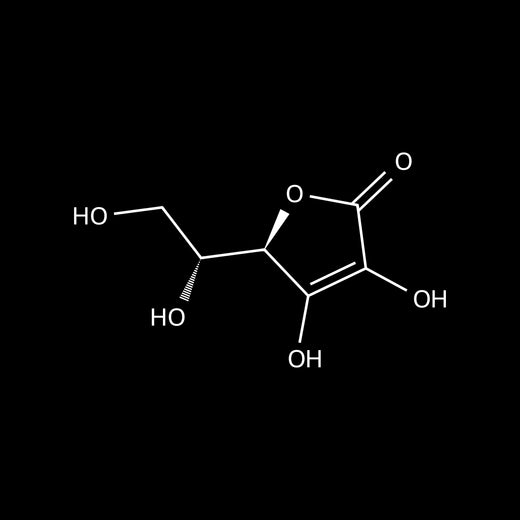
Erythorbic Acid is an isomer of ascorbic acid, a white to slightly yellow crystalline solid. It is odourless.
- Famille olfactive
- Gourmand · 495 entrées du glossaire dans cette famille Sous-famille : Famille vanille · 64 entrées de cette sous-famille Cluster : Gourmands vanillés · 57 entrées de ce groupe
- Matière
- Naturel et synthétique
- Pyramide
- Note de cœur
Erythorbic Acid · Facettes
Entrées du glossaire portant chaque facette, sur 3 979 :
- vanilla 79
- woody 790
Erythorbic Acid · Sentir
It has no odour of its own at full strength.
Erythorbic Acid · En parfumerie
Erythorbic acid is odourless, so it adds no scent of its own.
Pyramide
Erythorbic Acid : Cœur. Entrées du glossaire classées à chaque étage de la pyramide, sur 4 000 (35 n'en classent aucun) :
- Tête 718
- Tête · Cœur 496
- Cœur 1 644
- Cœur · Fond 513
- Fond 594
Erythorbic Acid · Extraction et chimie
Erythorbic acid is synthesised by the reaction between methyl 2-keto-D-gluconate and sodium methoxide. It can also be synthesised from sucrose and produced from Penicillium spp.
- Apparence
- White to slightly yellow crystalline solid
Erythorbic Acid · En profondeur
Identity
Erythorbic Acid has the CAS number 89-65-6 and the IUPAC name (2R)-2-[(1R)-1,2-dihydroxyethyl]-3,4-dihydroxy-2H-furan-5-one. Its molecular formula is C₆H₈O₆ and its molecular weight is 176.12 g/mol.
It belongs to the ascorbic acid class and is an isomer of ascorbic acid.
Odour
Erythorbic Acid is odourless, although vanilla and woody are also named for it. At 100 % it has no odour.
Occurrence in nature
It occurs in Flammulina velutipes, Grifola frondosa and Hypsizygus marmoreus.
Production
Erythorbic acid is synthesised by the reaction between methyl 2-keto-D-gluconate and sodium methoxide. It can also be synthesised from sucrose and produced from Penicillium spp.
Use in flavours
Erythorbic acid is added to food as an antimicrobial agent, antioxidant, colour or colouring adjunct, curing or pickling agent, flavour enhancer and flavouring agent or adjuvant. It is used as an antioxidant in the brewing industry and as a reducing agent in photography.
Properties
It forms shiny granular crystals from water or dioxane, and darkens gradually on exposure to light.
It melts at about 164 °C to 172 °C with decomposition. It dissolves to the extent of 40 g in 100 mL of water at 25 °C and is soluble in alcohol and pyridine.
Its estimated logP is -2.779.
Safety and IFRA
The 51st Amendment is in force, and no IFRA Standard covers this material itself.
Its INCI name is ERYTHORBIC ACID, and its function in cosmetics is antioxidant. Its EC number is 201-928-0 and it is registered under REACH.
Erythorbic Acid · Fiche technique
Masse moléculaire
176.12 g/mol Plus lourd que 538 des 885 autres entrées au même niveau de la pyramide pour lesquelles un poids est enregistré
2 572 entrées enregistrent un poids moléculaire. Par place dans la pyramide : Tête 547, Tête · Cœur 406, Cœur 886, Cœur · Fond 455, Fond 278.
Identité
- Type
- Ingrédient
- Catégorie
- Molécules aromatiques
Classification
- Classe chimique
- Carboxylic acid
Données chimiques
- Formule
- C6H8O6
- Numéro CAS
- 89-65-6
- PubChem CID
- 54675810, compound record on PubChem
- InChIKey
- CIWBSHSKHKDKBQ-DUZGATOHSA-N
- Wikidata · Wikipedia
- Erythorbic Acid: Q424531, item on Wikidata · Wikipedia, English article
Propriétés physiques
- Point d'ébullition
- 552 to 553 °C at 760 mmHg (estimated)
- Point de fusion
- 164 to 171 °C at 760 mmHg
- Point d'éclair
- > 110 °C (> 230 °F)
- Log P
- -2.779 (estimated)
Performances et règles
- Disponible en
- synthetic
- Statut IFRA
- No IFRA Standard for the material itself (51st Amendment)
Erythorbic Acid · Voir aussi
Entrées liées à Erythorbic Acid, selon leur place dans la pyramide.
Notes de cœur

Acide tartrique DL
caramélique · douce Gourmand / 150.09 g/mol

Erythorbic Acid · Sources
- PubChem Erythorbic Acid
- The Good Scents Company Information System Erythorbic Acid: data sheet
- ChEBI Erythorbic Acid: chemical classification record
- Pyrfume Good Scents odour data (Pyrfume archive)
- Pyrfume Leffingwell odour data (Pyrfume archive)
- Wikidata (LOTUS natural products data) Erythorbic Acid: organisms it is reported in, with the papers
- IFRA Standards, 51st Amendment
- European Commission, CosIng Erythorbic Acid: cosmetic ingredient record
- European Chemicals Agency Erythorbic Acid: substance record
Citer comme Glossaire PREMIEREPEAU, « Erythorbic Acid », https://premierepeau.com/
