


Pyrrole
Mots-clés : ethereal · sweet · burnt
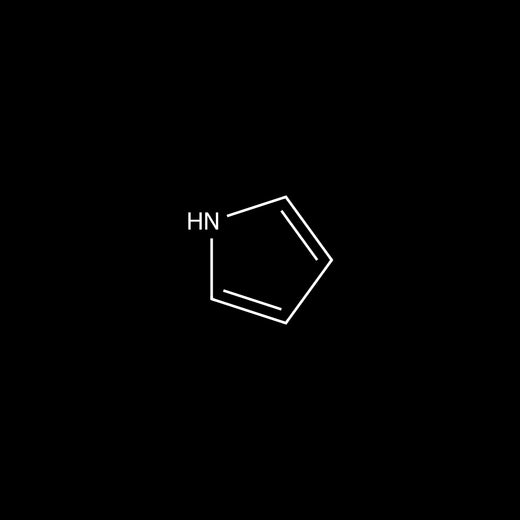
Pyrrole is a secondary amine, a colourless to yellowish liquid with a sweet, warm, nutty and ethereal odour.
- Famille olfactive
- Gourmand · 495 entrées du glossaire dans cette famille Sous-famille : Notes de fruits à coque · 88 entrées de cette sous-famille
- Matière
- Naturel et synthétique
- Pyramide
- Note de tête
Pyrrole · Facettes
Entrées du glossaire portant chaque facette, sur 3 979 :
- ethereal 184
- sweet 1 987
- burnt 75
- nutty 259
Pyrrole · Sentir
It smells sweet and warm, with ethereal, nutty and burnt facets.
Pyrrole · En parfumerie
Its odour is sweet and warm-ethereal, slightly burnt and nauseating.
Pyramide
Pyrrole : Tête. Entrées du glossaire classées à chaque étage de la pyramide, sur 4 000 (35 n'en classent aucun) :
- Tête 718
- Tête · Cœur 496
- Cœur 1 644
- Cœur · Fond 513
- Fond 594
Pyrrole · Extraction et chimie
It is a constituent of coal tar and bone oil. It is made by reacting ammonia with acetylene or butadiene. It also forms by thermal decomposition of ammonium mucate with glycerol or mineral oil, and on heating albumin or sheep's wool with aqueous barium hydroxide solution, or by pyrolysis of gelatin.
- Apparence
- A colourless to yellowish liquid that darkens on standing
Pyrrole · Le saviez-vous ?
It was found potentially useful as a tracer for the contribution of environmental tobacco smoke to volatile organic compounds in indoor environments with smoking.
Pyrrole · En profondeur
Identity
Pyrrole, named 1H-pyrrole in systematic terms, has the CAS number 109-97-7, the formula C₄H₅N and a molecular weight of 67.09 g/mol. It is a secondary amine and a pyrrole.
Odour
It smells sweet and warm, with ethereal, nutty and burnt facets. Arctander calls the odour sweet and warm-ethereal, slightly burnt and nauseating, while PubChem cites an agreeable, empyreumatic odour resembling that of chloroform.
Occurrence in nature
It has been reported in Coffea arabica, Nicotiana tabacum, Pistacia vera, Tamarindus indica and Zea mays.
Production
It is a constituent of coal tar and bone oil. It is made by reacting ammonia with acetylene or butadiene. It also forms by thermal decomposition of ammonium mucate with glycerol or mineral oil, and on heating albumin or sheep's wool with aqueous barium hydroxide solution, or by pyrolysis of gelatin.
Use in perfumery
It is used as a chemical intermediate for perfumes.
Use in flavours
It is used as a flavouring agent, with a burning, pungent taste. No safety concern arises at current levels of intake when it is used as a flavouring agent.
Properties
It is a colourless liquid when fresh, and it darkens on standing and turns brown when polymerised by light. It is hygroscopic. It boils at 129.7 °C and melts at -23.4 °C. Its density is 0.9698 at 20 °C, and its flash point is 33.33 °C. It dissolves in water at 45 mg/mL at 25 °C, and it is soluble in alcohol, ether, dilute acids and most fixed oils.
Safety and IFRA
No IFRA Standard covers this material itself. Its EC number is 203-724-7, and it is registered under REACH.
Pyrrole · Fiche technique
Masse moléculaire
67.09 g/mol Plus lourd que 33 des 546 autres entrées au même niveau de la pyramide pour lesquelles un poids est enregistré
2 572 entrées enregistrent un poids moléculaire. Par place dans la pyramide : Tête 547, Tête · Cœur 406, Cœur 886, Cœur · Fond 455, Fond 278.
Identité
- Type
- Ingrédient
- Catégorie
- Molécules aromatiques
Classification
- Cluster
- Notes de fruits à coque · 100 entrées de ce groupe
Données chimiques
- Formule
- C4H5N
- Numéro CAS
- 109-97-7
- PubChem CID
- 8027, compound record on PubChem
- InChIKey
- KAESVJOAVNADME-UHFFFAOYSA-N
- Wikidata
- Pyrrole: Q242627, item on Wikidata · Wikipedia, English article
Propriétés physiques
- Point d'ébullition
- 130 to 131 °C at 760 mmHg
- Point de fusion
- -23 °C at 760 mmHg
- Point d'éclair
- 33.33 °C (92 °F)
- Densité
- 0.955-0.975
- Pression de vapeur
- 12.234 mmHg at 25 °C (estimated)
- Log P
- 0.75
Performances et règles
- Disponible en
- synthetic
- Statut IFRA
- No IFRA Standard for the material itself (51st Amendment)
Pyrrole · Voir aussi
Entrées liées à Pyrrole, selon leur place dans la pyramide. « partagé » signale un mot olfactif que Pyrrole possède aussi.
Notes de tête

2-Acétylpyrrole
moisi · de fruits à coque (partagé) · noix Gourmand / Même famille olfactive / 109.13 g/mol
4,4-Dimethoxy-2-butanone
herbal · sweet (partagé) · musty Gourmand / Top · Heart / Même famille olfactive / 132.16 g/mol
1-Furfurylpyrrole
légume · vert · terreux Vert / Tête · Cœur / 147.17 g/mol


Notes de cœur

Indole
floral · animal · narcotique Animal / Naturel & Synthétique / 117.15 g/mol

Pyrrole · Sources
- PubChem Pyrrole
- ChEBI Pyrrole: chemical classification record
- Pyrfume Arctander, Perfume and Flavor Chemicals: odour descriptions (Pyrfume archive)
- Pyrfume Good Scents odour data (Pyrfume archive)
- Pyrfume Leffingwell odour data (Pyrfume archive)
- Wikidata (LOTUS natural products data) Pyrrole: organisms it is reported in, with the papers
- The Good Scents Company Information System Pyrrole: data sheet
- IFRA Standards, 51st Amendment
- European Chemicals Agency Pyrrole: substance record
Citer comme Glossaire PREMIEREPEAU, « Pyrrole », https://premierepeau.com/
