


Tridecanoic acid
Mots-clés : waxy · woody · fatty
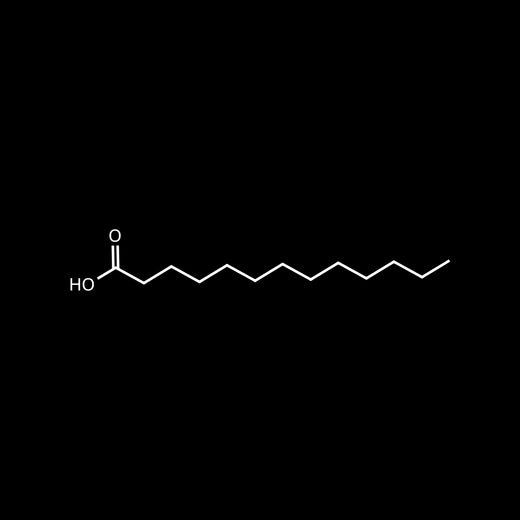
Tridecanoic acid is a straight-chain saturated fatty acid with a very faint waxy-woody odour. It is a white to off-white solid.
Tridecanoic acid · Facettes
Entrées du glossaire portant chaque facette, sur 3 979 :
- waxy 212
- woody 790
- fatty 268
Tridecanoic acid · Sentir
It smells waxy and woody, with a fatty edge, and its odour is very faint.
Tridecanoic acid · En parfumerie
It offers a very faint waxy-woody odour, and a highly purified material may be virtually odourless.
Pyramide
Tridecanoic acid : Cœur · Fond. Entrées du glossaire classées à chaque étage de la pyramide, sur 4 000 (35 n'en classent aucun) :
- Tête 718
- Tête · Cœur 496
- Cœur 1 644
- Cœur · Fond 513
- Fond 594
Tridecanoic acid · En profondeur
Identity
Its IUPAC name is tridecanoic acid and its CAS number is 638-53-9. Its molecular formula is C₁₃H₂₆O₂ and its molecular weight is 214.34 g/mol. It is a straight-chain saturated fatty acid with thirteen carbons, and it also acts as a plant metabolite. It is produced within the human body as a metabolite.
Odour
It smells waxy and woody, with a fatty edge. Its odour is very faint and waxy-woody, and a highly purified material may be virtually odourless.
Occurrence in nature
It is found in Agelas, Arnica montana, Bellis perennis, Caenorhabditis elegans, Carica papaya, Cucumis melo and Dictamnus albus, among other organisms.
Use in flavours
It is used as a flavouring agent. The Joint FAO/WHO Expert Committee on Food Additives found no safety concern at current levels of intake when it is used as a flavouring agent.
Properties
It boils at 312.4 °C and melts at 44.5 °C. Its flash point is 112.78 °C. It has an estimated logP of 5.282 and an estimated vapour pressure of 0.000299 mmHg at 25 °C. Its solubility in water is 33 mg/L at 20 °C.
Safety and IFRA
No IFRA Standard covers this material itself, as of the 51st Amendment. Its EC number is 211-341-1. It causes skin irritation and serious eye irritation, and it may cause respiratory irritation.
Tridecanoic acid · Fiche technique
Masse moléculaire
214.34 g/mol Plus lourd que 259 des 454 autres entrées au même niveau de la pyramide pour lesquelles un poids est enregistré; 13 pèsent le même poids
2 572 entrées enregistrent un poids moléculaire. Par place dans la pyramide : Tête 547, Tête · Cœur 406, Cœur 886, Cœur · Fond 455, Fond 278.
Identité
- Type
- Ingrédient
- Catégorie
- Molécules aromatiques
Classification
- Famille olfactive
- Bois · 363 entrées du glossaire dans cette famille
- Sous-famille
- Bois classiques · 130 entrées de cette sous-famille
- Cluster
- Bois terreux · 236 entrées de ce groupe
- Classe chimique
- Carboxylic acid
Données chimiques
- Formule
- C13H26O2
- Numéro CAS
- 638-53-9
- PubChem CID
- 12530, compound record on PubChem
- InChIKey
- SZHOJFHSIKHZHA-UHFFFAOYSA-N
- Apparence
- White to off-white solid
Propriétés physiques
- Point d'ébullition
- 312 to 313 °C at 760 mmHg
- Point de fusion
- 41 to 43 °C at 760 mmHg
- Point d'éclair
- 112.78 °C (235 °F)
- Pression de vapeur
- 0.000299 mmHg at 25 °C (estimated)
- Log P
- 5.282 (estimated)
Performances et règles
- Pyramide
- Cœur à fond
- Statut IFRA
- No IFRA Standard for the material itself (51st Amendment)
Tridecanoic acid · Voir aussi
Entrées liées à Tridecanoic acid, selon leur place dans la pyramide. « partagé » signale un mot olfactif que Tridecanoic acid possède aussi.
Notes de tête

Tridécanal
agrumes · cireux (partagé) · aldéhydé Agrumes / 198.34 g/mol

Notes de cœur

1-Tridécanol
boisé (partagé) · fruité · cireux (partagé) Bois / Cœur · Fond / Même famille olfactive / Naturel et synthétique / 200.36 g/mol
Aloe Vera
plante succulente · gel de feuille Aromatique / Naturel
Acide laurique
gras · cireux (partagé) · frais Vert / Cœur · Fond / 200.32 g/mol


Tridecanoic acid · Sources
- PubChem Tridecanoic acid
- ChEBI Tridecanoic acid: chemical classification record
- Pyrfume Arctander, Perfume and Flavor Chemicals: odour descriptions (Pyrfume archive)
- Pyrfume Good Scents odour data (Pyrfume archive)
- Pyrfume Leffingwell odour data (Pyrfume archive)
- Wikidata (LOTUS natural products data) Tridecanoic acid: organisms it is reported in, with the papers
- The Good Scents Company Information System Tridecanoic acid: data sheet
- IFRA Standards, 51st Amendment
- European Chemicals Agency Tridecanoic acid: substance record
Citer comme Glossaire PREMIEREPEAU, « Tridecanoic acid », https://premierepeau.com/fr/pages/glossary-terms/tridecanoic-acid Mis à jour 2026-11-20
