


(−)-Bornyl acetate
Keywords: pine · herbal · balsamic
(−)-Bornyl acetate is a colourless liquid or crystalline solid with a sweet, woody, fresh pine needle odour.
- Olfactive family
- Woods · 362 entries of the glossary in this family Subfamily: Coniferous woods · 30 entries in this subfamily Cluster: Camphoraceous aromatics · 114 entries in this cluster
- Pyramid
- Heart · Base · Volatility: Heart · Base
- Strength
- Medium Step 3 of 5 · shared by 1,473 of 2,156 graded entries Graded entries at each step, from 1 to 5: 4, 119, 1,473, 498, 39. 23 more sit between two steps.
- Also called
- L-bornyl acetate, (−)-Borneol acetate, Bornyl acetic ether
Family, subfamily and cluster: PREMIEREPEAU house classification, version 2026‑11.
(−)-Bornyl acetate · Facets
Entries of the glossary that carry each facet, of 3,979:
- pine 61
- herbal 757
- balsamic 343
- woody 792
- sweet 1,988
- cedar 20
(−)-Bornyl acetate · Scent
The odour is sweet, balsamic and woody, with fresh pine needle and herbal notes.
(−)-Bornyl acetate · In Perfumery
It is a fragrance ingredient with a balsamic, woody, pine needle character.
Pyramid
(−)-Bornyl acetate: Heart · Base. Entries of the glossary stored at each place of the pyramid, of 4,006 (42 store no place):
- Top 718
- Top · Heart 497
- Heart 1,641
- Heart · Base 514
- Base 594
(−)-Bornyl acetate · In Depth
Identity
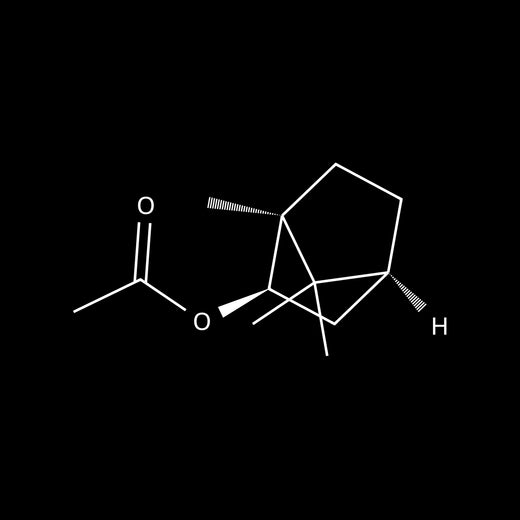
(−)-Bornyl acetate has the CAS number 5655-61-8 and the molecular formula C₁₂H₂₀O₂. Its molecular weight is 196.29 g/mol and its IUPAC name is [(1S,2R,4S)-1,7,7-trimethyl-2-bicyclo[2.2.1]
Odour
Its odour is sweet, balsamic and woody, with a fresh pine and herbal character. Its odour type is balsamic and its odour strength is medium. Its substantivity is 24 hours.
Occurrence in nature
It occurs in the essential oils of some plants. It occurs in Abies alba, Achillea millefolium, Acorus calamus and Artemisia vulgaris.
Use in perfumery
It is used in fragrances. Its cosmetic use is as a perfuming agent.
Use in flavours
It is used as a flavouring agent. Its flavour profile is herb and pine, and also floral.
Properties
It boils at 223 to 224 °C at 760 mmHg and melts at 27 to 29 °C. Its flash point is 84.44 °C. Its logP is 3.6. Its density is 0.981–0.985 and its refractive index is 1.462–1.466. Its vapour pressure is 0.6 mmHg at 20 °C. It is insoluble in glycerin, propylene glycol and water.
Safety and IFRA
No IFRA Standard covers this material itself. Its registered name is L-born-2-yl acetate, its EC number is 227-101-4 and it is registered under REACH. It does not meet GHS hazard criteria in 1557 of 1557 reports.
(−)-Bornyl acetate · Technical Sheet
Molecular weight
196.29 g/mol Heavier than 41 of the 451 other entries at the same place of the pyramid that store a weight; 15 weigh the same.
2,515 entries store a molecular weight. By place in the pyramid: Top 537, Top · Heart 403, Heart 861, Heart · Base 452, Base 262.
Identity
- Type
- Ingredient
- Category
- Aroma chemicals
Classification
- Chemical class
- Ester
Chemical data
- Formula
- C12H20O2
- CAS
- 5655-61-8
- Reported in plants
- Valeriana officinalis (12 papers; one: Journal of essential oil research 2000, Valeriana officinalis) · Abies sibirica (3 papers; one: Chem Nat Compd 1983, Abies sibirica) · Artemisia vulgaris (3 papers; one: J Chem Ecol 1985, Artemisia vulgaris) · Picea abies (3 papers; one: Planta Med 1977, Picea abies) · Abies sachalinensis (2 papers; one: Phytochemistry 1993, Abies sachalinensis) · Cistus creticus (2 papers; one: Journal of essential oil research 1994, Cistus creticus) · LOTUS
- PubChem CID
- 93009, compound record on PubChem
- InChIKey
- KGEKLUUHTZCSIP-HOSYDEDBSA-N
Physical properties
- Appearance
- Colourless or white clear liquid or crystals, by estimate
- Boiling point
- 223 to 224 °C at 760 mmHg
- Melting point
- 27 to 29 °C
- Flash point
- 84.44 °C (184 °F)
- Density
- 0.981–0.985
- Refractive index
- 1.462 to 1.466
- Vapour pressure
- 0.6 mmHg at 20 °C
- Log P
- 3.6
Performance and rules
- Tenacity
- 24 hours
- IFRA status
- No IFRA Standard for the material itself (51st Amendment)
(−)-Bornyl acetate · See Also
Entries related to (−)-Bornyl acetate, by their place in the pyramid. “shared” marks a scent word (−)-Bornyl acetate has too.
Top notes
-
Douglas Fir
coniferous · green · balsamic (shared) Woods / Top · Heart / Same cluster / Natural 
(3,5-dimethylcyclohex-3-en-1-yl)
methyl acetate
petal · floral · citrus Citrus / 182.26 g/mol

Heart notes

Isobornyl formate
earthy · green · pine (shared) Aromatic / Same cluster / 182.26 g/mol
Isobornyl isobutyrate
earthy · nutty · herbal (shared) Aromatic / Heart · Base / Same cluster / 224.34 g/mol
Bornyl butyrate
herbal (shared) · woody (shared) · fruity Woods / Heart · Base / 224.34 g/mol
Methyl 2,2-dimethylbicyclo(2.2.1)
heptane-3-carboxylate
fruity · fir needle · balsamic (shared) Woods / 182.26 g/mol
Conifer acetate
balsamic (shared) · woody (shared) · camphoraceous Woods / Heart · Base / Synthetic / 212.33 g/mol
Allyl cyclohexanepropionate
pineapple · fruity · sweet (shared) Fruity / Heart · Base / 196.29 g/mol
Fenchyl acetate
sweet (shared) · herbal (shared) · fresh Aromatic / Heart · Base / 196.29 g/mol
Allyl cyclohexaneacetate
fruity · sweet (shared) · ethereal Fruity / Synthetic / 182.26 g/mol
Dihydrocarvyl acetate
floral · rose · sweet (shared) Aromatic / Heart · Base / 196.29 g/mol
[(6E)-3,7-dimethylnona-1,6-dien-3-yl] acetate
floral · fruity · fresh Florals / Heart · Base / 210.31 g/mol
[(3E,6Z)-nona-3,6-dienyl] acetate
fresh · fruity · green Fruity / 182.26 g/mol
Methyl 2-undecynoate
floral · green · violet Green / Heart · Base / Synthetic / 196.29 g/mol
Bornyl formate
earthy · green · pine (shared) Earthy / 182.26 g/mol
Isobornyl propionate
herbal (shared) · fruity · pine (shared) Aromatic / Heart · Base / 210.31 g/mol


Base notes

Isobornyl benzoate
balsamic (shared) · pine (shared) · herbal (shared) Resinous / 258.35 g/mol

(−)-Bornyl acetate · Sources
- PubChem Bornyl acetate, (−)-
- The Good Scents Company Information System Bornyl acetate, (−)-: data sheet
- Pyrfume Arctander, Perfume and Flavor Chemicals: odour descriptions (Pyrfume archive)
- Pyrfume Good Scents odour data (Pyrfume archive)
- Pyrfume Leffingwell odour data (Pyrfume archive)
- IFRA Standards, 51st Amendment
- European Chemicals Agency Bornyl acetate, (−)-: substance record
Cite as PREMIEREPEAU Glossary, “(-)-Bornyl acetate”, https://premierepeau.com/

