


Siberian Fir
Keywords: woody · coniferous · balsamic
Siberian fir is Abies sibirica, a coniferous evergreen tree of the family Pinaceae, and the essential oil of its leaves is used in perfumes. The oil has a woody, coniferous and balsamic scent.
- Olfactive family
- Woods · 362 entries of the glossary in this family Subfamily: Coniferous woods · 30 entries in this subfamily Cluster: Camphoraceous aromatics · 114 entries in this cluster
- Material
- Natural Leaves (needles)
- Pyramid
- Heart · Volatility: Heart Note
- Also called
- Essential oil of Siberian fir
Family, subfamily and cluster: PREMIEREPEAU house classification, version 2026‑11.
Siberian Fir · Facets
Entries of the glossary that carry each facet, of 3,979:
- woody 792
- coniferous 21
- balsamic 343
- fruity 1,301
- green 1,442
- pine 61
Siberian Fir · Scent
The oil is described as woody, mossy, coniferous, fruity and balsamic.
Evolution over time
Siberian Fir: scent over time.
- Immediately
Coniferous and fruity.
Scent words: fruity - After a few hours
Woody and balsamic.
Scent words: balsamic · woody - After a few days
Mossy.
Siberian Fir · In Perfumery
Water-steam distilled Siberian fir oil, characterised by high α-pinene content, suits the perfumery and aromatherapy markets.
Pyramid
Siberian Fir: Heart. Entries of the glossary stored at each place of the pyramid, of 4,006 (42 store no place):
- Top 718
- Top · Heart 497
- Heart 1,641
- Heart · Base 514
- Base 594
Role in the formula
Siberian Fir: roles in the formula. Entries of the glossary that share each role, of 4,006:
- Backbone 196
- Freshness 720
- Modifier 1,167
- Perfuming agent 43
Siberian Fir · Extraction & Chemistry
Abies sibirica oil can be obtained by water steam distillation, by supercritical CO₂ extraction (40 °C, 10 MPa) or by microwave steam distillation (400 W, 30 min). The oil from trees growing in the Kirov region was obtained by steam distillation.
Available as
Siberian Fir: available as.
- essential oil
- CO2 extract
Siberian Fir · Did You Know?
The tree survives temperatures down to −50 °C (−58 °F). It grows as far north as 67°N in Siberia.
Siberian Fir · In Depth
The tree
Siberian fir, Abies sibirica, is a coniferous evergreen tree native to the taiga east of the Volga River and south of 67°40′ North latitude in Siberia through Turkestan, northeast Xinjiang, Mongolia and Heilongjiang. It grows 30–35 metres tall with a conical crown. The leaves are needle-like and 2–3 centimetres long on average. They are soft, flattened and strongly aromatic. The wood is soft, lightweight and weak, and it is used in construction, furniture and wood pulp.
Chemistry
Bornyl acetate, α-pinene and camphene are the main compounds of the Abies essential oils compared in one analysis. The extraction method has a marked influence on the composition of Siberian fir oil. Water-steam distillation gives oils dominated by volatile monoterpenes, including α-pinene (15.81%), camphene (15.83%) and 3-carene (15.04%).
Supercritical CO₂ extraction gives a profile enriched in bornyl acetate (40.0%) and in sesquiterpenes such as copaene (0.063%). In oil from Siberian fir growing in the Kirov region, oxygenated terpene derivatives, with bornyl acetate, predominate. Bornyl acetate is the acetate ester of the terpenoid borneol. Pinaceae needle oils contain (−)-bornyl acetate as their main odoriferous component.
Standard
The oil is covered by the international standard ISO 10869. It specifies certain characteristics of Siberian fir needle oil in order to facilitate assessment of its quality.
Siberian Fir · Technical Sheet
Identity
- Botanical
- Abies sibirica
- Taxonomy
- Pinales order › Pinaceae family › Abies genus · GBIF
- Botanical records
- Abies sibirica: POWO, Abies sibirica · IPNI, Abies sibirica · GBIF, Abies sibirica · Wikidata, Abies sibirica · Wikipedia, Abies sibirica · IUCN Least concern (LC), Abies sibirica
- IPNI
- Abies sibirica Ledeb., Fl. Altaic. [Ledebour]. 4: 202 (1833) — Ledebour, Carl(Karl) Friedrich von (1785–1851)
- Type
- Ingredient
- Category
- Woods and mosses
In Nature
- Recorded altitude
- 500–1,300 m · median 700 m · 2,017 records with an altitude · GBIF
- Wild or cultivated
- 7 native · 3 introduced · 38 cultivated among 9,261 records (the rest carry no such mark) · GBIF
- Recorded in
- 36 of 512 squares of the world grid; a brighter dot holds more records · GBIF
- Also from this genus
- Abies: Canadian Balsam · East Himalayan Fir · Fir · Grand Fir · Pacific Silver Fir · Sakhalin Fir · Subalpine Fir · White Fir
- Also from this botanical family
- Pinaceae: Aleppo Pine · Arolla Pine · Austrian Pine · Black Hemlock or Tsuga · Black Spruce · Cedar Roots · 11 more entries
In Print
- Timeline
- first described 1833 · earliest aroma paper in Europe PMC, 2014
- In English books
- most mentioned in the 1970s · Google Books Ngram
Chemical data
- Most reported compounds
- Levomenol (4 papers; one: Chem Nat Compd 1984, Levomenol) · Borneol (3 papers; one: Chem Nat Compd 1984, Borneol) · Nerolidol (3 papers; one: Chem Nat Compd 1984, Nerolidol) · (−)-Bornyl acetate (3 papers; one: Chem Nat Compd 1984, (−)-Bornyl acetate) · 3-Carene (2 papers; one: Chem Nat Compd 1984, 3-Carene) · LOTUS
- Structure
- Alpha-Pinene, Camphene:
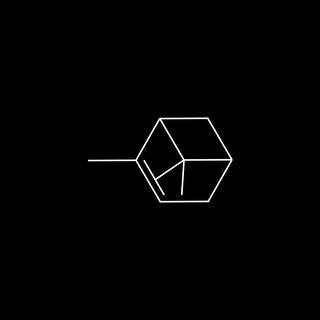
Alpha-Pinene
PubChem, Alpha-Pinene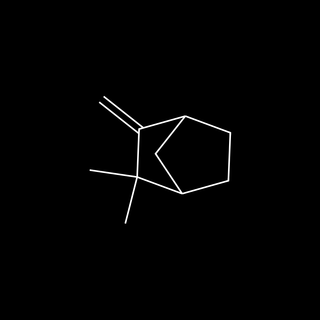
Camphene
PubChem, Camphene - Compound classes reported
- Monoterpenoids 23 % · Sesquiterpenoids 23 % · Triterpenoids 27 % · Diterpenoids 15 % · of 108 compounds reported, 11 % of them esters · LOTUS
Labelling
- Forms in the EU cosmetic inventory
- Siberian Fir: ABIES SIBIRICA NEEDLE OIL · ABIES SIBIRICA NEEDLE EXTRACT · ABIES SIBIRICA OIL
- EU allergens reported
- Limonene · Geraniol · Citronellol · Pinene · Terpineol · Terpinolene · Beta-Caryophyllene · Camphor · Vanillin
Physical properties
- Flash point
- 100 °F (37 °C)
Performance and rules
- IFRA status
- No IFRA Standard for the material itself (51st Amendment)
Siberian Fir · See Also
Entries related to Siberian Fir, by their place in the pyramid. “shared” marks a scent word Siberian Fir has too.
Top notes
-
White Fir
coniferous (shared) · woody (shared) · green (shared) Woods / Top · Heart / Same cluster / Natural -
Grand Fir
fresh · green (shared) · coniferous (shared) Woods / Top · Heart / Same cluster / Natural -
Pacific Silver Fir
coniferous (shared) · fresh · woody (shared) Woods / Top · Heart / Same cluster / Natural
Heart notes
-
East Himalayan Fir
coniferous (shared) · woody (shared) · green (shared) Woods / Same cluster / Natural -
Sakhalin Fir
coniferous (shared) · balsamic (shared) · fresh Woods / Same cluster / Natural -
Subalpine Fir
fresh · woody (shared) · balsam Woods / Same subfamily / Natural 
Fir
fresh · woody (shared) · balsamic (shared) Woods / Heart · Base / Natural
Conifer acetate
balsamic (shared) · woody (shared) · camphoraceous Woods / Heart · Base / Synthetic
Maltol
gourmand · caramel · sweet Gourmand / Semi-synthetic


Base notes

Cedarwood
woody (shared) · dry · clean Woods / Natural
Canadian Balsam
balsamic (shared) · woody (shared) · warm Resinous / Natural


Siberian Fir · Sources
- GBIF Abies sibirica (GBIF species record)
- International Plant Names Index (IPNI) Abies sibirica Ledeb.
- Pharmaceutics Comparative Phytochemical Profiling of Essential Oils from Selected Abies Species and Analysis of Their Antifungal and Antiradical Activity
- Scientific Reports Composition and antioxidant activity of Abies marocana essential oil
- chemistry of plant raw material Composition and properties of essential oil of Siberian fir Abies sibirica Ldb., growing in different areas of the Kirov region
- IFRA Standards, 51st Amendment
- Wikipedia Abies sibirica
- Wikipedia Bornyl acetate
- Wikipedia Abies
- PubChem Bornyl acetate
Cite as PREMIEREPEAU Glossary, “Siberian Fir”, https://premierepeau.com/
