


Candlenut
Keywords: fatty oil · nut kernel
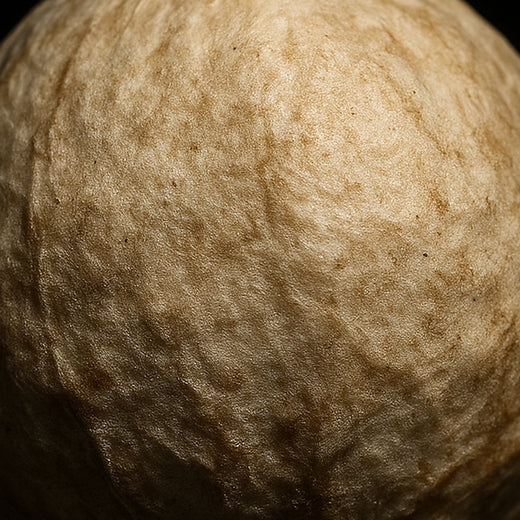
Candlenut is the common name of Aleurites moluccanus, a tree of the spurge family Euphorbiaceae, called kukui in Hawaii. Its kernel is soft, white and oily, and is the source of candlenut oil.
- Olfactive family
- Fruity · 698 entries of the glossary in this family Subfamily: Nutty notes · 3 entries in this subfamily
- Material
- Natural Kernel of the nut
- Pyramid
- Base · Volatility: Base Note
- Strength
- Medium Step 3 of 5 · shared by 1,462 of 2,148 graded entries Graded entries at each step, from 1 to 5: 4, 118, 1,462, 500, 40. 24 more sit between two steps.
- Also called
- Kukui nut, Indian walnut, Candleberry, Kemiri, Lumbang
Candlenut · Facets
Entries of the glossary that carry each facet, of 3,979:
- floral 1,546
- citrus 487
- sweet 1,988
- warm 1,108
- fresh 1,387
- creamy 401
- nutty 258
Candlenut · Scent
The cold-pressed oil has an agreeable smell.
Evolution over time
Candlenut: scent over time.
- Immediately
A light scent with an acidic, slightly grassy edge.
- After a few days
A nutty scent remains.
Scent words: nutty
Candlenut · In Perfumery
Pyramid
Candlenut: Base. Entries of the glossary stored at each place of the pyramid, of 4,000 (36 store no place):
- Top 718
- Top · Heart 497
- Heart 1,641
- Heart · Base 514
- Base 594
Role in the formula
Candlenut: roles in the formula. Entries of the glossary that share each role, of 4,000:
- Modifier 1,167
- Signature note 897
- Lifting agent 567
- Blender 1,040
- Volume builder 780
- Freshness 720
PREMIEREPEAU collection: Extrait de parfum
Candlenut · Terroir & Origins
- Producing countries
- DR Congo, Tanzania, Uganda, Comoros, Madagascar, South Africa
Candlenut · Extraction & Chemistry
Candlenut oil or kukui nut oil is extracted from the nut of Aleurites moluccanus. Solvent extraction of the oil from the crushed kernel yields a light yellow oil; when obtained by expression (pressing), the oil may be dark from impurities. Roughly half the weight of the kernel is oil. Grinding the whole stones and pressing the oil gives a rather low oil yield, but extracting the seeds from the stones is difficult.
Available as
Candlenut: available as.
- synthetic accord
- fantasy note
- cold-pressed oil
- solvent-extracted oil
- kernel
- Appearance
- Pale yellow oil (cold-pressed)
Candlenut · Did You Know?
In ancient Hawaiʻi, kukui fruits were burned to provide light. The nuts were strung in a row on a palm leaf midrib, lit on one end, and burned one by one every fifteen minutes or so, which led to their use as a measure of time.
Candlenut · In Depth
Description and range
Aleurites moluccanus, commonly known as candlenut, is a tree in the spurge family Euphorbiaceae. Since ancient times it has occurred from India and China, throughout South-East Asia, to Polynesia and New Zealand. It has also been introduced for cultivation in many tropical countries and has become the national tree of Hawaii.
The fruit is a drupe with one or two lobes, and each lobe has a single soft, white, oily kernel contained within a hard shell.
Explore all seven extraits in the Discovery Set.
Origin and Production
The tree grows in tropical rainforests and gallery forests. It is a very fast-growing tree and often appears in disturbed rainforest. The stone of the fruit weighs 10–14 g and is made up of shell (65–70%) and seed (30–35%).
Traditionally, a combination of mechanical (hammering) and physical (successive heating and cooling) methods is applied to crack the stone. The best quality seeds for use as a spice are obtained by sun-drying the stones for 5–10 days, followed by mechanical cracking.
Candlenut is traded and transported as stones or ‘nuts’. In Indonesia there is a considerable internal trade in candlenuts, mainly with Java as the destination.
Chemistry and Composition
Per 100 g edible portion, dry seed contains fat 60–62 g, protein 8–22 g and carbohydrate 7–18 g. Because the seeds contain saponin, phorbol and toxalbumins, they are mildly toxic when raw, inducing a laxative effect. Heat treatment reduces the toxicity of the protein component.
Left to stand, the cold-pressed oil dries into a thin frosty film. Linoleic acid makes up 34–49% and linolenic acid 21–35% of the fatty acids of the oil.
Uses
The fatty seed oil is not suitable for cooking, but is used in cosmetics, industrially, for illumination and medicinally. In Indonesia the oil is used in the batik industry. The oil can often be found in Indonesian hair-care products. In Fiji, where the nut is called sikeci, the oil is used in cosmetic products. In the Philippines, the fruit and tree are traditionally known as lumbang.
Culinary Use
The seed, called kemiri in Indonesia, is an indispensable spice in Indonesian cooking. It has very little flavour of its own and seems to act mainly as a flavour enhancer. In Indonesian and Malaysian cooking it is commonly added to curries. In Hawaii, a spice called inamona is made from the seeds mixed with seaweed and salt.
Traditional Uses and History
Archaeological evidence of candlenut cultivation is also found in Neolithic sites of the Toalean culture in southern Sulawesi dated to around 3,700 to 2,300 BP. Early Austronesian voyagers introduced candlenuts, as a canoe plant, widely across the Pacific islands.
Hawaiians extracted the oil from the nut and burned it in a stone oil lamp called a kukui hele po with a wick made of kapa cloth. They also made leis from the shells, leaves and flowers, and ink for tattoos from charred nuts.
As recently as 1993 on the outlying islands of the kingdom of Tonga, candlenuts were chewed into sweet-scented emollient used during a traditional funerary ritual. Candlenuts were also made into various sweet-smelling oils for the skin.
Related: Black Walnut · Brazil Nut · Breadnut · Cashew · Chestnut · Nutty Notes · Walnut · Sesame
Candlenut · Technical Sheet
Identity
- Botanical
- Aleurites moluccanus
- Taxonomy
- Malpighiales order › Euphorbiaceae family › Aleurites genus · GBIF
- Botanical records
- Aleurites moluccanus: POWO, Aleurites moluccanus · IPNI, Aleurites moluccanus · GBIF, Aleurites moluccanus · Wikidata, Aleurites moluccanus · Wikipedia, Aleurites moluccanus · IUCN Least concern (LC), Aleurites moluccanus
- IPNI
- Aleurites moluccanus (L.) Willd., Sp. Pl., ed. 4. 4(1): 590 (1805) — Carl Ludwig Willdenow (1765–1812) · ≡ Jatropha moluccana L. (1753)
- Type
- Ingredient
- Category
- Fruits, vegetables and nuts
- Note
- N/A — olfactory accord / concept
In Nature
- Growth form
- Tree · POWO
- Native range
- China · Eastern Asia · Indian Subcontinent · Indo-China · Malesia · Papuasia · Australia · Southwestern Pacific · 1 more region · POWO
- Introduced to
- 35 regions · Pacific 13 · Southern America 13 · Africa 6 · Tropical Asia 1 · Australasia 1 · Northern America 1
- Flowering
- peak in April–July · north of the equator · iNaturalist
- Recorded altitude
- 0–900 m · median 150 m · 817 records with an altitude · GBIF
- Wild or cultivated
- 17 native · 21 introduced · 10 cultivated among 6,836 records (the rest carry no such mark) · GBIF
- Recorded in
- 94 of 512 squares of the world grid; a brighter dot holds more records · GBIF
- Also from this botanical family
- Euphorbiaceae: Caoutchouc · Cascarilla · Euphorbia · Poinsettia · Rubber · Tamboti Wood · 2 more entries
In Print
- In English books
- most mentioned in the 2010s · Google Books Ngram
Classification
- Cluster
- Nutty notes · 97 entries in this cluster
- Chemical class
- Fatty oil
Chemical data
- Formula
- Oil rich in linolenic acid C₁₈H₃₀O₂ and linoleic acid C₁₈H₃₂O₂
- Most reported compounds
- Swertisin (3 papers; one: Planta Med 1999) · 2′’-O-Rhamnosylswertisin (2 papers; one: Planta Med 1999) · Alpha-Amyrin (1 paper; one: Phytomedicine 1998) · Beta-Amyrin (1 paper; one: Phytomedicine 1998) · Scoparone (1 paper; one: Fitoterapia 2001) · LOTUS
- CAS
- 8015-80-3
- INCI
- ALEURITES MOLUCCANUS SEED OIL · SKIN CONDITIONING
- INCI names (CosIng)
- ALEURITES MOLUCCANUS BARK EXTRACT (SKIN CONDITIONING)ALEURITES MOLUCCANUS EXTRACT (ASTRINGENT)ALEURITES MOLUCCANUS SEED EXTRACT (SKIN CONDITIONING)
Physical properties
- Density
- 0.92 g/cm³ (solvent-extracted oil)
Performance and rules
- IFRA status
- No IFRA Standard for the material itself (51st Amendment)
Candlenut · See Also
Entries related to Candlenut, by their place in the pyramid. “shared” marks a scent word Candlenut has too.
Top notes

Lychee
fruity · floral (shared) · rosy Fruity / Natural

Heart notes

Chestnut
nutty (shared) · sweet (shared) · warm (shared) Fruity / Same cluster / Fantasy/Concept
Purple Yam
sweet (shared) · earthy · nutty (shared) Fruity / Same cluster / Fantasy/Concept
Pistachio
creamy (shared) · nutty (shared) · rich Fruity / Same cluster / Natural
Breadnut
nutty (shared) · fruity · warm (shared) Gourmand / Heart · Base / Same cluster / Fantasy/Concept


Candlenut · Sources
- IFRA Standards, 51st Amendment
- PlantUse Aleurites moluccanus (PROTA)
- Wikipedia Aleurites moluccanus
- Wikipedia Candlenut oil
Cite as PREMIEREPEAU Glossary, “Candlenut”, https://premierepeau.com/
