


Citrus Water
Keywords: citrus · fresh · fruity
Citrus Water: The original Eau de Cologne is a spirit-citrus perfume launched in Cologne in 1709 by Giovanni Maria Farina, an Italian perfume maker.
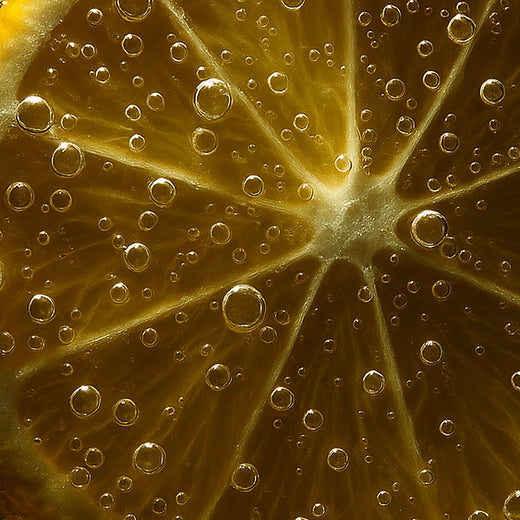
- Olfactive family
- Citrus · 152 entries of the glossary in this family Subfamily: Zesty citrus · 110 entries in this subfamily
- Material
- Fantasy/Concept Citrus fruit peel, bitter-orange blossom
- Pyramid
- Top · Volatility: Top Note
- Strength
- N/A — no measured strength for a fantasy accord Not on the graded scale
- Also called
- Citrus essence · Citrus infusion · Eau d’agrumes
Family, subfamily and cluster: PREMIEREPEAU house classification, version 2026‑11.
Citrus Water · Facets
Entries of the glossary that carry each facet, of 3,979:
- floral 1,546
- citrus 487
- sweet 1,988
- fresh 1,387
Editorial note We own no rights to this material, its name or its trademark. This entry is independent editorial journalism, published under freedom of expression.
Citrus Water · Scent
The aroma of d-limonene is described as citrus, orange, fresh, sweet and peely. The citrus aroma of bergamot oil is described as citrus, floral, green, spicy, orange peel and ginger. The racemic form of linalyl acetate has an aroma described as sweet, green, citrus, bergamot, lavender, woody, floral, spicy, clean and terpenic.
Evolution over time
Citrus Water: scent over time.
- After a few hours
N/A — no documented evolution for a fantasy accord
- Tenacity
- N/A — no measured tenacity for a fantasy accord
Citrus Water · In Perfumery
Bergamot oil is one of the most commonly used ingredients in perfumery. Bergamot is a major component of the original Eau de Cologne. In a base of dilute ethanol (70–90%), eau de cologne contains a mixture of citrus oils, including oils of lemon, orange, tangerine, clementine, bergamot, lime, grapefruit, blood orange, bitter orange, and neroli. It can also contain oils of lavender, rosemary, thyme, oregano, petitgrain (orange leaf), jasmine, olive, oleaster, and tobacco. D-limonene is used as a fragrance in perfumery, aftershave lotions, bath products, and other personal care products.
Pyramid
Citrus Water: Top. Entries of the glossary stored at each place of the pyramid, of 4,006 (42 store no place):
- Top 718
- Top · Heart 497
- Heart 1,641
- Heart · Base 514
- Base 594
Role in the formula
Citrus Water: roles in the formula. Entries of the glossary that share each role, of 4,006:
- N/A — no documented formula role 361
Citrus Water · Terroir & Origins
- Producing countries
- United States (California)
Citrus Water · Extraction & Chemistry
Cold pressing of citrus rind, steam distillation, hydrodistillation
Available as
Citrus Water: available as.
- synthetic accord
- fantasy note
- Appearance
- Clear, colorless to slightly hazy liquid
Citrus Water · Did You Know?
A single vial of Farina’s aqua mirabilis, Latin for miracle water, cost half the annual salary of a civil servant. Eau de Cologne was once believed to protect against bubonic plague: by drinking the cologne, the citrus oil scent would exude through the pores, repelling fleas.
Citrus Water · In Depth
Original Eau de Cologne
The original Eau de Cologne is a spirit-citrus perfume launched in Cologne in 1709 by Giovanni Maria Farina, an Italian perfume maker. It has since come to be a generic term for scented formulations in a typical concentration of 2–5%, and more depending upon their type. Citrus is the oldest fragrance family, and it gave birth to lightweight eau de colognes.
History
In 1708, Farina wrote to his brother Jean Baptiste that he had found a fragrance that reminded him of an Italian spring morning, of mountain daffodils and orange blossoms after the rain. Farina named his fragrance Eau de Cologne in honour of his new hometown.
When free trade was established in Cologne by the French in 1797, the success of Eau de Cologne prompted countless other businessmen to sell their own fragrances under the name of Eau de Cologne. In 1693, the Italian barber Giovanni Paolo Feminis created a perfume water called Aqua Admirabilis, today best known as eau de cologne.
Origin and Production
Essential oils are produced by steam distillation, by cold pressing of the rind of citrus fruits, and by a variety of solvent extraction techniques. Of all raw materials, only the fragrant oils from the peels of fruits in the citrus family are extracted by expression, since the oil is present in large enough quantities to make this method economically feasible.
Herbal distillates, also known as floral waters or hydrosols, are aqueous products of hydrodistillation. Orange flower water is a clear aromatic by-product of the distillation of fresh bitter-orange blossoms for their essential oil. Herbal waters are essentially diluted essential oils at less than 1% concentration (typically 0.02% to 0.05%). Hydrosols are not sterile, and should be kept refrigerated to preserve freshness.
Chemistry
Limonene is a slightly yellow-green liquid aliphatic hydrocarbon classified as a cyclic monoterpene, and is the major component in the fragrance and essential oil of citrus fruit peels. d-Limonene, the (+)-isomer, occurs more commonly in nature in citrus fruit peels, the principal commercial source, from which it is obtained by centrifugal separation and steam distillation. Orange rind oil has a limonene content of about 90–95%. Bergamot rind oil has a limonene content of about 30–45%, with linalool and linalyl acetate among its other distinctive oils.
Linalyl acetate is the acetate ester of linalool, and one of the principal components of the essential oils of bergamot, lavender and lemon. Its chemical formula is C₁₂H₂₀O₂.
Uses
In the 18th and 19th centuries, eau de cologne was commonly applied as a refreshing body splash, a linen spray, and even as a mild antiseptic due to its high alcohol content. Orange flower water has traditionally been used as an aromatizer in many Mediterranean dessert dishes. In the Maghreb, orange blossom water also serves as a perfume or freshener, usually given to guests to wash their hands upon entering the host’s house or before drinking tea.
Citrus Water · Technical Sheet
Identity
- Botanical
- N/A — olfactory concept or hydrosol blend (various Citrus spp.)
- Type
- Accord
- Category
- Citrus smells
- Note
- Olfactory concept or citrus hydrosol (by-product of essential oil distillation). Light, watery-citrus character.
Classification
- Cluster
- Zesty citrus · 18 entries in this cluster
- Chemical class
- Composed accord (olfactory concept)
Chemical data
- Formula
- N/A (concept — key molecules: linalyl acetate, limonene, linalool)
Performance and rules
- IFRA status
- No IFRA Standard for the material itself (51st Amendment)
Citrus Water · See Also
Entries related to Citrus Water, by their place in the pyramid. “shared” marks a scent word Citrus Water has too.
Top notes

Buddha’s Hand
citrus (shared) Citrus / Same cluster / Natural
Dihydromyrcenol
fresh (shared) · citrus (shared) · aromatic Citrus / Same cluster / Synthetic
Sparkling Accord
citrus (shared) · fresh (shared) · floral (shared) Citrus / Same cluster / Fantasy/Concept
Vitamin C
odorless · antioxidant vitamin Citrus / Same cluster / Synthetic
Lemon
citrus (shared) · fresh (shared) · fruity (shared) Citrus / Same cluster / Natural
Bergamot
citrus (shared) · aromatic · bitter · tea-like Citrus / Same subfamily / Natural
Blood Orange
citrus (shared) · fresh (shared) · fruity (shared) Citrus / Natural
Bitter Orange
citrus (shared) · bitter · fresh (shared) Citrus / Natural
Soda Bubbles
fresh (shared) · aquatic · effervescent Aquatic / Top · Heart / Fantasy/Concept


Citrus Water · Sources
- IFRA Standards, 51st Amendment
- Wikipedia Eau de Cologne
- Wikipedia Perfume
- Wikipedia Herbal distillate
- Wikipedia Orange blossom water
- Wikipedia Limonene
- Wikipedia Linalyl acetate
- Wikipedia Bergamot orange
- Wikipedia Essential oil
- Wikipedia Citrus
Cite as PREMIEREPEAU Glossary, “Citrus Water”, https://premierepeau.com/
