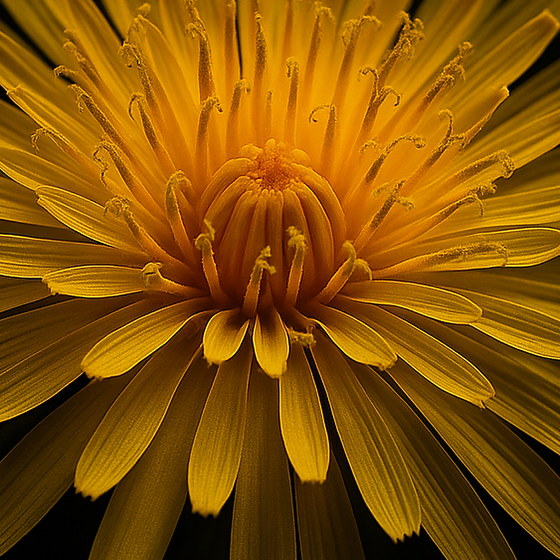
Dandelion

NaturalFLOWERSfloral · earthy · green
HeartPyramid
—Strength
—Tenacity
—Origins
Specimen
Dandelion perfume ingredient
Heart
Taraxacum officinale
Definition

Dandelion is the common name of Taraxacum officinale, a plant of the Asteraceae family that has milky latex. It secretes latex when its tissues are cut or broken.

FLORAL GREEN EARTHY WARM FRESH BITTER
Lion's-tooth, Puff-ball, Blowball, Cankerwort, Milk witch, Yellow-gowan, Irish daisy
Type
Ingredient
Olfactive family
Florals
Subfamily
Green florals
Cluster
Green-fresh florals
Instruments
Pyramid
TTop
HHeart
BBase

Scent

In the headspace of the flowers, ketones such as (E,E)-3,5-octadien-2-one, 3-octanone and 6-methyl-5-hepten-2-one give green, grassy, woody and earthy notes. In supercritical CO2 extracts of the flowers, 2-phenylethanol, benzyl alcohol and two lactones give sweet, floral, fresh, honey-like and fruity notes.

The Full Story

The plant

Dandelion is the common name of Taraxacum officinale, a species of the Asteraceae family. It grows from a generally unbranched taproot and produces several hollow, leafless flower stems. Each flowering stem bears a single yellow flower head. The plant has milky latex, and the leaves are all basal. Dandelions secrete latex when the tissues are cut or broken. In the wild type the latex content is low and varies greatly. Raw leaves have a slightly bitter taste.

Name

The name dandelion comes from the French dent de lion, meaning lion's tooth, in reference to the plant's jagged-edged leaves. The Latin genus name Taraxacum derives from the Arabic tarakhshaqūn, meaning bitter herb. The specific epithet officinale refers to the Latin word for 'medicinal' or 'of the apothecaries'.

Uses

The entire plant, including the leaves, stems, flowers and roots, is edible. The leaves, called dandelion greens, can be eaten cooked or raw, in soup or in salad. Dandelion was also commonly used to make the traditional British soft drink dandelion and burdock. In Silesia and other parts of Poland and the world, dandelion flowers are used to make a honey substitute syrup with added lemon. The yellow flowers can be dried and ground into a yellow-pigmented powder and used as a dye.

Latex and chemistry

Taraxalisin is a serine proteinase found in the latex of dandelion roots. Unroasted root of Taraxacum officinale contains, among other compounds, the phenolic acids caffeic acid, chlorogenic acid and chicoric acid. Taraxacum kok-saghyz, a species of dandelion called the Russian dandelion, contains on average 12% natural rubber.

—

Related: Abelia · Almond Blossom · Alpha Terpineol · Alstroemeria · Alumroot · Amarillys · Amazon Moonflower · Amethyst Flower

Did You Know?

The Soviet Union cultivated Taraxacum kok-saghyz on a large scale between 1931 and 1950, notably during World War II, as an emergency source of rubber. The latex of Taraxacum kok-saghyz was traditionally used as a kind of chewing gum.

Extraction & Chemistry

Extraction method

After harvesting, the dandelion roots are dried, chopped and roasted to make dandelion coffee. The roots are sliced lengthwise and placed to dry for two weeks in a warm area. When ready, the dried roots are oven-roasted and stored away.

Formula
Complex natural mixture (key constituents: chlorogenic acid C₁₆H₁₈O₉; chicoric acid C₂₂H₁₈O₁₂; caffeic acid C₉H₈O₄)
Botanical
Taraxacum officinale
Synonyms
Lion's-tooth, Puff-ball, Blowball, Cankerwort, Milk witch, Yellow-gowan, Irish daisy
IFRA status
See note

No IFRA Standard for the material itself (51st Amendment)

In Perfumery

The plant contains little essential oil, so its oil is not considered practical for commercial production. Leaf extract is used as a flavouring agent in alcoholic and soft drinks, frozen dairy desserts, candies, baked goods, pudding and cheese. The solid root extract carries the US flavour-ingredient GRAS number 2358.

Role in the formula
01modifier
02signature note
03lifting agent
04blender
05freshness
Available as
whole plant flowers dried root roasted root

See Also

7 notes