


Ethyl Myristate
Keywords: waxy · violet · iris
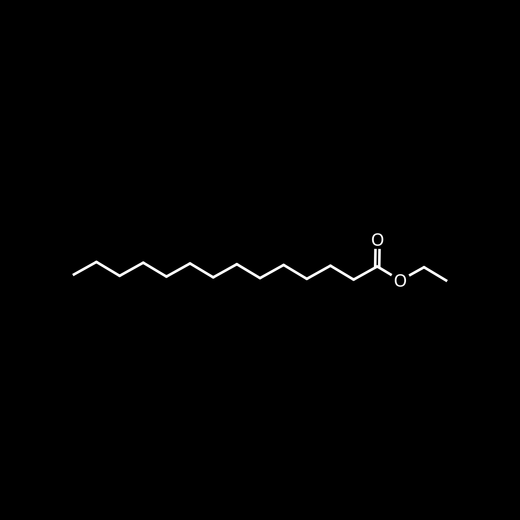
Ethyl Myristate is a long-chain fatty acid ethyl ester formed by the formal condensation of myristic acid with ethanol. It has a very mild, oily, ethereal odour that resembles orris and violet.
- Olfactive family
- Florals · 779 entries of the glossary in this family Subfamily: Powdery florals · 63 entries in this subfamily Cluster: Iris-violet powdery florals · 36 entries in this cluster
- Pyramid
- Base · Volatility: Base Note
- Strength
- Low Step 2 of 5 · shared by 119 of 2,156 graded entries Graded entries at each step, from 1 to 5: 4, 119, 1,473, 498, 39. 23 more sit between two steps.
- Also called
- Myristic acid ethyl ester
Family, subfamily and cluster: PREMIEREPEAU house classification, version 2026‑11.
Ethyl Myristate · Facets
Entries of the glossary that carry each facet, of 3,979:
- waxy 215
- violet 44
- iris 30
- sweet 1,988
- ethereal 184
- oily 237
Ethyl Myristate · Scent
Very mild, oily and ethereal, with a waxy sweetness and some resemblance to orris and violet.
Ethyl Myristate · In Perfumery
It is a fragrance ingredient with a very mild, oily, ethereal odour that resembles orris and violet.
Pyramid
Ethyl Myristate: Base. Entries of the glossary stored at each place of the pyramid, of 4,006 (42 store no place):
- Top 718
- Top · Heart 497
- Heart 1,641
- Heart · Base 514
- Base 594
Ethyl Myristate · In Depth
Identity
Ethyl Myristate has the CAS number 124-06-1, the molecular formula C₁₆H₃₂O₂ and a molecular weight of 256.42 g/mol, and its IUPAC name is ethyl tetradecanoate.
Odour
Ethyl Myristate smells waxy and sweet, with an oily, ethereal touch of violet and orris. Its odour is very mild, oily and ethereal, with some resemblance to orris and violet. Its odour strength is low. Its substantivity is 4 hours at 100 %.
Occurrence in nature
It is found in Carica papaya, Daphne odora, Hamamelis virginiana, Litchi chinensis, Mandragora autumnalis, Mandragora officinarum, Mangifera indica, Mimusops elengi, Monascus purpureus, Psidium guajava, Saussurea involucrata and Zingiber officinale.
Use in perfumery
It is used as a fragrance ingredient. In cosmetics it works as a perfuming and fragrance ingredient, an emollient, a skin conditioner and a solvent.
Use in flavours
It is used as a flavouring agent. The joint expert committee on food additives found no safety concern at current levels of intake when it is used as a flavouring agent.
Properties
It is a colourless to pale yellow liquid that boils at 178 to 180 °C at 12 mmHg and melts at 12.3 °C. Its density is 0.857–0.862 and its refractive index is 1.434–1.438. Its flash point is above 110 °C and its vapour pressure is estimated at 0.002 mmHg at 25 °C. Its logP (o/w) is estimated at 6.899. It is slightly soluble in ether. One part dissolves in 1 part of 95% ethanol.
Safety and IFRA
No IFRA Standard covers this material itself, as of the 51st Amendment. Its INCI name is ETHYL MYRISTATE and its EC number is 204-675-4. It is not classified as hazardous, as it does not meet GHS hazard criteria in 100% (354 of 354) of all reports.
Ethyl Myristate · Technical Sheet
Molecular weight
256.42 g/mol Heavier than 123 of the 261 other entries at the same place of the pyramid that store a weight; 6 weigh the same.
2,515 entries store a molecular weight. By place in the pyramid: Top 537, Top · Heart 403, Heart 861, Heart · Base 452, Base 262.
Identity
- Type
- Ingredient
- Category
- Aroma chemicals
Classification
- Chemical class
- Ester
Chemical data
- Formula
- C16H32O2
- CAS
- 124-06-1
- Reported in plants
- Daphne odora (1 paper; one: Agricultural and Biological Chemistry 1983, Daphne odora) · Litchi chinensis (1 paper; one: J Agric Food Chem 1980, Litchi chinensis) · Mangifera indica (1 paper; one: Phytochemistry 1988, Mangifera indica) · Nelumbo nucifera (1 paper; one: J Agric Food Chem 2010, Nelumbo nucifera) · Psidium guajava (1 paper; one: Phytochemistry 1982, Psidium guajava) · Saussurea involucrata (1 paper; one: Journal of essential oil research 1992, Saussurea involucrata) · LOTUS
- PubChem CID
- 31283, compound record on PubChem
- InChIKey
- MMKRHZKQPFCLLS-UHFFFAOYSA-N
- Wikidata
- Ethyl Myristate: Q27158117, item on Wikidata
Physical properties
- Appearance
- Colourless to pale yellow clear liquid
- Boiling point
- 178 to 180 °C at 12 mmHg
- Melting point
- 12.3 °C
- Flash point
- > 110 °C (> 230 °F)
- Density
- 0.857–0.862
- Refractive index
- 1.434–1.438
- Vapour pressure
- 0.002 mmHg at 25 °C (estimated)
- Log P
- 6.899 (estimated)
Performance and rules
- Tenacity
- 4 hours at 100 %
- IFRA status
- No IFRA Standard for the material itself (51st Amendment)
Ethyl Myristate · See Also
Entries related to Ethyl Myristate, by their place in the pyramid. “shared” marks a scent word Ethyl Myristate has too.
Heart notes

Ethyl Dodecanoate
fruity · floral · fatty Green / Heart · Base / 228.37 g/mol

Base notes

Isopropyl Myristate
neutral · emollient · carrier Amber & musk / Synthetic / 270.5 g/mol
Methyl Myristate
fatty · honey · oily (shared) Gourmand / 242.4 g/mol
Cedrol formate
woody · amber · green Woods / 250.38 g/mol
Octyl caprylate
herbal · tea · sweet (shared) Aromatic / 256.42 g/mol
Butyl Myristate
fatty · oily (shared) · waxy (shared) 284.5 g/mol
Ethyl palmitate
waxy (shared) · sweet (shared) · greasy Gourmand / 284.5 g/mol
Ethyl pentadecanoate
musky · fatty · oily (shared) Amber & musk / 270.5 g/mol
Ethyl linolenate
fatty · oily (shared) Green / 306.5 g/mol
Hexyl Laurate
oily (shared) · creamy · fatty 284.5 g/mol


Ethyl Myristate · Sources
- PubChem Ethyl Myristate
- ChEBI Ethyl Myristate: chemical classification record
- Pyrfume Arctander, Perfume and Flavor Chemicals: odour descriptions (Pyrfume archive)
- Pyrfume Good Scents odour data (Pyrfume archive)
- Pyrfume Leffingwell odour data (Pyrfume archive)
- The Good Scents Company Information System Ethyl Myristate: data sheet
- Wikidata (LOTUS natural products data) Ethyl Myristate: organisms it is reported in, with the papers
- European Commission, CosIng Ethyl Myristate: cosmetic ingredient record
- IFRA Standards, 51st Amendment
Cite as PREMIEREPEAU Glossary, “Ethyl Myristate”, https://premierepeau.com/
