


Exaltolide®
Keywords: powdery · musky · fruity
Exaltolide®: Exaltolide is a name for cyclopentadecanolide, a macrolide lactone. Its odor is musklike.
- Olfactive family
- Amber & musk · 134 entries of the glossary in this family Subfamily: Clean musks · 26 entries in this subfamily
- Material
- Synthetic Produced synthetically for commercial use; occurs in small quantities in angelica root essential oil
- IFRA status
- Restricted
- Pyramid
- Base Note
- Strength
- Medium to strong Between steps 3 and 4 · shared by 21 of 2,161 graded entries Graded entries at each step, from 1 to 5: 4, 117, 1,469, 507, 40. 24 more sit between two steps.
- Also called
- Cyclopentadecanolide, angelica lactone, muskalactone, muskolactone, pentalide, pentadecanolide, pentadecalactone, omega-pentadecalactone, pentadecan-15-olide
Exaltolide® · Facets
Entries of the glossary that carry each facet, of 3,979:
- woody 794
- floral 1,551
- earthy 657
- sweet 1,990
- powdery 197
- fruity 1,307
- warm 1,109
- fresh 1,392
Editorial note We own no rights to this material, its name or its trademark. This entry is independent editorial journalism, published under freedom of expression.
Exaltolide® · Scent
Its aroma is described as musk, animal, powdery, natural, fruity, tobacco, coumarinic, heliotrope, and licorice. Another description calls it delicate, sweet, musky, powdery, warm and animal-like, with subtle floral-fruity nuances reminiscent of ambrette seed. It is also described as slightly pastoral and herbal, with an angelica root character.
Evolution over time
Exaltolide®: scent over time.
- Immediately
Delicate, sweet and fruity, with a floral note and pear-like and peach-like facets.
Scent words: floral · fruity · sweet - After a few hours
Musky, powdery and creamy, with a clean character.
Scent words: powdery · creamy · musky - After a few days
Balsamic, vanilla-like and slightly woody, with a warm animal-like musk that is extremely tenacious.
Scent words: balsamic · warm · woody · musky · animalic
- Tenacity
- Extremely tenacious
Exaltolide® · In Perfumery
Cyclopentadecanolide is used as a musklike perfume fixative in fine fragrances and as a flavoring agent. It is a substitute for the extremely expensive animal musk.
Pyramid
Exaltolide®: Base. Entries of the glossary stored at each place of the pyramid, of 4,000 (35 store no place):
- Top 718
- Top · Heart 501
- Heart 1,646
- Heart · Base 512
- Base 588
Role in the formula
Exaltolide®: roles in the formula. Entries of the glossary that share each role, of 4,000:
- Fixative 341
- Modifier 1,168
- Backbone 196
- Signature note 898
- Blender 1,041
- Volume builder 780
Exaltolide® · Extraction & Chemistry
Cyclopentadecanolide is produced by ring expansion of cyclotetradecanone. Another synthesis route is the depolymerization of polyesters of 15-hydroxypentadecanoic acid. It also occurs in small quantities in angelica root essential oil. Catalytic hydrogenation of Globalide, a mixture of the isomeric 11- and 12-pentadecen-15-olides, over a Raney nickel catalyst converts it to Exaltolide.
- Appearance
- Colorless crystals
Exaltolide® · Did You Know?
Until the mid-1920s, chemists believed that rings with more than eight atoms were unstable and could not exist. With a group of his doctoral students, Leopold Ružička proved the structure of muscone and civetone, macrocyclic ketone scents derived from the musk deer and the civet cat.
Exaltolide® · In Depth
What it is
Exaltolide is a name for cyclopentadecanolide, an organic compound with the formula (CH₂)₁₄CO₂. Its preferred IUPAC name is 1-oxacyclohexadecan-2-one. Its odor threshold in air is 1 to 4 ppb.
Occurrence
Cyclopentadecanolide is present in angelica root in small quantities, less than 1% in the roots and less than 0.5% in the seeds. It gives angelica root a distinctive musky aroma. Angelica archangelica, the plant that yields the root, is a biennial of the family Apiaceae, and its root is used in flavoring preparations.
Chemistry and physical form
Cyclopentadecanolide forms colorless crystals that melt at 34 °C and boil at 98 °C under a pressure of 0.02 Torr.
Musks and ring size
Plant musks are generally lactones, while musks from animals are generally ketones. Muscone, a macrocyclic ketone, is the primary contributor to the odor of deer musk. Macrocyclic musks are often lactones, containing ester linkages, and they are thought to have stronger musky smells.
A musky smell tends to occur in ring compounds with about 14 to 19 atoms in the ring, whether ketones or lactones. Synthetic musks as a class emulate the scent of deer musk and other animal musks, with a clean, smooth and sweet scent that lacks the fecal notes of animal musks.
Pentadecanolide synthesis
Its molecular formula is C 15 H 28 O 2 and its molar mass is 240.387 g·mol -1. It is the musk compound responsible for the pleasant odor of angelica root oil. Its odor is described as tobacco, coumarin, heliotropine, powdery, licorice and brown, and its odor type is musk.
The latest evaluation as a flavouring agent dates from 1997 and found no safety concern at current levels of intake. Its COE number is 181 and its JECFA number is 239.
Pentadecanolide started its career in perfumery when the synthesis of the lactones from hydroxy acids became an industrial proposition. Chain extension is far easier when a hetero-atom can be used instead of a carbon atom, and for economic reasons heterocyclic lactones met with a certain success. 10-hydroxydecanoic acid is the starting material for a pentadecanolide synthesis, and from it the synthesis of 11-oxahexadecanolide is easy.
In the years after the second world war, 12-oxahexadecanolide was introduced under different trade names and appreciated by many perfumers as an element for their cheaper compounds. In 1926 Leopold Ruzicka synthesized muscone in very small quantities. Leopold Ružička shared the 1939 Nobel Prize in Chemistry for his work on polymethylenes and higher terpenes.
Muscone and civetone, macrocyclic ketone scents derived from the musk deer and the civet cat, were the first natural products shown to have rings with more than six atoms.
—
Related: Ambretone · Ambrette (Musk Mallow) · Ambrettolide (Natural Musk) · Galaxolide · Tonalide® · Ethylene Brassylate · Musk Ketone · Musk Xylene
Exaltolide® · History
Cyclopentadecanolide turned up in angelica root oil in 1927. That same year Kerschbaum reported a macrocyclic lactone in the ambrette plant, which was commercialised as Ambrettolide. The IFRA Standard on cyclopentadecanolide was published in January 2020, in Amendment 49.
Exaltolide® · Technical Sheet
Identity
- Botanical
- N/A — synthetic macrocyclic lactone (a Swiss fragrance house)
- Type
- Ingredient
- Category
- Musk, amber, animalic smells
Classification
- Cluster
- Clean musks · 24 entries in this cluster
- Chemical class
- Macrolide lactone
Chemical data
- Formula
- C15H28O2
- Structure
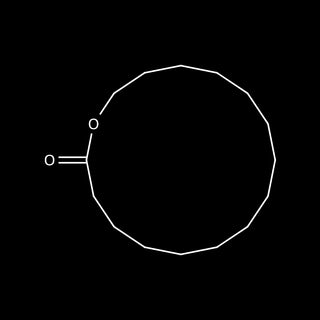 PubChem
- CAS
- 106-02-5
- PubChem CID
- 235414, compound record on PubChem
- InChIKey
- FKUPPRZPSYCDRS-UHFFFAOYSA-N
Physical properties
- Boiling point
- 137.00 °C @ 2.00 mm Hg
- Melting point
- 34.00 to 38.00 °C. @ 760.00 mm Hg
- Flash point
- > 220.00 °F. TCC ( > 104.44 °C. )
- Log P
- 6.100
Performance and rules
- Producing countries
- Europe (Switzerland — a Swiss fragrance house)
- Available as
- standard form
- IFRA status
- Restricted — IFRA Standard « Cyclopentadecanolide » (Amendment 49)
Exaltolide® · See Also
Entries related to Exaltolide®, by their place in the pyramid. « shared » marks a scent word Exaltolide® has too.
Top notes

Romandolide®
creamy · floral (shared) · sweet (shared) Amber & musk / Same cluster / Synthetic

Heart notes

Serenolide
musky (shared) Amber & musk / Same cluster / Synthetic

Base notes

Helvetolide
woody (shared) · musky (shared) · warm (shared) Amber & musk / Same cluster / Synthetic
Habanolide®
musky (shared) · warm (shared) · powdery (shared) Amber & musk / Same cluster / Synthetic
Skin Musk
musky (shared) · warm (shared) · powdery (shared) Amber & musk / Same cluster / Fantasy/Concept
Cosmone
musk · powdery (shared) · warm (shared) Amber & musk / Same subfamily / Synthetic
Musk
animalic · clean · skin Amber & musk / Natural & Synthetic
Ambroxan
woody (shared) · amber · musky (shared) Amber & musk / Semi-synthetic
Cashmere
musky (shared) · woody (shared) · spicy Amber & musk / Synthetic
Amber
warm (shared) · resinous · sweet (shared) Amber & musk / Accord
Aldron
animalic · woody (shared) · amber Amber & musk / Synthetic
Hexadecanolide
animal · musk · amber Amber & musk
Velvione™
musky (shared) · warm (shared) · powdery (shared) Amber & musk / Synthetic
Tonka Bean
Gourmand / Natural
5-Hexadecanolide
dairy · fatty · waxy Gourmand


Exaltolide® · Sources
- University of Bristol Muscone and other musks, Molecule of the Month
- IFRA Standards, 51st Amendment
- PubChem Pentadecalactone
- Wikipedia Cyclopentadecanolide
- Wikipedia Angelica archangelica
- Wikipedia Muscone
- Wikipedia Synthetic musk
- Wikipedia Leopold Ružička
- The Good Scents Company omega-pentadecalactone
- INCHEM JECFA Evaluations-omega-PENTADECALACTONE
Cite as PREMIEREPEAU Glossary, “Exaltolide®”, https://premierepeau.com/pages/glossary-terms/exaltolide Updated 2026-11-19
