


Green Tea Flower
Keywords: floral · green · fresh
Green tea flower is the white blossom of Camellia sinensis, a species of the family Theaceae. This entry follows the aroma chemistry of the flower and its extraction, while White Tea Blossom follows the blooming stages and the flower on the plant. Half-opened and fully opened flowers have floral, powdery or almond-like odors.
- Olfactive family
- Florals · 782 entries of the glossary in this family Subfamily: Powdery florals · 63 entries in this subfamily
- Material
- Natural Flower
- Pyramid
- Heart · Volatility: Heart Note
- Strength
- Medium Step 3 of 5 · shared by 1,462 of 2,148 graded entries Graded entries at each step, from 1 to 5: 4, 118, 1,462, 500, 40. 24 more sit between two steps.
- Also called
- tea flower
Green Tea Flower · Facets
Entries of the glossary that carry each facet, of 3,979:
- floral 1,546
- green 1,442
- sweet 1,988
- powdery 197
- fresh 1,387
Green Tea Flower · Scent
Half-opened tea flowers have a strong floral odor and an almond-like odor of high intensity. Fully opened tea flowers have a strong powdery odor and a moderate floral odor. Unopened buds have a moderate green odor and a weak fragrance.
Evolution over time
Green Tea Flower: scent over time.
- Immediately
Green, fresh and fruity
Scent words: fresh · green · fruity - After a few hours
Floral, with a sweet note
Scent words: floral · sweet - After a few days
Powdery and almond-like
Scent words: powdery
Green Tea Flower · In Perfumery
Half-opened tea flowers, with strong floral and almond-like odors, are an ideal choice for use in perfumes and cosmetics to impart a fresh and inviting scent. The aroma of tea flowers differs between flowering stages, and these differences could be used to create distinctive and appealing products.
Pyramid
Green Tea Flower: Heart. Entries of the glossary stored at each place of the pyramid, of 4,000 (36 store no place):
- Top 718
- Top · Heart 497
- Heart 1,641
- Heart · Base 514
- Base 594
Role in the formula
Green Tea Flower: roles in the formula. Entries of the glossary that share each role, of 4,000:
- Modifier 1,167
- Signature note 897
- Lifting agent 567
- Blender 1,040
- Freshness 720
Green Tea Flower · Terroir & Origins
- Producing countries
- China, India, Japan
Green Tea Flower · Extraction & Chemistry
Volatile flavour components of tea flowers have been isolated by simultaneous distillation extraction and by supercritical fluid extraction, and compared with headspace analysis. Supercritical fluid extraction retains the floral, fresh and fruity odour of tea flowers, with very little loss of heat sensitive volatiles. The flavour isolated by supercritical fluid extraction has superior quality compared to that from simultaneous distillation extraction.
Available as
Green Tea Flower: available as.
- synthetic accord
- fantasy note
- flower
- supercritical fluid extract
- simultaneous distillation extract
- Appearance
- White flower, 2.5 to 3.5 cm across
Green Tea Flower · Did You Know?
Among three stages of tea flowers sampled, acetophenone appeared only in the half-opened flowers. It was their largest aroma contributor, with an ACI of 57.35%.
Green Tea Flower · In Depth
The flower
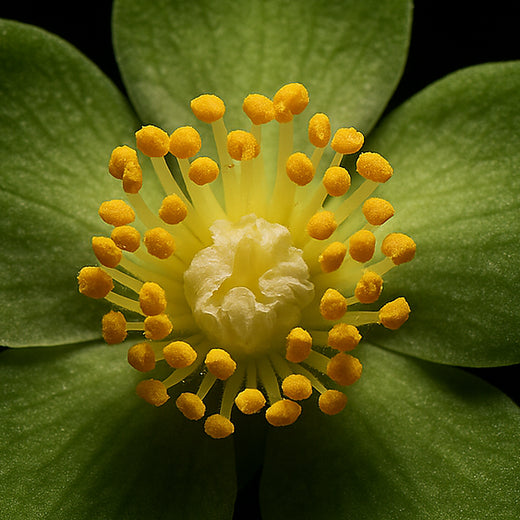
Green tea flower is the bloom of Camellia sinensis, an evergreen shrub of the family Theaceae. The flowers are white, 2.5 to 3.5 cm across, with six to eight petals. They bud in the leaf axils and can be solitary or have up to three in a cluster.
Aroma chemistry
Linalool was the only volatile compound with an ACI above 27 in all samples, whether the flowers were unopened, half-opened or fully opened. Half-opened tea flowers had the most volatile compounds, including high levels of linalool and its oxides. Linalool is a terpene alcohol found in many flowers and spice plants. Unopened buds contained the highest amounts of alcohols, while fully opened flowers had the highest amounts of heterocyclic compounds.
In tea flowers from Kangra, phenylethanol, linalool and geraniol were among the major components of the supercritical fluid extract. In headspace analysis, linalool made up 35.1% of the volatiles.
Origin and naming
The tea plant was originally native to the highlands of the Hengduan-Purvanchal region between southwestern China, northern Myanmar and northeastern India. Linnaeus did not consider the plant a Camellia but placed it in a separate genus, Thea. In 1818 Robert Sweet merged the two genera, selecting Camellia for the merged genus.
Explore all seven extraits in the Discovery Set.
Related: Mimosa Absolute · Tieguanyin Tea
Green Tea Flower · Technical Sheet
Identity
- Botanical
- Camellia sinensis
- Taxonomy
- Ericales order › Theaceae family › Camellia genus · GBIF
- Botanical records
- Camellia sinensis: POWO, Camellia sinensis · IPNI, Camellia sinensis · GBIF, Camellia sinensis · Wikidata, Camellia sinensis · Wikipedia, Camellia sinensis · IUCN Data deficient (DD), Camellia sinensis
- IPNI
- Camellia sinensis (L.) Kuntze, Trudy Imp. S.-Peterburgsk. Bot. Sada 10: 195 (1887) — Carl Ernst Otto Kuntze (1843–1907) · ≡ Thea sinensis L. (1753)
- Type
- Ingredient
- Category
- Flowers
In Nature
- Native range
- China · Indian Subcontinent · Indo-China · POWO
- Introduced to
- 20 regions · Africa 6 · Tropical Asia 6 · Temperate Asia 5 · Southern America 3
- Flowering
- peak in October–November · north of the equator · iNaturalist
- Recorded altitude
- 50–1,500 m · median 700 m · 1,310 records with an altitude · GBIF
- Wild or cultivated
- 130 native · 148 introduced · 80 cultivated among 10,046 records (the rest carry no such mark) · GBIF
- Recorded in
- 85 of 512 squares of the world grid; a brighter dot holds more records · GBIF
- Also from this genus
- Camellia: Assam Tea · Duck Poo Oolong · Earl Grey Tea · Fermented Tea · Genmaicha · Gyokuro Tea · Jin Xuan Tea Leaves · Keemun Tea · 13 more entries
In Print
- Timeline
- first described 1887 · earliest aroma paper in Europe PMC, 1985
- In English books
- most mentioned in the 2010s · Google Books Ngram
Classification
- Cluster
- Powdery florals · 32 entries in this cluster
Chemical data
- Formula
- complex mixture (linalool, geraniol, catechins)
- Most reported compounds
- Gallocatechin Gallate (67 papers; one: DOI) · Catechin (63 papers; one: DOI) · Epicatechin-3-Gallate (59 papers; one: DOI) · (-)-Gallocatechin (58 papers; one: DOI) · Caffeine (53 papers; one: DOI) · LOTUS
- INCI names (CosIng)
- CAMELLIA SINENSIS LEAF OIL (ANTIOXIDANT, SKIN CONDITIONING)CAMELLIA SINENSIS SEED OIL (HUMECTANT, SKIN CONDITIONING)CAMELLIA SINENSIS CALLUS CULTURE EXTRACT (SKIN CONDITIONING, PERFUMING)CAMELLIA SINENSIS CALLUS EXTRACT (SKIN PROTECTING)CAMELLIA SINENSIS EXTRACT (ANTIOXIDANT, BLEACHING, SKIN CONDITIONING)CAMELLIA SINENSIS FLOWER EXTRACT (SKIN CONDITIONING, PERFUMING)CAMELLIA SINENSIS LEAF BUD EXTRACT (HUMECTANT)CAMELLIA SINENSIS LEAF CELL EXTRACT (ANTIOXIDANT, SKIN PROTECTING)
Labelling
- EU allergens reported
- Limonene · Linalool · Geraniol · Benzyl Alcohol · Benzyl Benzoate · Linalyl Acetate · Pinene · Terpineol · Alpha-Terpinene · Terpinolene · Beta-Caryophyllene · Carvone · Menthol · Benzaldehyde · Methyl Salicylate · Rose Ketones
Physical properties
- Specific gravity
- 0.870 to 0.920 at 25 °C (est)
Performance and rules
- IFRA status
- No IFRA Standard for the material itself (51st Amendment)
Green Tea Flower · See Also
Entries related to Green Tea Flower, by their place in the pyramid. “shared” marks a scent word Green Tea Flower has too.
Heart notes

Cyclamen
floral (shared) · powdery (shared) · sweet (shared) Florals / Same cluster / Fantasy/Concept
Apple Blossom
floral (shared) · fruity · sweet (shared) Florals / Same cluster / Natural
Lily
floral (shared) · green (shared) · waxy Florals / Synthetic
Orange Blossom
floral (shared) · honeyed · citrus Florals / Natural
Jasmine
floral (shared) Florals / Natural
Pinwheel Flower
floral (shared) Florals / Natural
Camellia
floral (shared) · rich · fresh (shared) Florals / Natural
White Tea Blossom
floral (shared) · fresh (shared) · green (shared) Florals / Natural


Base notes

Iris
powdery (shared) · earthy · violet Florals / Same subfamily / Natural

Other entries · Place in the pyramid not stored

Carnation
floral (shared) · spicy · clove Florals / Natural

Green Tea Flower · Sources
Read the science
- Foods (2023) Aroma Identification and Classification in 18 Kinds of Teas (Camellia sinensis) by Sensory Evaluation, HS-SPME-GC-IMS/GC × GC-MS, and Chemometrics
- Food Chem (2025) Study on dynamic changes in characteristic volatile compounds uncovers aroma development of Hainan Dayezhong (Camellia sinensis var. assamica) black tea
- Food Chem (2025) Insight into volatile metabolites and key odorants in black teas processed from Jianghua Kucha tea germplasm (Camellia sinensis var. assamica cv. Jianghua)
- Frontiers in Nutrition (2024) Characterization of the volatile compounds in tea (Camellia sinensis L.) flowers during blooming
- IFRA Standards, 51st Amendment
- Wikipedia Camellia sinensis
- Wikipedia Linalool
Cite as PREMIEREPEAU Glossary, “Green Tea Flower”, https://premierepeau.com/
