


Kangaroo Paw
Keywords: floral · fresh · green
Kangaroo paw is the common name of the plants of the genus Anigozanthos, which belongs to the bloodwort family Haemodoraceae. All 11 species are endemic to the south west of Western Australia.
- Olfactive family
- Florals · 781 entries of the glossary in this family Subfamily: Green florals · 144 entries in this subfamily Cluster: Green-fresh florals · 135 entries in this cluster
- Material
- Fantasy/Concept Flowers
- Pyramid
- Heart · Volatility: Heart Note
- Strength
- N/A — no measured strength for a fantasy accord Not on the graded scale
- Also called
- wallaby paw
Kangaroo Paw · Facets
Entries of the glossary that carry each facet, of 3,979:
- woody 791
- floral 1,546
- green 1,444
- sweet 1,988
- fresh 1,389
- honeyed 76
Editorial note We own no rights to this material, its name or its trademark. This entry is independent editorial journalism, published under freedom of expression.
Kangaroo Paw · In Perfumery
Pyramid
Kangaroo Paw: Heart. Entries of the glossary stored at each place of the pyramid, of 4,000 (35 store no place):
- Top 718
- Top · Heart 496
- Heart 1,644
- Heart · Base 513
- Base 594
Role in the formula
Kangaroo Paw: roles in the formula. Entries of the glossary that share each role, of 4,000:
- N/A — no documented formula role 360
Available as
Kangaroo Paw: available as.
- synthetic accord
- fantasy note
PREMIEREPEAU collection: Extrait de parfum
Kangaroo Paw · Terroir & Origins
- Producing countries
- Australia
Kangaroo Paw · Did You Know?
Different species of kangaroo paw usually deposit pollen on different areas of the birds’ head. This means that pollen from one species is unlikely to be deposited in the flowers of another species. A single plant of the tall kangaroo paw, Anigozanthos flavidus, may produce over 350 flowers on up to 10 long stems.
Kangaroo Paw · In Depth
The plant
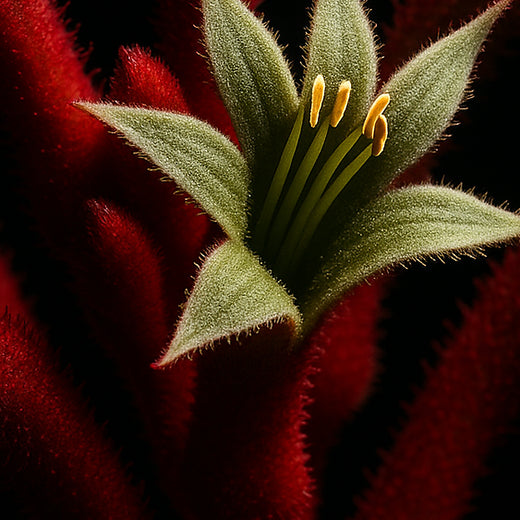
The plants grow from short, underground, horizontal rhizomes. The sap in the root system allows the plants to survive extreme dry spells. Long leafless stalks, which can reach 2 m, end in a raceme of flowers. The flower buds are covered with coloured hairs, giving them a velvety aspect. The colour of the flower may range from almost black to yellow, orange and red. The tubular form of the flower bud resembles a kangaroo paw, hence its name.
Pollination
The flowers appear over spring and summer and are pollinated by birds. The long flower-stalks usually rise above the undergrowth and advertise the presence of nectar in the flowers. The stalks also provide a perch for visiting birds.
Names and species
The common name kangaroo paw was initially given to Anigozanthos manglesii and came to be used for other species of Anigozanthos as they became known. A further species, previously identified as Anigozanthos fuliginosus, was separated to a monotypic genus as Macropidia fuliginosa.
Cultivation
Numerous hybrids and cultivars have been developed for cultivation and floristry in recent years. Kangaroo paws are much in demand as house plants and as cut flowers. They are grown commercially in Australia, the United States, Japan and Israel. Most species are dormant over winter, and some die back completely. Plant performance in the garden declines after 3 to 5 years, so kangaroo paws are best regarded as short-lived plants. A major disease of kangaroo paws is a fungus which causes ink disease.
Explore all seven extraits in the Discovery Set.
Related: Abelia · Almond Blossom · Alpha Terpineol · Alstroemeria · Alumroot · Amarillys · Amethyst Flower · Moon Flower
Kangaroo Paw · History
The genus was first named by Jacques Labillardière, a French botanist, in his work issued in 1800. He collected and described the type species, Anigozanthos rufus, during the d’Entrecasteaux expedition’s visit to Southwest Australia in 1792. Anigozanthos flavidus was first described by Augustin Pyramus de Candolle in 1807. In November 1960, Anigozanthos manglesii was adopted as the floral emblem of Western Australia.
Kangaroo Paw · Technical Sheet
Identity
- Botanical
- Anigozanthos
- Taxonomy
- Commelinales order › Haemodoraceae family › Anigozanthos genus · GBIF
- Botanical records
- Anigozanthos: POWO, Anigozanthos · IPNI, Anigozanthos · GBIF, Anigozanthos · Wikidata, Anigozanthos · Wikipedia, Anigozanthos
- IPNI
- Anigozanthos Labill., Voy. Rech. Pérouse 1: 409, t. 22 (1800) — Jacques Julien Houtou de Labillardière (1755–1834)
- Type
- Accord
- Category
- Flowers
- Note
- Anigozanthos spp. — native Australian wildflower; no commercial essential oil produced; used as olfactory inspiration
Classification
- Chemical class
- Fantasy note (accord)
Chemical data
- Formula
- N/A — complex natural material
Physical properties
- Appearance
- Tubular flowers covered in coloured hairs, ranging from almost black to yellow, orange and red
Performance and rules
- IFRA status
- No IFRA Standard for the material itself (51st Amendment)
Kangaroo Paw · See Also
Entries related to Kangaroo Paw, by their place in the pyramid. “shared” marks a scent word Kangaroo Paw has too.
Heart notes

Pomegranate Blossom
floral (shared) · fruity · sweet (shared) Florals / Same cluster / Fantasy/Concept
Flax
seed oil · fibre plant Florals / Same cluster / Natural
Amethyst Flower
floral (shared) · fresh (shared) · green (shared) Florals / Same cluster / Fantasy/Concept
Snowdrops
floral (shared) · fresh (shared) · green (shared) Florals / Same cluster / Fantasy/Concept
Lily
floral (shared) · green (shared) · waxy Florals / Synthetic
Orange Blossom
floral (shared) · honeyed (shared) · citrus Florals / Natural
Jasmine
floral (shared) Florals / Natural
Tuberose
floral (shared) · narcotic · creamy Florals / Natural


Other entries · Place in the pyramid not stored

Carnation
floral (shared) · spicy · clove Florals / Natural

Kangaroo Paw · Sources
- Australian National Botanic Gardens Australian Plant Information
- IFRA Standards, 51st Amendment
- Wikipedia Anigozanthos
- Wikipedia Anigozanthos flavidus
- Wikipedia Anigozanthos manglesii
Cite as PREMIEREPEAU Glossary, “Kangaroo Paw”, https://premierepeau.com/
