


Methyl phenylacetate
Keywords: honey · floral · sweet
Methyl phenylacetate is a colourless liquid with a powerful honey and jasmine odour.
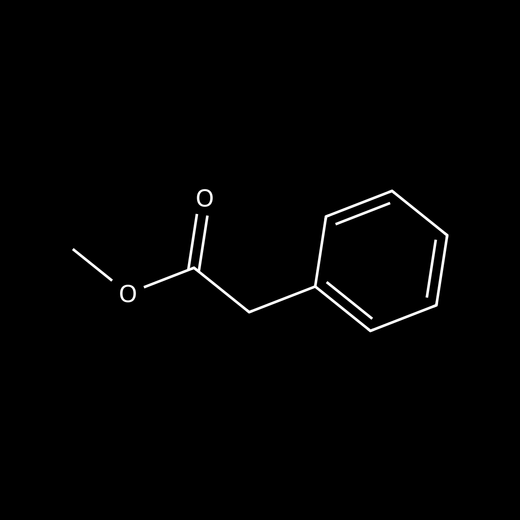
- Olfactive family
- Florals · 783 entries of the glossary in this family Subfamily: White florals · 95 entries in this subfamily Cluster: Jasmine-like white florals · 40 entries in this cluster
- Material
- Natural & Synthetic
- Pyramid
- Heart Note
- Strength
- High Step 4 of 5 · shared by 501 of 2,149 graded entries Graded entries at each step, from 1 to 5: 4, 118, 1,462, 501, 40. 24 more sit between two steps.
- Also called
- Methyl benzeneacetate, Phenyl-acetic acid methyl ester
Methyl phenylacetate · Facets
Entries of the glossary that carry each facet, of 3,979:
- honey 97
- floral 1,547
- sweet 1,987
- jasmine 57
- musky 115
- spicy 473
Methyl phenylacetate · Scent
A powerful, diffusive honey-musky odour with jasmine-floral traces.
Methyl phenylacetate · In Perfumery
It is used in perfumery and has a honey and jasmine odour.
Pyramid
Methyl phenylacetate: Heart. Entries of the glossary stored at each place of the pyramid, of 4,000 (35 store no place):
- Top 718
- Top · Heart 496
- Heart 1,644
- Heart · Base 513
- Base 594
Methyl phenylacetate · Extraction & Chemistry
It is made by methanolic esterification of the corresponding acid or nitrile, or by reacting hydrogen chloride over a solution of benzyl nitrile in methanol.
- Appearance
- Colourless to nearly colourless liquid
Methyl phenylacetate · In Depth
Identity
Methyl phenylacetate has the CAS number 101-41-7 and the molecular formula C₉H₁₀O₂. Its molecular weight is 150.17 g/mol and its IUPAC name is methyl 2-phenylacetate. It belongs to the chemical class of benzenes.
Odour
The odour is honeyed and sweetly floral, with a musky depth and a jasmine accent. It is powerful and quite diffusive, with traces of jasmin-floral notes and moderate to poor tenacity. Its detection threshold is 25 ppb. Its odour strength is high.
Occurrence in nature
It is found in cocoa, coffee, strawberry, pineapple, pepper, hop oil, cognac, peanut, honey and starfruit. It has also been found in Aspalathus linearis, Coffea arabica, Humulus lupulus and Lonicera japonica.
Production
It is made by methanolic esterification of the corresponding acid or nitrile, or by reacting hydrogen chloride over a solution of benzyl nitrile in methanol.
Use in perfumery
It is used in perfumery as a fragrance ingredient.
Use in flavours
It is a flavouring agent with a honey and jasmine taste. At 30 ppm its taste is floral, honey, spice, waxy and sweet. It is also used in flavours for tobacco.
Properties
It boils at 215 °C and has a density of 1.062 g/mL. Its index of refraction is 1.503–1.509 and its logP is 1.83. It is soluble in most organic solvents and in oils, dissolves 1:6 in 60% alcohol, and is insoluble in water, glycerin and propylene glycol. Its vapour pressure is 0.13 mm Hg at 20 °C. It is stable under recommended storage conditions.
Safety and IFRA
In the 51st Amendment, no IFRA Standard covers this material itself. Its EC number is 202-940-9 and it is registered under REACH. When heated to decomposition it emits acrid smoke and irritating fumes.
Methyl phenylacetate · Technical Sheet
Molecular weight
150.17 g/mol Heavier than 36 of the 885 other entries at the same place of the pyramid that store a weight; 16 weigh the same.
2,572 entries store a molecular weight. By place in the pyramid: Top 547, Top · Heart 406, Heart 886, Heart · Base 455, Base 278.
Identity
- Type
- Ingredient
- Category
- Aroma chemicals
Classification
- Chemical class
- Ester
Chemical data
- Formula
- C9H10O2
- CAS
- 101-41-7
- PubChem CID
- 7559, compound record on PubChem
- InChIKey
- CRZQGDNQQAALAY-UHFFFAOYSA-N
- Wikidata · Wikipedia
- Methyl phenylacetate: Q390681, item on Wikidata · Wikipedia, English article
Physical properties
- Boiling point
- 215 to 217 °C at 760 mmHg
- Flash point
- 90.56 °C (195 °F)
- Density
- 1.062 g/mL
- Refractive index
- 1.503–1.509
- Vapour pressure
- 0.129 mmHg at 25 °C (estimated)
- Log P
- 1.83
- Tenacity
- 56 hour(s) at 100 %
Performance and rules
- Available as
- synthetic
- IFRA status
- No IFRA Standard for the material itself (51st Amendment)
Methyl phenylacetate · See Also
Entries related to Methyl phenylacetate, by their place in the pyramid. “shared” marks a scent word Methyl phenylacetate has too.
Top notes

Phenylacetaldehyde
floral (shared) · green · rosy Florals / Natural & Synthetic / 120.15 g/mol

Heart notes

Benzyl phenylacetate
floral (shared) · sweet (shared) · honey (shared) Florals / Heart · Base / 226.27 g/mol
Ethyl phenylacetate
honey (shared) · apricot · sweet (shared) Fruity / Natural & Synthetic / 164.2 g/mol
Isobutyl phenylacetate
honey (shared) · waxy · rose Gourmand / 192.25 g/mol


Base notes

Anisyl phenylacetate
honey (shared) · balsamic · fruity Florals / 256.3 g/mol
Para-Cresyl Phenyl Acetate
animalic · floral (shared) · narcotic Florals / Synthetic / 226.27 g/mol
Honey
gourmand · animalic · sweet (shared) Gourmand / Natural & Synthetic
Phenyl Acetic Acid
animalic · honeyed · sweet (shared) Amber & musk / Synthetic / 136.15 g/mol


Methyl phenylacetate · Sources
- PubChem Methyl phenylacetate
- Pyrfume Arctander, Perfume and Flavor Chemicals: odour descriptions (Pyrfume archive)
- ChEBI Methyl phenylacetate: chemical classification record
- Pyrfume Good Scents odour data (Pyrfume archive)
- Pyrfume Leffingwell odour data (Pyrfume archive)
- The Good Scents Company Information System Methyl phenylacetate: data sheet
- Wikidata (LOTUS natural products data) Methyl phenylacetate: organisms it is reported in, with the papers
- IFRA Standards, 51st Amendment
- European Chemicals Agency Methyl phenylacetate: substance record
Cite as PREMIEREPEAU Glossary, “Methyl phenylacetate”, https://premierepeau.com/
