


Mirabilis
Keywords: floral · warm · sweet
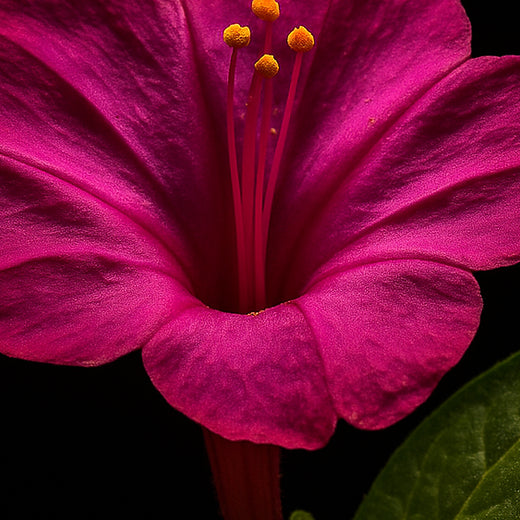
Mirabilis is the four o’clock flower or marvel of Peru, Mirabilis jalapa, a plant of the family Nyctaginaceae. Its flowers produce a strong, sweet fragrance throughout the night.
- Olfactive family
- Florals · 779 entries of the glossary in this family Subfamily: Classic florals · 313 entries in this subfamily
- Material
- Fantasy/Concept Flowers
- Pyramid
- Heart · Volatility: Heart Note
- Strength
- High Step 4 of 5 · shared by 498 of 2,156 graded entries Graded entries at each step, from 1 to 5: 4, 119, 1,473, 498, 39. 23 more sit between two steps.
- Also called
- Four o’clock flower, Marvel of Peru, Beauty of the night
Family, subfamily and cluster: PREMIEREPEAU house classification, version 2026‑11.
Mirabilis · Facets
Entries of the glossary that carry each facet, of 3,979:
- floral 1,546
- green 1,442
- sweet 1,988
- fruity 1,301
- warm 1,108
- fresh 1,387
Editorial note We own no rights to this material, its name or its trademark. This entry is independent editorial journalism, published under freedom of expression.
Mirabilis · Scent
The flowers are sweetly scented. They exhale a scent reminiscent of the tobacco flower. The fragrance is strong and sweet, and the flowers give it off throughout the night.
Evolution over time
Mirabilis: scent over time.
- Immediately
Sweet, reminiscent of the tobacco flower
Scent words: floral · sweet - After a few hours
Strong, sweet fragrance
Scent words: sweet - After a few days
Sweet
Scent words: sweet
Mirabilis · In Perfumery
An extract of Mirabilis jalapa is used in cosmetic products to condition and protect the skin.
Pyramid
Mirabilis: Heart. Entries of the glossary stored at each place of the pyramid, of 4,006 (42 store no place):
- Top 718
- Top · Heart 497
- Heart 1,641
- Heart · Base 514
- Base 594
Role in the formula
Mirabilis: roles in the formula. Entries of the glossary that share each role, of 4,006:
- Diffusion enhancer 248
- Modifier 1,167
- Signature note 897
- Lifting agent 567
- Blender 1,040
- Volume builder 780
Mirabilis · Terroir & Origins
- Producing countries
- Mexico
Mirabilis · Extraction & Chemistry
Volatiles emitted by the whole plant and by detached flowers were investigated using dynamic headspace analysis and gas chromatography/mass spectrometry. The headspace of a whole plant with several flowers was trapped on Super-Q in 3-hour intervals, and compounds were identified by comparing their mass spectra with library spectra or with standards.
Available as
Mirabilis: available as.
- essential oil
- reconstructed accord
- Appearance
- Colorless to pale yellow liquid
Mirabilis · Did You Know?
Around 1900, Carl Correns used Mirabilis as a model organism for his studies on cytoplasmic inheritance, using its variegated leaves to prove that certain factors outside the nucleus affected phenotype. In Japan the plant is called oshiroi-bana, because the white, powdery endosperm inside of mature seeds looks like oshiroi, the powder foundation used by geishas.
Mirabilis · In Depth
The plant
Mirabilis jalapa is native to the tropical regions of America. It is the most commonly grown ornamental species of Mirabilis, and it is available in a range of colors. It is an erect herbaceous perennial that grows from a tuberous rootstock and can grow up to 60 cm tall. It has become widely naturalized as a weed in many countries from the temperate zone to the tropics.
The genus Mirabilis belongs to the family Nyctaginaceae and is known as the four-o’clocks or umbrellaworts. The genus has several dozen species of herbaceous plants, mostly found in the Americas.
Flowering and pollination
The flowers usually open from late afternoon or at dusk, between 4 and 8 o’clock, giving rise to one of the plant’s common names. Each flower stays open for one night, and senescence develops after approximately 16 to 20 hours the following morning. The flowers are pollinated by hawk moths. Despite their appearance, the flowers are not formed from petals but are a pigmented modification of the calyx.
Scent chemistry
The scent consists mainly of the monoterpene (E)-β-ocimene, with additional compounds such as (Z)-3-hexenyl acetate and myrcene. Clearly detectable amounts of β-myrcene, (Z)-3-hexenyl acetate, (Z)-ocimene, (E)-epoxy-ocimene and benzyl benzoate were also found. Minor components include alloocimene, (Z)-3-hexenol and methyl salicylate.
The major compound (E)-β-ocimene reached its maximum emission between 1700 and 2000 and could be detected until 0200, but only at trace levels thereafter. The emission of (Z)-3-hexenyl acetate peaked later, between 2000 and 2300. The petaloid lobes of the limb are the site of (E)-β-ocimene release. The emission of scent peaks in the evening, matching flower opening and the activity of hawkmoth pollinators. Benzyl benzoate, one of the scent components, has a weak, sweet-balsamic odor.
Colors
A single flower can be plain yellow, red, magenta, pink, or white, or have a combination of sectors, flakes, and spots. In the yellow variety, flowers can gradually change to a dark pink colour as the plant matures, and white flowers can change to light violet.
Uses
The flowers are used in food colouring. An edible crimson dye is obtained from the flowers to color cakes and jellies. In herbal medicine, parts of the plant may be used as a diuretic, purgative, and for vulnerary (wound healing) purposes. The powdered seed is used as a cosmetic, but the seeds are considered poisonous. Flower extract can be used as a natural pH indicator in acid-base titration.
Related: Bougainvillea
Mirabilis · History
Mirabilis jalapa is believed to have been cultivated by the Aztecs for medicinal and ornamental purposes. It arrived in Europe in 1525. Carl Von Linné gave the plant its name in 1753, and Mirabilis alludes to the remarkable colors of its flowers.
Mirabilis · Technical Sheet
Identity
- Botanical
- Mirabilis jalapa
- Taxonomy
- Caryophyllales order › Nyctaginaceae family › Mirabilis genus · GBIF
- Botanical records
- Mirabilis jalapa: POWO, Mirabilis jalapa · IPNI, Mirabilis jalapa · GBIF, Mirabilis jalapa · Wikidata, Mirabilis jalapa · Wikipedia, Mirabilis jalapa
- IPNI
- Mirabilis jalapa L., Sp. Pl. 1: 177 (1753) — Carl Linnaeus (1707–1778)
- Type
- Accord
- Category
- Flowers
- Note
- Absolute / CO₂ extract from Mirabilis jalapa flowers
In Nature
- Growth form
- Herb · POWO
- Native range
- Mexico · Central America · POWO
- Introduced to
- 178 regions · Africa 44 · Southern America 33 · Northern America 28 · Tropical Asia 20 · Pacific 20 · Europe 15 · Temperate Asia 12 · Australasia 5 · Antarctic 1
- Flowering
- peak in July–October · north of the equator · iNaturalist
- Recorded altitude
- 0–1,000 m · median 150 m · 16,346 records with an altitude · GBIF
- Wild or cultivated
- 419 native · 1,139 introduced · 131 cultivated among 52,597 records (the rest carry no such mark) · GBIF
- Recorded in
- 160 of 512 squares of the world grid; a brighter dot holds more records · GBIF
In Print
- Timeline
- first described 1753 · earliest aroma paper in Europe PMC, 2005
- In English books
- most mentioned in the 1990s · Google Books Ngram
Classification
- Cluster
- Classic florals · 245 entries in this cluster
- Chemical class
- Floral volatiles, mainly monoterpene
Chemical data
- Formula
- Complex natural mixture (key constituents: (E)-β-ocimene; (Z)-3-hexenyl acetate; myrcene; benzyl benzoate C₁₄H₁₂O₂)
- Most reported compounds
- L-Valine (1 paper; one: Amino acids in higher plants 2015, L-Valine) · Alpha-Amyrin (1 paper; one: Botanical Gazette 1916, Alpha-Amyrin) · D-Alanine (1 paper; one: Amino acids in higher plants 2015, D-Alanine) · LOTUS
- Structure
- Cis-3-Hexenyl Acetate (Leaf Acetate), Myrcene, Benzyl Benzoate:
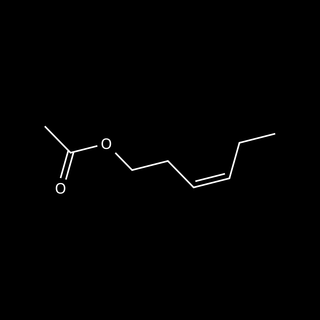
Cis-3-Hexenyl Acetate (Leaf Acetate)
PubChem, Cis-3-Hexenyl Acetate (Leaf Acetate)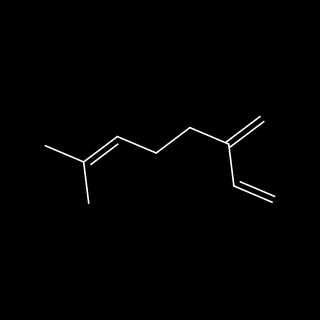
Myrcene
PubChem, Myrcene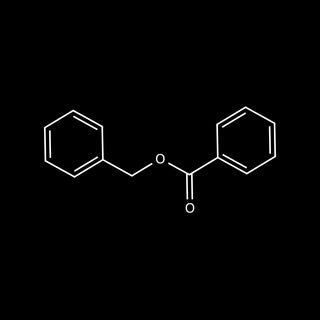
Benzyl Benzoate
PubChem, Benzyl Benzoate - CAS
- 91722-88-2
- INCI names (CosIng)
- MIRABILIS JALAPA CALLUS EXTRACT (SKIN PROTECTING)MIRABILIS JALAPA EXTRACT (SKIN CONDITIONING, SKIN PROTECTING)MIRABILIS JALAPA FLOWER EXTRACT (ANTIMICROBIAL, ANTIOXIDANT, ASTRINGENT, SKIN CONDITIONING – EMOLLIENT, SKIN PROTECTING)MIRABILIS JALAPA FLOWER/LEAF/STEM EXTRACT (SKIN CONDITIONING)MIRABILIS JALAPA SEED EXTRACT (SKIN PROTECTING)MIRABILIS JALAPA CALLUS POWDER (SKIN CONDITIONING)
- Key compounds
- trigonelline, boeravinone derivatives (root), floral volatiles
Physical properties
- Specific gravity
- 0.90–0.95 at 25 °C (est)
Performance and rules
- IFRA status
- No IFRA Standard for the material itself (51st Amendment)
Mirabilis · See Also
Entries related to Mirabilis, by their place in the pyramid. “shared” marks a scent word Mirabilis has too.
Top notes

trans-Alloocimene
herbal · floral (shared) · fresh (shared) Aromatic / Top · Heart

Heart notes

Angel’s Trumpet
floral (shared) · warm (shared) · spicy Florals / Same cluster / Accord
Lily
floral (shared) · green (shared) · waxy Florals / Synthetic
Orange Blossom
floral (shared) · honeyed · citrus Florals / Natural
Violet
floral (shared) · violet Florals / Natural & Synthetic
Tuberose
floral (shared) · narcotic · creamy Florals / Natural
Jarana Flower
timber tree Florals / Natural
Wisteria
floral (shared) · sweet (shared) · fruity (shared) Florals / Accord


Other entries · Place in the pyramid not stored

Carnation
floral (shared) · spicy · clove Florals / Same cluster / Natural

Mirabilis · Sources
Read the science
- Am J Bot (2005) Volatile composition, emission pattern, and localization of floral scent emission in Mirabilis jalapa (Nyctaginaceae)
- GBIF Mirabilis jalapa
- International Plant Names Index (IPNI) Mirabilis jalapa L.
- Frontiers Floral Scents and Fruit Aromas: Functions, Compositions, Biosynthesis, and Regulation
- IFRA Standards, 51st Amendment
- COSMILE Europe MIRABILIS JALAPA EXTRACT
- Wikipedia Mirabilis jalapa
- Wikipedia Mirabilis (plant)
- Wikipedia Benzyl benzoate
Cite as PREMIEREPEAU Glossary, “Mirabilis”, https://premierepeau.com/
