


Mistletoe
Keywords: green · fresh · woody
Mistletoe is the common name of Viscum album, European mistletoe, a hemi-parasitic evergreen shrub. Mistletoe absolute is a dark green viscous liquid with a bitter herbal green foliage bark odour.
- Olfactive family
- Aromatic · 510 entries of the glossary in this family Subfamily: Green notes · 93 entries in this subfamily Cluster: Green leafy notes · 420 entries in this cluster
- Material
- Natural Leaves
- Pyramid
- Heart · Volatility: Heart Note
- Strength
- Medium Step 3 of 5 · shared by 1,473 of 2,156 graded entries Graded entries at each step, from 1 to 5: 4, 119, 1,473, 498, 39. 23 more sit between two steps.
- Also called
- European mistletoe, common mistletoe, viscum album leaf absolute
Family, subfamily and cluster: PREMIEREPEAU house classification, version 2026‑11.
Mistletoe · Facets
Entries of the glossary that carry each facet, of 3,979:
- woody 792
- floral 1,546
- green 1,442
- sweet 1,988
- warm 1,108
- fresh 1,387
- herbal 757
- bitter 75
- foliage 11
- bark 1
Mistletoe · Scent
Mistletoe absolute smells bitter, herbal and green, with a foliage and bark character. Its odour type is herbal.
Evolution over time
Mistletoe: scent over time.
- Immediately
Herbal, green.
Scent words: green · herbal - After a few hours
Foliage, bitter.
Scent words: bitter - After a few days
Bark.
Mistletoe · In Perfumery
In flavour, mistletoe is an ingredient of biska, a pomace brandy-based liquor made in Istria.
Pyramid
Mistletoe: Heart. Entries of the glossary stored at each place of the pyramid, of 4,006 (42 store no place):
- Top 718
- Top · Heart 497
- Heart 1,641
- Heart · Base 514
- Base 594
Role in the formula
Mistletoe: roles in the formula. Entries of the glossary that share each role, of 4,006:
- Signature note 897
- Lifting agent 567
- Blender 1,040
- Volume builder 780
- Freshness 720
Mistletoe · Terroir & Origins
- Producing countries
- Asia, Europe
Mistletoe · Extraction & Chemistry
Viscum album leaf extract is an extract of the leaves of the mistletoe. Mistletoe absolute is sold under the synonym viscum album leaf absolute.
Available as
Mistletoe: available as.
- essential oil
- absolute
- Appearance
- Dark green viscous liquid
Mistletoe · Did You Know?
European mistletoe is a multicellular plant that lacks a functioning respiratory complex I in its electron transport chain and has reduced levels of complexes II and V. It also has one of the largest genomes of all organisms, at about 90 billion base pairs.
Mistletoe · In Depth
The plant
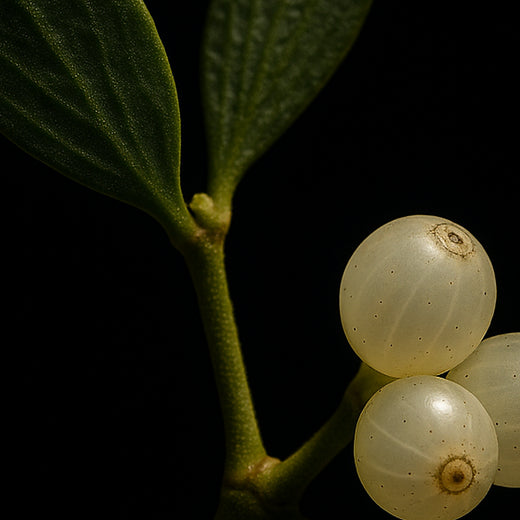
Mistletoe is the common name of Viscum album, a species in the family Santalaceae. It is native to Europe, as well as western and southern Asia. It is a hemi-parasitic evergreen shrub that grows on the stems of other trees. As a hemiparasite on several species of trees, it takes water and nutrients from them. The leaves are in opposite pairs, leathery and yellowish-green. The fruit is a white or yellow berry.
Composition
The high molecular weight viscotoxins and mistletoe lectins are considered to be the main active substances in aqueous extracts of Viscum album. Extracts also contain small molecules such as phenolic acids, flavonoids, terpenoids, tannins, phytosterol, saponins and organic acids. Oleanolic acid has been observed in Viscum album. Fermented aqueous extracts of Viscum album from two host tree species separate clearly by host tree in metabolome analysis. The metabolites may vary with harvesting time, plant organs, growth stage and extraction procedures.
Uses
Mistletoe leaves and young twigs are used by herbalists, and preparations made from them are popular in Europe, especially in Germany. These preparations are used in attempts to treat circulatory and respiratory system problems. Alcoholic extracts of Viscum species have demonstrated hypotensive, anticancer, antimicrobial, analgesic and anti-inflammatory activities in studies. Birdlime, an adhesive for trapping small animals or birds, was made from the sticky juice of mistletoe berries.
Toxicity
European mistletoe is potentially fatal if ingested in a concentrated form, such as a herbal tea infusion. People have been known to become seriously ill from eating the berries. The toxic lectin viscumin has been isolated from Viscum album.
Folklore
In modern times, mistletoe is commonly featured among Christmas decorations and symbology. Mistletoe is the county flower of Herefordshire.
Explore all seven extraits in the Discovery Set.
Related: Green Notes
Mistletoe · History
At the beginning of the 20th century, Rudolf Steiner and Ita Wegman introduced European mistletoe as an anthroposophical remedy for cancer treatment. The Romans associated mistletoe with peace, love, and understanding and hung it over doorways to protect the household. Viscum album was introduced to Northern California in 1900.
Mistletoe · Technical Sheet
Identity
- Botanical
- Viscum album
- Taxonomy
- Santalales order › Viscaceae family › Viscum genus · GBIF
- Botanical records
- Viscum album: POWO, Viscum album · IPNI, Viscum album · GBIF, Viscum album · Wikidata, Viscum album · Wikipedia, Viscum album
- IPNI
- Viscum album L., Sp. Pl. 2: 1023 (1753) — Carl Linnaeus (1707–1778)
- Type
- Ingredient
- Category
- Greens, herbs and fougeres
- Note
- Absolute or tincture from aerial parts; limited commercial availability
In Nature
- Native range
- Northern Europe · Middle Europe · Southwestern Europe · Southeastern Europe · Eastern Europe · Northern Africa · Caucasus · Western Asia · 3 more regions · POWO
- Introduced to
- 4 regions · Northern America 2 · Europe 1 · Temperate Asia 1
- Flowering
- peak in March · north of the equator · iNaturalist
- Recorded altitude
- 100–900 m · median 450 m · 18,720 records with an altitude · GBIF
- Wild or cultivated
- 12,554 native · 15 introduced · 45 cultivated among 281,989 records (the rest carry no such mark) · GBIF
- Recorded in
- 38 of 512 squares of the world grid; a brighter dot holds more records · GBIF
- Also from this botanical family
- Santalaceae: Hawaiian Sandalwood · Indian Sandalwood · Mysore Sandalwood · New Caledonian Sandalwood · Northern Sandalwood · Quandong Desert Peach · 2 more entries
In Print
- Timeline
- first described 1753 · earliest aroma paper in Europe PMC, 1978
- In English books
- most mentioned in the 1970s · Google Books Ngram
Classification
- Chemical class
- Botanical extract (absolute)
Chemical data
- Formula
- Complex natural mixture (key constituents: oleanolic acid C₃₀H₄₈O₃; viscotoxins)
- Most reported compounds
- Syringin (9 papers; one: J Ethnopharmacol 2000, Syringin) · Coniferin (4 papers; one: J Ethnopharmacol 2000, Coniferin) · Ononitol (3 papers; one: New Phytol 1992, Ononitol) · Oleanolic Acid (2 papers; one: Arch Pharm Res 2004, Oleanolic Acid) · LOTUS
- CAS
- 84929-55-5
- EC
- 284-538-3
- INCI names (CosIng)
- VISCUM ALBUM EXTRACT (NAIL CONDITIONING, SKIN CONDITIONING, SOOTHING)VISCUM ALBUM FRUIT EXTRACT (SOOTHING)VISCUM ALBUM LEAF EXTRACT (SOOTHING)
- Compound classes reported
- Monoterpenoids 5 % · Sesquiterpenoids 3 % · Flavonoids 20 % · Amino acids and peptides 13 % · of 60 compounds reported, 10 % of them esters · LOTUS
Performance and rules
- IFRA status
- No IFRA Standard for the material itself (51st Amendment)
Mistletoe · See Also
Entries related to Mistletoe, by their place in the pyramid. “shared” marks a scent word Mistletoe has too.
Top notes

Shishito Pepper
green (shared) · spicy · vegetal Aromatic / Same cluster / Natural & Synthetic
Basil
aromatic · green (shared) · herbal (shared) Aromatic / Top · Heart / Same subfamily / Natural
Kunzea
fresh (shared) · green (shared) · floral (shared) Aromatic / Top · Heart / Same subfamily / Natural
Rosemary
aromatic · herbal (shared) · camphorous Aromatic / Top · Heart / Natural


Heart notes

Linaloe Berry
fruity · woody (shared) · fresh (shared) Aromatic / Same cluster / Natural
Gromwell
earthy · green (shared) · fresh (shared) Aromatic / Same cluster / Natural
Sage
aromatic · herbal (shared) · amber Aromatic / Natural
Wheat
roasted · malty · bready Gourmand / Natural


Base notes

Tobacco
warm (shared) · sweet (shared) · leathery Aromatic / Natural

Mistletoe · Sources
- International Plant Names Index (IPNI) Viscum album L.
- Molecules (2020) Comprehensive Metabolome Analysis of Fermented Aqueous Extracts of Viscum album L. by Liquid Chromatography-High Resolution Tandem Mass Spectrometry
- Plants (2023) A Scoping Review of Genus Viscum: Biological and Chemical Aspects of Alcoholic Extracts
- Current Biology (2018) Absence of Complex I Implicates Rearrangement of the Respiratory Chain in European Mistletoe
- PubChem Oleanolic Acid
- IFRA Standards, 51st Amendment
- Wikipedia Viscum album
- Wikipedia Mistletoe
Cite as PREMIEREPEAU Glossary, “Mistletoe”, https://premierepeau.com/
