


Nectarine Blossom
Keywords: floral · fruity · fresh
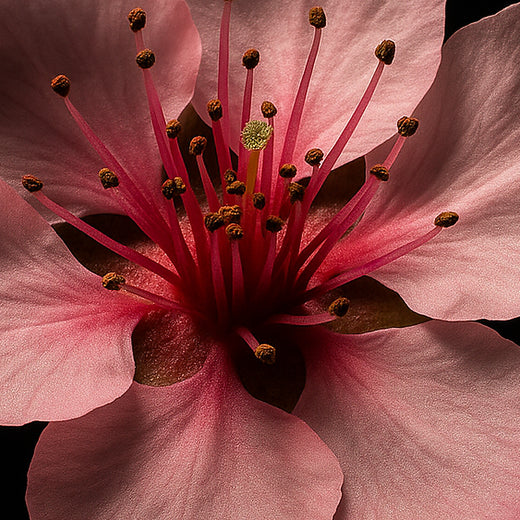
Nectarine blossom comes from the nectarine, a glossy-skinned, non-fuzzy variety of the peach species Prunus persica; peaches are planted as ornamentals for their flowers.
- Olfactive family
- Florals · 779 entries of the glossary in this family Subfamily: Green florals · 143 entries in this subfamily Cluster: Green-fresh florals · 135 entries in this cluster
- Material
- Fantasy/Concept
- Pyramid
- Heart · Volatility: Heart Note
- Strength
- N/A — no measured strength for a fantasy accord Not on the graded scale
- Also called
- Nectarine Flower, Peach Blossom
Family, subfamily and cluster: PREMIEREPEAU house classification, version 2026‑11.
Nectarine Blossom · Facets
Entries of the glossary that carry each facet, of 3,979:
- floral 1,546
- green 1,442
- sweet 1,988
- fruity 1,301
- warm 1,108
- fresh 1,387
Editorial note We own no rights to this material, its name or its trademark. This entry is independent editorial journalism, published under freedom of expression.
Nectarine Blossom · Scent
Nectarines carry more fruity and floral notes than peaches. One variety reads as more citrus-sweet and another as more fresh and fruity. The lactones that give the peach-like character include γ-octalactone, which smells sweet, herbaceous and coconut-like.
Evolution over time
Nectarine Blossom: scent over time.
- Immediately
N/A — no documented evolution for a fantasy accord
- After a few hours
N/A
Nectarine Blossom · In Perfumery
Peach volatiles are used as flavoring agents in the food and fragrance industry. A sought-after industrial product with a peach-like aroma is γ-decalactone.
Pyramid
Nectarine Blossom: Heart. Entries of the glossary stored at each place of the pyramid, of 4,006 (42 store no place):
- Top 718
- Top · Heart 497
- Heart 1,641
- Heart · Base 514
- Base 594
Role in the formula
Nectarine Blossom: roles in the formula. Entries of the glossary that share each role, of 4,006:
- N/A — no documented formula role 361
Nectarine Blossom · Terroir & Origins
- Producing countries
- China
Nectarine Blossom · Extraction & Chemistry
Fresh fruits such as apples, strawberries and cherries rarely yield the expected odours when extracted. Fruit notes of this kind found in a perfume are more likely to be of synthetic origin.
Available as
Nectarine Blossom: available as.
- synthetic accord
- fantasy note
- Appearance
- N/A — no commercial essential oil; the blossom note is a perfumery reconstruction
Nectarine Blossom · Did You Know?
Nectarines are not a separate species from peaches. Several genetic studies have concluded that nectarines are produced by a recessive allele, whereas a fuzzy peach skin is dominant.
Nectarine Blossom · In Depth
The nectarine and the peach
The difference between the two fruits is the lack of fuzz, the trichomes, on the skin of the nectarine. The gene PpeMYB25 regulates the formation of trichomes on peach fruits. A mutation can cause a loss of function that results in the changed fruit type.
The flower
The peach is planted as an ornamental for its flowers as well as for its fruit. Each flower has four or five petals and is somewhat cup-shaped, with the petals curving to shelter the centre of the flower. Each flower has 20 to 30 stamens, with purple-red anthers at their ends. Pink or red flowers 2 to 3.5 cm wide are typical of cultivars selected for their fruit.
Aroma compounds
Nectarines generate fewer volatiles than peaches, but have more fruity and floral aroma notes because of greater ester, linalool and terpinolene production.
History
The history of the nectarine is unclear: the first recorded mention in English is from 1611, but nectarines had probably been grown much earlier within the native range of the peach in central and eastern Asia. Peaches were first domesticated and cultivated in China during the Neolithic period. In 1917 the botanist Ulysses Prentiss Hedrick argued that the differences between peaches and nectarines are merely simple mutations and not species or even varieties.
Explore all seven extraits in the Discovery Set.
Related: Almond Blossom
Nectarine Blossom · Technical Sheet
Identity
- Botanical
- Prunus persica
- Taxonomy
- Rosales order › Rosaceae family › Prunus genus · GBIF
- Botanical records
- Prunus persica: POWO, Prunus persica · IPNI, Prunus persica · GBIF, Prunus persica · Wikidata, Prunus persica · Wikipedia, Prunus persica
- IPNI
- Prunus persica (L.) Batsch, Beytr. Entw. Gewächsreich 30 (1801) — August Johann Georg Karl Batsch (1761–1802) · ≡ Amygdalus persica L. (1753)
- Source
- Fantasy/Concept
- Type
- Accord
- Category
- Flowers
- Note
- No commercial essential oil from nectarine blossoms. The note is reconstructed using γ-decalactone (peach), linalool, and floral elements.
In Nature
- Native range
- China · POWO
- Introduced to
- 105 regions · Northern America 42 · Europe 20 · Temperate Asia 17 · Africa 11 · Tropical Asia 7 · Australasia 4 · Southern America 3 · Pacific 1
- Flowering
- peak in March · north of the equator · iNaturalist
- Sample origins in GC-MS studies
- Xinjiang (1 paper; one: Foods 2022, Xinjiang)
- Recorded altitude
- 50–650 m · median 150 m · 16,378 records with an altitude · GBIF
- Wild or cultivated
- 12 native · 592 introduced · 99 cultivated among 28,101 records (the rest carry no such mark) · GBIF
- Recorded in
- 103 of 512 squares of the world grid; a brighter dot holds more records · GBIF
- Also from this genus
- Prunus: Peach · Peach Blossom · Peach Leaf · Peach Tree · Almond · Almond Blossom · Almond tree · Amaretto · 17 more entries
- Also from this botanical family
- Rosaceae: Apothecary Rose · Apple · Apple Blossom · Apple Tree · Arctic Bramble · Ashberry · 44 more entries
In Print
- Timeline
- first described 1753 · earliest aroma paper in Europe PMC, 2003
- In English books
- most mentioned in the 1980s · Google Books Ngram
Classification
- Chemical class
- Reconstructed accord
Chemical data
- Formula
- N/A — no commercial essential oil
- Most reported compounds
- Chlorogenic Acid (7 papers; one: J Agric Food Chem 1990, Chlorogenic Acid) · Catechin (6 papers; one: J Agric Food Chem 1990, Catechin) · Beta-Carotene (4 papers; one: J Agric Food Chem 1989, Beta-Carotene) · Amygdalin (4 papers; one: Arch Pharm Res 2002, Amygdalin) · Quercetin (3 papers; one: J Agric Food Chem 1992, Quercetin) · LOTUS
- INCI names (CosIng)
- PRUNUS PERSICA KERNEL OIL (SKIN CONDITIONING – EMOLLIENT, SKIN CONDITIONING)PRUNUS PERSICA BUD EXTRACT (HUMECTANT)PRUNUS PERSICA CALLUS CULTURE EXTRACT (ANTIOXIDANT)PRUNUS PERSICA CALLUS EXTRACT (ANTIOXIDANT)PRUNUS PERSICA EXTRACT (CLEANSING, HAIR CONDITIONING, MOISTURISING, SKIN CONDITIONING)PRUNUS PERSICA FLOWER EXTRACT (MOISTURISING, SKIN CONDITIONING)PRUNUS PERSICA FRUIT EXTRACT (ABRASIVE, BULKING, MOISTURISING, SKIN CONDITIONING)PRUNUS PERSICA FRUIT WATER EXTRACT (SKIN CONDITIONING – EMOLLIENT, FRAGRANCE, PERFUMING)
- Compound classes reported
- Monoterpenoids 2 % · Flavonoids 21 % · Diterpenoids 14 % · of 149 compounds reported, 7 % of them esters · LOTUS
Labelling
- EU allergens reported
- Linalool · Geraniol · Eugenol · Coumarin · Benzyl Alcohol · Cinnamyl Alcohol · Terpineol · Benzaldehyde · Vanillin
Performance and rules
- IFRA status
- No IFRA Standard for the material itself (51st Amendment)
Nectarine Blossom · See Also
Entries related to Nectarine Blossom, by their place in the pyramid. “shared” marks a scent word Nectarine Blossom has too.
Heart notes

Jarana Flower
timber tree Florals / Same cluster / Natural
Petunia
floral (shared) · fruity (shared) · fresh (shared) Florals / Same cluster / Fantasy/Concept
Strawberry Flower
floral (shared) · fruity (shared) · fresh (shared) Florals / Same cluster / Fantasy/Concept
Cherry Blossom
floral (shared) · fresh (shared) · fruity (shared) Florals / Same cluster / Accord
Pear Blossom
floral (shared) · fresh (shared) · fruity (shared) Florals / Same cluster / Fantasy/Concept
Plum Blossom
floral (shared) · fruity (shared) · fresh (shared) Florals / Same cluster / Accord
Tuberose
floral (shared) · narcotic · creamy Florals / Natural
Orange Blossom
floral (shared) · honeyed · citrus Florals / Natural
Violet
floral (shared) · violet Florals / Natural & Synthetic
Rose
floral (shared) · honeyed · waxy Florals / Natural
Lily
floral (shared) · green (shared) · waxy Florals / Synthetic
Orchard Blossom
floral (shared) · fruity (shared) · fresh (shared) Florals / Fantasy/Concept
Peach Blossom
floral (shared) · fruity (shared) · sweet (shared) Florals / Fantasy/Concept
Sour Cherry Blossom
floral (shared) · vanilla-like Florals / Accord
Apple Blossom
floral (shared) · fruity (shared) · sweet (shared) Florals / Natural
Apricot Blossom
floral (shared) · fruity (shared) · sweet (shared) Florals / Fantasy/Concept
Peach Leaf
fruity (shared) · green (shared) · fresh (shared) Aromatic / Natural


Nectarine Blossom · Sources
Read the science
- Food Res Int (2021) Characterization of the major aroma-active compounds in peach (Prunus persica L. Batsch) by gas chromatography-olfactometry, flame photometric detection and molecular sensory science approaches
- Plant J (2021) New high-quality peach (Prunus persica L. Batsch) genome assembly to analyze the molecular evolutionary mechanism of volatile compounds in peach fruits
- International Plant Names Index (IPNI) Prunus persica (L.) Batsch
- Plants (2022) HS-SPME-GC-MS Volatile Profile Characterization of Peach (Prunus persica L. Batsch) Varieties Grown in the Eastern Balkan Peninsula
- IFRA Standards, 51st Amendment
- Wikipedia Peach
- Wikipedia Nectarine
- Wikipedia Prunus persica
- Wikipedia Perfume
Cite as PREMIEREPEAU Glossary, “Nectarine Blossom”, https://premierepeau.com/
