


Ozone Acetaldehyde
Keywords: fruity · sweet · ethereal
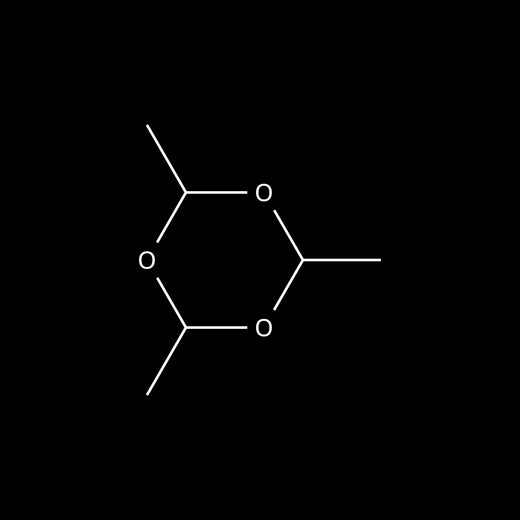
Ozone Acetaldehyde: Paraldehyde (CAS 123-63-7) is the cyclic trimer of acetaldehyde. Its odor is described as sweet and pleasant.
- Olfactive family
- Fruity · 698 entries of the glossary in this family Subfamily: Classic fruits · 425 entries in this subfamily Cluster: Mixed fruit notes · 346 entries in this cluster
- Material
- Synthetic Cyclic trimer of acetaldehyde
- Pyramid
- Top · Volatility: Top Note
- Producing countries
- Synthetic — manufactured worldwide
- Also called
- Paraldehyde, paracetaldehyde, acetaldehyde trimer, elaldehyde, triacetaldehyde, paraacetaldehyde, paral
Ozone Acetaldehyde · Facets
Entries of the glossary that carry each facet, of 3,979:
- green 1,442
- ozonic 12
- fresh 1,387
- fruity 1,301
- sweet 1,988
- ethereal 184
Ozone Acetaldehyde · Scent
The odor profile lists fruity, sweet, ethereal, green, rummy, musty, fresh, aromatic, winey and pungent facets. Other descriptions give a pleasant, agreeable or characteristic aromatic odor. Its odor impact is estimated as high, with a recognition threshold of 0.02–0.025 mg/cu m.
Evolution over time
Ozone Acetaldehyde: scent over time.
- Immediately
Fruity, ethereal and sweet.
Scent words: fruity · sweet
Ozone Acetaldehyde · In Perfumery
Pyramid
Ozone Acetaldehyde: Top. Entries of the glossary stored at each place of the pyramid, of 4,000 (36 store no place):
- Top 718
- Top · Heart 497
- Heart 1,641
- Heart · Base 514
- Base 594
Role in the formula
Ozone Acetaldehyde: roles in the formula. Entries of the glossary that share each role, of 4,000:
- Modifier 1,167
- Top note lift 54
- Freshness 720
PREMIEREPEAU collection: Extrait de parfum
Ozone Acetaldehyde · Extraction & Chemistry
Paraldehyde can be produced by the direct reaction of acetaldehyde and sulfuric acid. At room temperature and higher the trimer is the preferred product, while around −10 °C the tetramer metaldehyde is more likely to form. The reaction of sulfuric acid and acetaldehyde is exothermic.
- Appearance
- Clear colorless liquid
Ozone Acetaldehyde · Did You Know?
Weidenbusch found it quite remarkable that heating paraldehyde with a trace of the acid reversed the reaction and recreated acetaldehyde.
Ozone Acetaldehyde · In Depth
What it is
Paraldehyde is the cyclic trimer of acetaldehyde. Formally, it is a derivative of 1,3,5-trioxane, with a methyl group in place of a hydrogen atom at each carbon. Its systematic name is 2,4,6-trimethyl-1,3,5-trioxane, and its formula is C₆H₁₂O₃.
Chemistry
It is a colourless liquid, sparingly soluble in water and highly soluble in ethanol. It slowly oxidizes in air, turning brown and producing an odour of acetic acid. It attacks most plastics and rubbers and should be kept in glass bottles. Paraldehyde is produced and used as a mixture of two diastereomers, cis- and trans-paraldehyde. Heated with catalytic amounts of acid, it depolymerizes back to acetaldehyde.
Uses
Paraldehyde has uses in industry and medicine. It handles better than anhydrous acetaldehyde, and may therefore stand in for it, directly or indirectly, in synthesis. It is used as-is in the synthesis of bromal (tribromoacetaldehyde). It is a central nervous system depressant, and was soon found to be an effective anticonvulsant, hypnotic and sedative. Today it is sometimes used to treat status epilepticus.
Explore all seven extraits in the Discovery Set.
Related: Aldehydes
Ozone Acetaldehyde · History
Paraldehyde was first observed in 1835 by the German chemist Justus Liebig. Its empirical formula was determined in 1838 by Liebig’s student Hermann Fehling. The German chemist Valentin Hermann Weidenbusch synthesized it in 1848 by treating acetaldehyde with acid, either sulfuric or nitric, and cooling to 0 °C. Vincenzo Cervello, an Italian physician, introduced it into clinical practice in the UK in 1882. It was regularly given at bedtime in psychiatric hospitals and geriatric wards until the 1970s.
Ozone Acetaldehyde · Technical Sheet
Molecular weight
132.16 g/mol Heavier than 426 of the 536 other entries at the same place of the pyramid that store a weight.
2,515 entries store a molecular weight. By place in the pyramid: Top 537, Top · Heart 403, Heart 861, Heart · Base 452, Base 262.
Identity
- Botanical
- N/A — synthetic molecule
- Type
- Ingredient
- Category
- Aroma chemicals
Classification
- Chemical class
- Ether derivative of 1,3,5-trioxane
Chemical data
- Formula
- C6H12O3
- CAS
- 123-63-7
- PubChem CID
- 31264, compound record on PubChem
- InChIKey
- SQYNKIJPMDEDEG-UHFFFAOYSA-N
- Wikidata · Wikipedia
- Ozone Acetaldehyde: Q424342, item on Wikidata · Wikipedia, English article
Physical properties
- Boiling point
- 123.00 to 124.00 °C at 760 mm Hg
- Melting point
- 12.6 °C
- Flash point
- 24 °C (closed cup)
- Specific gravity
- 0.9943 at 68 °F
- Refractive index
- 1.4049 at 20 °C/D
- Log P
- 0.67
Performance and rules
- Available as
- synthetic
- IFRA status
- No IFRA Standard for the material itself (51st Amendment)
Ozone Acetaldehyde · See Also
Entries related to Ozone Acetaldehyde, by their place in the pyramid. “shared” marks a scent word Ozone Acetaldehyde has too.
Top notes

Cascalone
fresh (shared) · aquatic · floral Aquatic / Synthetic / 206.24 g/mol
Calone
marine · ozonic (shared) · aquatic Aquatic / Top · Heart / Synthetic / 178.19 g/mol
Cis-3-Hexenol (Leaf Alcohol)
green (shared) · leafy · fresh (shared) Green / Natural & Synthetic / 100.16 g/mol


Ozone Acetaldehyde · Sources
- PubChem Paraldehyde
- CAMEO Chemicals, NOAA Paraldehyde
- IFRA Standards, 51st Amendment
- Wikipedia Paraldehyde
Cite as PREMIEREPEAU Glossary, “Ozone Acetaldehyde”, https://premierepeau.com/
