


Rosebay Willowherb
Keywords: herbal · tea plant
Rosebay willowherb (Chamaenerion angustifolium) is a perennial herbaceous flowering plant in the willowherb family, Onagraceae. It is native throughout the temperate Northern Hemisphere, including large parts of the boreal forests.

- Olfactive family
- Florals · 779 entries of the glossary in this family Subfamily: Green florals · 143 entries in this subfamily Cluster: Green-fresh florals · 135 entries in this cluster
- Material
- Natural Perennial herbaceous plant (leaves dried for tea)
- Pyramid
- Heart · Volatility: Heart Note
- Strength
- Medium Step 3 of 5 · shared by 1,473 of 2,156 graded entries Graded entries at each step, from 1 to 5: 4, 119, 1,473, 498, 39. 23 more sit between two steps.
- Also called
- Fireweed, Great willowherb, Bombweed, Chamerion angustifolium, Epilobium angustifolium, Chamaenerion angustifolium
Family, subfamily and cluster: PREMIEREPEAU house classification, version 2026‑11.
Rosebay Willowherb · Facets
Entries of the glossary that carry each facet, of 3,979:
- floral 1,546
- green 1,442
- earthy 660
- sweet 1,988
- powdery 197
- herbal 757
- fresh 1,387
Rosebay Willowherb · Scent
The tea brewed from the dried leaves has a pleasant, specific aroma.
Rosebay Willowherb · In Perfumery
The herb is used in cosmetic products.
Pyramid
Rosebay Willowherb: Heart. Entries of the glossary stored at each place of the pyramid, of 4,006 (42 store no place):
- Top 718
- Top · Heart 497
- Heart 1,641
- Heart · Base 514
- Base 594
Role in the formula
Rosebay Willowherb: roles in the formula. Entries of the glossary that share each role, of 4,006:
- Diffusion enhancer 248
- Modifier 1,167
- Signature note 897
- Lifting agent 567
- Blender 1,040
- Volume builder 780
Rosebay Willowherb · Terroir & Origins
- Producing countries
- Russia (leaf tea), United States (honey)
Rosebay Willowherb · Extraction & Chemistry
Mature leaves are dried for use as tea. An infusion in edible oil is made by adding 10 g of sunflower oil to 1 g of dried and ground leaves and storing the mixture for 14 days.
Available as
Rosebay Willowherb: available as.
- synthetic accord
- fantasy note
- dried leaf
- tea infusion
- oil infusion
- Appearance
- Perennial herb with reddish stems and magenta to pink flowers
Rosebay Willowherb · Did You Know?
The seeds can fly up to ten kilometres. A plant bears about 80,000 minute seeds. Flowers, buds and fruits are usually present on the inflorescence at the same time. Fireweed is the floral emblem of Yukon.
Rosebay Willowherb · In Depth
The plant is known in North America as fireweed and in the British Isles as both fireweed and rosebay willowherb. The common American name fireweed derives from the species’ abundance as a colonizer on burnt sites after forest fires and other disturbances. The generic name Chamaenerion means dwarf rosebay, and the specific epithet angustifolium means narrow-leaved.
Description and habitat
The reddish stems are usually simple, erect and smooth, and 0.5–2 metres high. The inflorescence is a symmetrical terminal raceme that blooms progressively from bottom to top. The upright, reddish-brown linear seed capsule splits from the apex and curls open. The seeds have silky hairs to aid wind dispersal.
Fireweed is often abundant in wet calcareous to slightly acidic soils in open fields, pastures, and particularly burned-over lands. The plant attracts bees, flies, other insects and hummingbirds.
Uses of fireweed
In Russia, fireweed is made into a tea known as Ivan-Chai. Fireweed tea is rich in flavour and deep in colour, and contains no caffeine. It is sold commercially blended with mint or thyme. Fireweed petals are made into jelly.
Traditionally the young shoots are collected in the spring by Native American and Siberian people and mixed with other greens. The seed hairs used to be woven into candle wicks. Most fireweed honey is produced in locations in cool climates, such as the Pacific Northwest in the United States and Scandinavian countries in Europe.
Chemical constituents
Oenothein B, a unique macrocyclic ellagitannin dimer, occurs in Epilobium angustifolium, the name Kew accepts for this plant. In Epilobium angustifolium, oenothein B is the predominant polyphenol, at 14–23%, while flavonoid content is below 2%. Woodfordin I, a dimer, has also been isolated from the plant. The main volatile components of the plant are 2-hexenal, α-bourbonene, β-caryophyllene, α-caryophyllene, germacrene D, caryophyllene oxide and 3-phenethylbenzonitrile.
Explore all seven extraits in the Discovery Set.
Related: Fuchsia
Rosebay Willowherb · History
In Britain the plant was considered a rare species in the 18th century, and one confined to a few locations with damp, gravelly soils. The plant’s rise from local rarity to widespread abundance seems to have occurred at the same time as the expansion of the railway network and the associated soil disturbance.
The plant became locally known as ‘bombweed’ due to its rapid colonization of bomb craters during World War II. Rosebay Willowherb was voted the county flower of London in 2002 following a poll by the wild plant conservation charity Plantlife. In Russia, Koporsky tea has been produced since the 13th century in the town of Koporye.
Rosebay Willowherb · Technical Sheet
Identity
- Botanical
- Epilobium angustifolium L. (syn. Chamaenerion angustifolium)
- Accepted name (Kew)
- Epilobium angustifolium L. · POWO
- Taxonomy
- Myrtales order › Onagraceae family › Chamaenerion genus · GBIF
- Botanical records
- Chamaenerion angustifolium: POWO, Chamaenerion angustifolium · IPNI, Chamaenerion angustifolium · GBIF, Chamaenerion angustifolium · Wikidata, Chamaenerion angustifolium · Wikipedia, Chamaenerion angustifolium
- IPNI
- Chamaenerion angustifolium (L.) Scop., Fl. Carniol., ed. 2. 1: 271 (1771) (1771) — Scopoli, Joannes Antonius (Giovanni Antonio) (1723–1788)
- Type
- Ingredient
- Category
- Flowers
- Note
- Chamaenerion angustifolium (fireweed); no standardized essential oil — used as accord
In Nature
- Growth form
- Herb · POWO
- Flowering
- peak in July–August · north of the equator · iNaturalist
- Recorded altitude
- 50–1,950 m · median 1,000 m · 40,245 records with an altitude · GBIF
- Wild or cultivated
- 44,669 native · 23 introduced · 162 cultivated among 929,247 records (the rest carry no such mark) · GBIF
- Recorded in
- 128 of 512 squares of the world grid; a brighter dot holds more records · GBIF
In Print
- In English books
- most mentioned in the 1960s · Google Books Ngram
Chemical data
- Formula
- Complex natural mixture (key constituents: oenothein B; β-caryophyllene)
- Structure
- Beta-Caryophyllene:
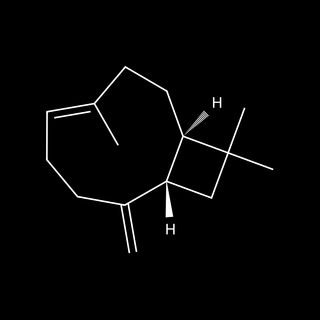
Beta-Caryophyllene
PubChem, Beta-Caryophyllene - CAS
- 90028-31-2 (Epilobium angustifolium extract)
Labelling
- Forms in the EU cosmetic inventory
- Rosebay Willowherb: EPILOBIUM ANGUSTIFOLIUM FLOWER/LEAF/STEM EXTRACT · EPILOBIUM ANGUSTIFOLIUM LEAF EXTRACT · EPILOBIUM ANGUSTIFOLIUM EXTRACT
Performance and rules
- IFRA status
- No IFRA Standard for the material itself (51st Amendment)
Rosebay Willowherb · See Also
Entries related to Rosebay Willowherb, by their place in the pyramid. “shared” marks a scent word Rosebay Willowherb has too.
Heart notes

Orange Blossom
floral (shared) · honeyed · citrus Florals / Natural
Rose
floral (shared) · honeyed · waxy Florals / Natural
Jasmine
floral (shared) Florals / Natural
Violet
floral (shared) · violet Florals / Natural & Synthetic
China Rose
floral (shared) · light · earthy (shared) Florals / Natural
Dried Rose
floral (shared) · rose · dried petals Florals / Natural


Other entries · Place in the pyramid not stored

Carnation
floral (shared) · spicy · clove Florals / Natural

Rosebay Willowherb · Sources
- International Plant Names Index (IPNI) Epilobium angustifolium L.
- Molecules (2018) Chemical and Biological Significance of Oenothein B and Related Ellagitannin Oligomers with Macrocyclic Structure
- Phytotherapy Research (2016) Therapeutic Potential of Polyphenols from Epilobium Angustifolium (Fireweed)
- Plants (2025) Exploring the Phytochemical Profile and Biological Insights of Epilobium angustifolium L. Herb
- Oregon State University Extension Service Chamaenerion angustifolium (fireweed)
- IFRA Standards, 51st Amendment
- Wikipedia Chamaenerion angustifolium
- Wikipedia Fireweed
Cite as PREMIEREPEAU Glossary, “Rosebay Willowherb”, https://premierepeau.com/
