Silverthorn Flower

AccordFLOWERSfloral · sweet
HeartPyramid
5/5Strength
—Tenacity
3Origins

Editorial noteWe own no rights to this material, its name or its trademark. This entry is independent editorial journalism, published under freedom of expression.

Specimen
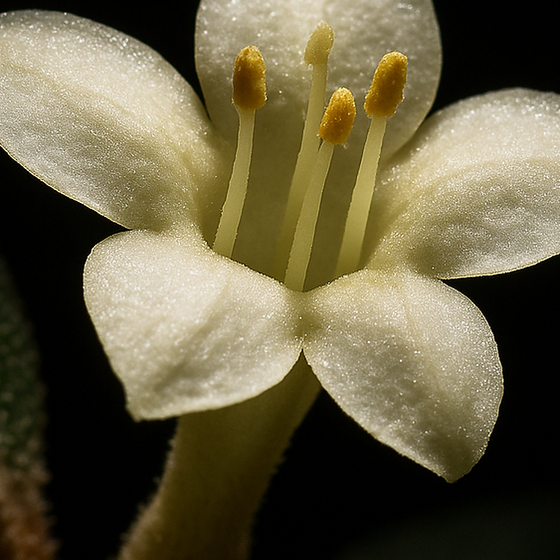
Silverthorn Flower perfume ingredient
Heart
Elaeagnus pungens
Fantasy/Concept
Definition

Silverthorn (Elaeagnus pungens) is an evergreen shrub of the family Elaeagnaceae. Its autumn flowers are sweet-scented and are described as similar to a gardenia.

FLORAL SWEET
silverthorn, thorny olive, spiny oleaster, thorny elaeagnus
Type
Accord
Olfactive family
Florals
Subfamily
White florals
Cluster
Classic florals
Source
flower
Instruments
Pyramid
TTop
HHeart
BBase
5/5Strength
Very high
odour strength
Producing countries
China Korea Japan

Scent

The flowers are sweet-scented. Their scent is described as sweet and similar to a gardenia. The small flowers are extremely fragrant. The flowers are also described as fragrant and pungent.

The Full Story

Silverthorn (Elaeagnus pungens) is a dense, branching shrub that can grow over 7 metres tall and 4 metres wide. Its evergreen leaves have silvery white undersides with brown flecks. Parts of the stem carry thorns up to 8 centimetres long. The leaves are leathery, shiny green above and silvery white below with tiny brown scales, and young branchlets are covered with brown scales. The thorny stems can hook onto other plants and structures, and the shrub can climb into overhead trees if its branches are not maintained.

The flowers, about half an inch in size, are bell-shaped, silvery-white and fragrant, and they bloom in axillary clusters in fall. Blooming occurs in the autumn and the fruit develops during the spring. The fruit is a drupe up to 1.5 centimetres long that contains one seed. Many birds feed on the fruits of the shrub.

In the genus Elaeagnus, the flowers are small, with no petals, and are often fragrant. The genus name Elaeagnus comes from the Greek words elaia meaning "olive tree" and agnos meaning "chaste" or "pure". Many Elaeagnus species harbor nitrogen-fixing organisms in their roots, so they grow well in low-nitrogen soils.

The species is native to Asia, including China and Japan. In China it occurs on hillsides and in thickets. It is present in the southeastern United States as an introduced species. It can form dense thickets that displace native species, and it is sometimes an invasive species. It is widely cultivated as a garden plant in temperate regions and tolerates varied environmental conditions, including heat, cold, wind, coastal conditions, shade, and full sun. It is also a parent of the hybrid Elaeagnus × submacrophylla, which is grown in gardens as an ornamental plant.

—

Related: Abelia · Almond Blossom · Alpha Terpineol · Alstroemeria · Alumroot · Amarillys · Amazon Moonflower · Amethyst Flower

Did You Know?

Elaeagnus pungens has inconspicuous flowers with a large scent. Between 8 March and 5 April 1981, researchers counted 298 cedar waxwings killed while trying to get fruits from thorny-olive shrubs growing along one highway in Brazos County, Texas.

Extraction & Chemistry

Botanical
Elaeagnus pungens
Appearance
Bell-shaped, silvery-white flowers
Odour strength
Extremely fragrant
Synonyms
silverthorn, thorny olive, spiny oleaster, thorny elaeagnus
IFRA status
See note

No IFRA Standard for the material itself (51st Amendment)

See Also

8 notes