


Stinkwort
Keywords: camphoraceous · balsamic · green
Stinkwort is the common name of Dittrichia graveolens, a plant of the Asteraceae family. It has a strong aroma with a camphor-like smell.
- Olfactive family
- Aromatic · 510 entries of the glossary in this family Subfamily: Herbal aromatics · 230 entries in this subfamily Cluster: Camphoraceous aromatics · 114 entries in this cluster
- Material
- Natural Aerial parts
- Pyramid
- Heart · Volatility: Heart Note
- Also called
- Inula graveolens, Erigeron graveolens, Cupularia graveolens, stinkweed, stinking fleabane, camphor Inula, Cape khakiweed, odorous Inula
Family, subfamily and cluster: PREMIEREPEAU house classification, version 2026‑11.
Stinkwort · Facets
Entries of the glossary that carry each facet, of 3,979:
- camphoraceous 140
- balsamic 343
- green 1,442
- herbal 757
- aromatic 102
- pungent 90
Stinkwort · Scent
The essential oil has a balsamic odor type. The leaves have an unpleasant odor. The oil from plants harvested in July had a stronger odor than the oils obtained in the other three seasons.
Stinkwort · In Perfumery
The essential oil, known as “odorous Inula”, is used in the production of perfumes, soaps and toiletries.
Pyramid
Stinkwort: Heart. Entries of the glossary stored at each place of the pyramid, of 4,006 (42 store no place):
- Top 718
- Top · Heart 497
- Heart 1,641
- Heart · Base 514
- Base 594
Role in the formula
Stinkwort: roles in the formula. Entries of the glossary that share each role, of 4,006:
- Modifier 1,167
- Fragrance ingredient 51
- Perfuming agent 43
Stinkwort · Extraction & Chemistry
Supercritical CO2 extraction of the flowering plant gave an extract in which bornyl acetate and borneol were not present even in trace amounts.
Available as
Stinkwort: available as.
- essential oil
- CO2 extract
Stinkwort · Did You Know?
The species name graveolens is Latin and means “heavy smelling.”
Stinkwort · In Depth
The plant
Stinkwort is a fall-flowering, sticky, aromatic annual native to southern Europe, northern Africa, and southwestern Asia. Its foliage has sticky hairs covered with resin. The sticky leaves and stems may cause contact dermatitis.
Composition and variation
Borneol and bornyl acetate are the principal metabolites of the essential oil. Next come the monoterpenes camphene and terpineol and the sesquiterpenes caryophyllene, cadinol and farnesol. An oil from France contained 54% bornyl acetate, followed by borneol at 20% and camphene at 4.9%. Borneol prevailed in an oil from Iran, at 60.7%.
The chemical composition is strongly influenced by collection season, phenological stage, processing and extraction methods. Plants harvested in July gave the highest oil yield, 0.678%. The oil obtained in summer showed the highest content of bornyl acetate, borneol and thymol.
Stinkwort · History
The genus name Dittrichia honors a German botanist, Manfred Dittrich.
Stinkwort · Technical Sheet
Identity
- Botanical
- Dittrichia graveolens
- Taxonomy
- Asterales order › Asteraceae family › Dittrichia genus · GBIF
- Botanical records
- Dittrichia graveolens: POWO, Dittrichia graveolens · IPNI, Dittrichia graveolens · GBIF, Dittrichia graveolens · Wikidata, Dittrichia graveolens · Wikipedia, Dittrichia graveolens
- IPNI
- Dittrichia graveolens (L.) Greuter, Exsicc. Genav. Conserv. Bot. Distrib. Fasc. 4: 71 (1973) — Werner Rodolfo Greuter (1938-)
- Type
- Ingredient
- Category
- Greens, herbs and fougeres
In Nature
- Flowering
- peak in October · north of the equator · iNaturalist
- Sample origins in GC-MS studies
- Lebanon (1 paper; one: Journal of essential oil research 2006) · Greece (1 paper; one: Journal of essential oil research 2004)
- Recorded altitude
- 50–550 m · median 200 m · 6,153 records with an altitude · GBIF
- Wild or cultivated
- 591 native · 5,141 introduced · 3 cultivated among 35,643 records (the rest carry no such mark) · GBIF
- Recorded in
- 39 of 512 squares of the world grid; a brighter dot holds more records · GBIF
In Print
- Timeline
- first described 1973 · earliest aroma paper in Europe PMC, 2000
- In English books
- most mentioned in the 2000s · Google Books Ngram
Classification
- Chemical class
- Oxygenated monoterpenes
Chemical data
- Formula
- Complex natural mixture (key constituents: bornyl acetate; borneol)
- GC-MS study
- Chem Biodivers 2016, Dittrichia graveolens (L.) Greuter Essential Oil: Chemical Composition, Multivariate Analysis, and Antimicrobial Activity
- Structure
- Borneol:
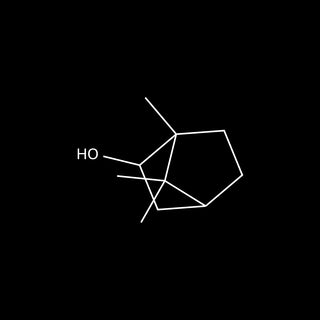
Borneol
PubChem, Borneol - Compound classes reported
- Monoterpenoids 3 % · Sesquiterpenoids 69 % · Flavonoids 20 % · of 61 compounds reported, 20 % of them esters · LOTUS
Labelling
- EU allergens reported
- Beta-Caryophyllene
Performance and rules
- IFRA status
- No IFRA Standard for the material itself (51st Amendment)
Stinkwort · See Also
Entries related to Stinkwort, by their place in the pyramid. “shared” marks a scent word Stinkwort has too.
Top notes

Artemisia
green (shared) · fresh · woody Aromatic / Top · Heart / Same subfamily / Natural

Heart notes
-
Camphor Bush
herbal (shared) · camphoraceous (shared) · minty Aromatic / Same cluster / Natural 
Immortelle
aromatic (shared) · honey · herbal (shared) Aromatic / Same subfamily / Natural
African Marigold
herbal (shared) · fruity · warm Aromatic / Same subfamily / Natural
Inula
earthy · floral · warm Aromatic / Same subfamily / Natural
Artichoke
green (shared) · earthy · fresh Green / Natural


Stinkwort · Sources
- GBIF Dittrichia graveolens
- International Plant Names Index (IPNI) Dittrichia graveolens (L.) Greuter
- Molecules Dittrichia graveolens (L.) Greuter, a Rapidly Spreading Invasive Plant: Chemistry and Bioactivity
- NC State Extension Stinkwort
- IFRA Standards, 51st Amendment
- Cal-IPC (California Invasive Plant Council) Dittrichia graveolens Profile
Cite as PREMIEREPEAU Glossary, “Stinkwort”, https://premierepeau.com/

