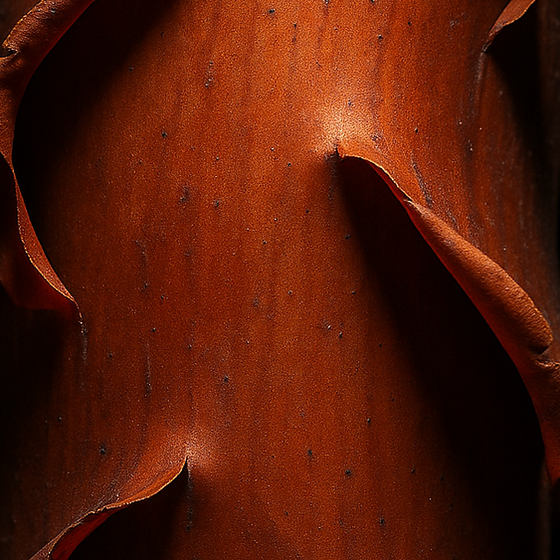
The tree has waxy foliage, a contorted growth habit and flaky bark. It is about 10 to 25 metres tall, and in the right conditions up to 30 m. The leaves are thick, waxy and elliptical, glossy dark green above and lighter, more grayish green beneath. In spring it bears sprays of small white to pink, bell-like flowers, and in autumn red berries. Individual trees can live for over 300 years.
Distribution and Habitat
Madrones are mainly found in Puget Sound, the Oregon Coast Range and the California Coast Ranges, and are also scattered on the west slope of the Sierra Nevada and Cascade mountain ranges. The tree grows in dry and rocky sites, is tolerant of salt water, but is fairly intolerant of shade. Mature trees survive fire and can regenerate more rapidly after fire than Douglas-firs. Many mammal and bird species feed off the berries. The largest known madrone was burned and possibly killed in the Soberanes Fire of mid-2016.
Ecology and Cultivation
The thin bark is susceptible to fire, but new saplings readily sprout after such disturbances. The tree also sprouts from cut stems. A lignotuber near ground level stores energy and sprouting buds that resist fire, ready to replace the trunk or limbs if fire damage requires it. Transplanting is difficult, so a seedling should be set in its permanent spot while still small. The site should be sunny, with south- or west-facing slopes best, well drained and lime-free.
Names
The tree is commonly called madrone or madrona in the United States and arbutus in Canada. In the United States, madrone is the more common name south of the Siskiyou Mountains of southern Oregon and Northern California, and madrona is the more common name north of them. In the United States it is also known as bearberry.
Uses
The berries are considered unpalatable and may be harmful to people or pets if eaten; overeating the berries causes cramps. The berries also serve Native Americans for necklaces and other decorations and as fishing bait; the Karuk people used them to catch steelhead. The bark was often made into tea to be drunk for supposed medicinal purposes. The Straits Salish people of Vancouver Island made medicines from the bark and leaves for colds, stomach problems and tuberculosis. The wood has a warm colour after finishing, so it has become more popular as a flooring material, especially in the Pacific Northwest. An attractive veneer, called madrona burl, can also be made from the wood or the root. Large pieces of madrona lumber warp severely and unpredictably during drying, so they are not used much. Madrone is burned for firewood, since it is a very hard and dense wood that burns long.
Related Species
The genus Arbutus has 12 accepted species. The berries of the strawberry tree, Arbutus unedo, are used mostly for jam, marmalades, yogurt and alcoholic beverages, such as the Portuguese medronho, a type of strong brandy.
Explore all seven extraits in the Discovery Set.