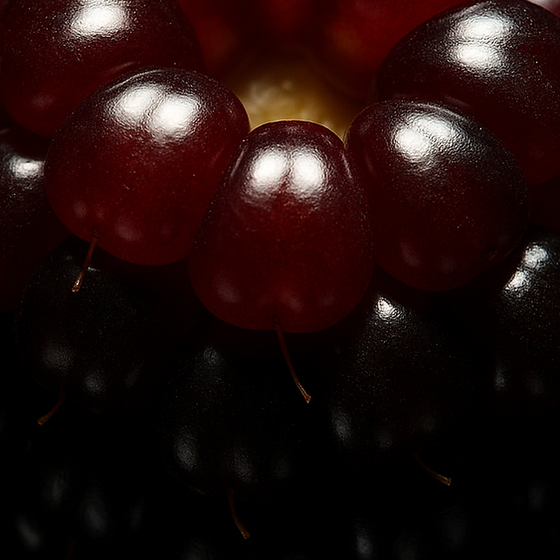
Boysenberry

AkordVOĆE, POVRĆE I ORAŠASTI PLODOVIvoćni · bogat · sladak
Gornje notePiramida
3/5Jačina
—Trajnost
2Poreklo
Uzorak
Boysenberry kao sirovina za parfeme
Gornje note
Rubus ursinus × idaeus
Fantazijska/konceptualna
Definicija

Cooked-down blackberry jam with a raspberry tang and a faint violet undertone. No boysenberry extract exists in perfumery — the note is a fantasy accord built from frambinone, beta-ionone, and furaneol, approximating the overripe, almost winey sweetness of the actual fruit.

VOĆNI SLADAK KAO BOBIČASTO VOĆE DŽEMAST TOPAO
BOYSEN BERRY BOYSEN'S BERRY
Type
Akord
Olfactive family
Voćni
Source
synthetic reconstruction (fantasy accord)
Chemical class
fantasy note (accord)
Instrumenti
Piramida
GGornje note
SSrednje note
BBazne note
3/5Jačina
Srednja
jačina mirisa
Zemlje proizvođači
Novi Zeland Sjedinjene Američke Države (Kalifornija, Oregon)

Miris

Dark, jammy, overripe. Thicker and more cooked than fresh raspberry, less green and seedy than blackberry, with a violet undertone that raspberry lacks. The opening is tart-sweet and ester-bright — crushed berries releasing juice. Within minutes, the tartness folds into a caramelized, almost burned-sugar sweetness (the furaneol contribution), and a faint powdery-floral note from beta-ionone emerges. Compared to cassis, boysenberry is warmer and less catty-sulfurous. Compared to strawberry, it is darker, more tannic, and less candy-like.

Detaljno

The boysenberry (Rubus ursinus × R. idaeus, with additional dewberry and loganberry parentage) is a complex berry hybrid developed by Rudolf Boysen in the 1920s in Napa Valley, California. No essential oil, absolute, or CO2 extract of boysenberry exists in commercial perfumery. The note is entirely reconstructed — a fantasy accord assembled from synthetic aroma chemicals that approximate the fruit’s volatile profile.

Chemistry of the Accord

Food-chemistry analyses of related Rubus berries (Marion blackberry, a boysenberry relative) identify furaneol (4-hydroxy-2,5-dimethyl-3(2H)-furanone, CAS 3658-77-3) as the dominant odorant, with an odor activity value of 368 — five times higher than in other blackberry cultivars. Beta-ionone (CAS 14901-07-6) contributes a violet-woody-raspberry quality. Linalool provides floral lift; alpha-terpineol adds a lilac-like sweetness. In perfumery reconstruction, the core accord typically relies on frambinone (raspberry ketone, CAS 5471-51-2) for the jammy berry backbone, beta-ionone for the violet-raspberry bridge, furaneol or its homologue mesifurane for the cooked-fruit sweetness, and ethyl 2-methylbutyrate (CAS 7452-79-1) for a green-fruity ester lift. Additional components may include gamma-decalactone (peach-lactone creaminess), styralyl butyrate (floral-fruity body), and dihydro-alpha-ionone.

Perfumery Context

Boysenberry sits within the broader family of dark-berry fantasy notes alongside blackberry, mulberry, and cassis accords. It is distinguished from blackberry by a more pronounced jammy-cooked quality (higher furaneol proportion) and from raspberry by greater tartness and a faint violet shadow from beta-ionone. The note functions almost exclusively in the top-to-heart register, providing an initial burst of fruit that softens into a sweet, slightly lactonic warmth. Because frambinone has low volatility despite its fruity character, a well-constructed boysenberry accord can extend further into the heart than most citrus or light-fruit notes.

—

Related: Acai Berry · Aldehyde C 16 Strawberry · Ashberry · Barberry · Bearberry · Blackberry · Blueberry · Cloudberry

Dobijanje i hemija

Način dobijanja

No boysenberry essential oil, absolute, or CO2 extract exists. The note is a fantasy accord — a reconstruction assembled from synthetic aroma chemicals. Core building blocks include frambinone (raspberry ketone, CAS 5471-51-2, a para-hydroxyphenyl ketone), beta-ionone (CAS 14901-07-6, a C13 norisoprenoid), and furaneol (CAS 3658-77-3, a hydroxyfuranone). Supporting materials vary by formulator but commonly include ethyl 2-methylbutyrate (CAS 7452-79-1) for ester lift, gamma-decalactone for lactonic creaminess, and styralyl butyrate for floral-fruity body. No natural extraction is commercially viable because boysenberry fruit volatiles exist at trace concentrations insufficient for economic isolation.

Formula
complex mixture (multiple esters, anthocyanins)
CAS
N/A — natural fruit, no single CAS
Botanički naziv
Rubus ursinus × idaeus
Izgled
N/A — fantasy accord, no single material
Jačina mirisa
Srednji
Sinonimi
BOYSEN BERRY BOYSEN'S BERRY
Status prema standardima IFRA
Bez ograničenja

No known restrictions

Fizička svojstva
Relativna gustina
0.990 to 1.050 @ 25 °C (est)

U parfemima

Boysenberry is a fantasy accord — no natural extract exists. It functions as a top-to-heart fruity note, constructed primarily from frambinone (CAS 5471-51-2), beta-ionone (CAS 14901-07-6), and furaneol (CAS 3658-77-3), with supporting esters and lactones. The accord provides a jammy, dark-fruit sweetness that reads as more complex than single-molecule berry notes. In composition, it works as a fruity modifier in gourmand and fruity-floral families — adding a cooked, winey depth that lighter fruit notes (peach, pear, apple) cannot deliver. The beta-ionone component gives boysenberry accords a useful bridge into violet and iris territory, allowing perfumers to connect a fruity opening to a powdery-floral heart without a jarring transition. Boysenberry pairs structurally with dark florals (rose absolute, violet leaf), warm spices (black pepper, pink pepper), and base-note anchors like vanilla, tonka, and patchouli. It can also sharpen citrus openings when used sparingly alongside bergamot or blood orange. The note has no IFRA restrictions of its own — constraints depend entirely on which individual molecules are used to build the accord.

Uloga u formuli
01modifikator
02sredstvo za podizanje
Oblici na tržištu
sintetički akord fantazijska nota

Pogledajte i

6 nota